
Your needs, this model
Does it fit your priorities?
Is the 2720-20 the same saw generation as 2821-20?
No. The 2720-20 manual specifies a 1-1/8-inch stroke, while Milwaukee's Gen 2 2821-20 page and manual specify 1-1/4 inches. Milwaukee's announcement describes the second-generation 2821 line as replacing 2720. These are distinct generation records, not interchangeable package suffixes; inspect the exact catalog number and condition.
Explore this need in the finder →What is included with the 2720-20?
The exact product page calls 2720-20 tool only and says the XC5.0 battery is not included. Budget for compatible M18 battery and charging equipment if you do not already have them; the page's cross-sells do not change the -20 package.
Explore this need in the finder →Which blades and setup checks does the manual specify?
The model-matched manual describes a Quik-Lok lever clamp for 1/2-inch universal Sawzall blades and says not to use blades under four inches. Remove the battery before changing a blade, tug-check that it is locked, keep the blade extending beyond the shoe and workpiece throughout its stroke, and do not operate the saw without the shoe.
Explore this need in the finder →Can the 2720-20 satisfy a strict tool-weight ceiling?
The exact page and 2720-20 operator's manual reviewed here do not publish a bare-tool weight. The strict weight filter treats that missing value as unknown, not as a lightweight pass; compare another model with a source-defined tool-only figure if weight is essential.
Explore this need in the finder →An earlier FUEL SAWZALL, not a current-generation suffix
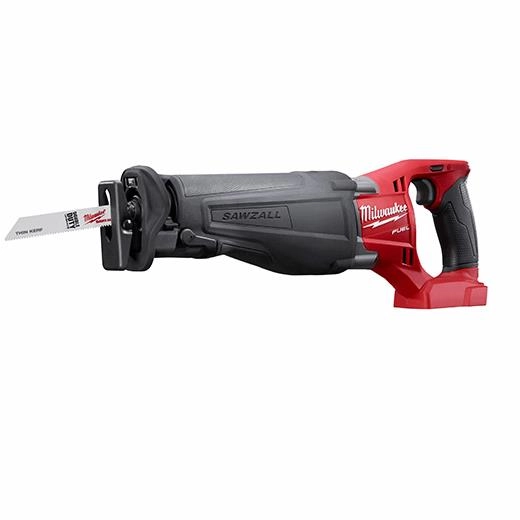
The Milwaukee 2720-20 is an M18 FUEL reciprocating saw sold as a tool-only configuration. It belongs in a different comparison from the 2821-20 Gen 2 saw and the 2821-21 one-battery kit. Milwaukee's own second-generation announcement identifies the 2821 line as replacing 2720, so this review treats the 2720-20 as an earlier model reference—not as a claim that a particular retailer has discontinued every offer. If you are shopping a specific listing, verify its exact condition and number rather than assuming a familiar M18 label means the newer machine.
What the manual establishes about the saw
The model-matched operator's manual lists 18 volts DC, an M18 battery, 0 to 3,000 no-load strokes per minute and a 1-1/8-inch stroke. The product page calls it a brushless M18 FUEL saw and describes an adjustable shoe, LED and hanging hook. These are published attributes, not a promise of loaded speed, battery runtime, durability, or the number of cuts in a material. A reciprocating saw's result depends on blade type, teeth, workpiece support, battery, angle, pressure and cut condition; no comparative cutting trial is claimed here.
The 1-1/8-inch stroke is the clearest numeric generation distinction. The Gen 2 2821-20 manual specifies 1-1/4 inches, and its current kit sibling 2821-21 uses that saw. Stroke length is useful when comparing specifications, but it does not alone tell you whether one model is the better tool for a particular demolition cut. For a compact one-handed format, compare a HACKZALL assessment rather than treating this full-size two-hand frame as a small access saw.
Blade and shoe setup are not optional details
The manual describes a Quik-Lok lever clamp that takes universal half-inch-shank Sawzall blades and warns against blades shorter than four inches. It directs the user to remove the battery before changing a blade, tug-check that the clamp holds it, keep the blade extending beyond the shoe and workpiece through the entire stroke, and avoid operating without the shoe. The shoe can move forward or backward, but Milwaukee does not state a set number of positions in the sources reviewed. That is a useful setup adjustment, not proof that the saw has an orbital selector, a workpiece clamp, or a depth stop.
For a flush or plunge cut, the blade must remain long enough for the shoe and the material to clear it through the stroke. The manual's warning about secure work support and hidden wiring applies regardless of the saw's power or motor label. Choose a blade made for the material and geometry, and secure the work rather than holding it against the body. The same setup advice applies to newer models, but do not transfer a newer model's exact blade-length or control details without checking its own manual.
The -20 package calls for a battery plan
The exact 2720-20 product title says tool only, and its page says the XC5.0 battery is not included. A buyer already set up on M18 may value a bare tool rather than another pack and charger; someone starting a system needs to account for compatible power equipment separately. The page's product-family cross-links and images are not a substitute for reading the exact box contents. No battery or charger is treated as included in this SKU.
The source page and manual we checked do not provide a clear bare-tool weight. For that reason, the weight filter does not count the 2720-20 as meeting any maximum weight. That is an evidence gap, not a claim that the saw is heavy or light. If overhead work or repeated reach is central to the job, do not fill in an absent mass from an adjacent generation's data.
Who should keep it on the list
The 2720-20 is most relevant to someone evaluating an existing earlier M18 saw, or comparing a specific tool-only offer where the model and condition are clear. Its listed M18 platform, adjustable shoe and lever clamp may fit a full-size cordless work plan. A buyer seeking a current M18 saw can compare the 2821-20 tool-only assessment with the 2821-21 kit review; the latter's package lists one XC5.0 pack and charger and has a longer published stroke. For ONE-KEY features, the earlier 2721-20 and the current-generation 2822-20 are separate saws with different generation and control details.
This is a source-based assessment, not hands-on advice. I have not used, tested, owned or measured the 2720-20, and no field-performance result is inferred. The manufacturer page, manual and generation announcement are listed with this review. Follow the exact manual for blade selection, adjustment, eye protection, work support and battery handling, and inspect the actual package and seller terms before making a purchase decision.
Key specifications
Key details at a glance
| Saw format | Full-size, two-handed saw |
|---|---|
| Power source | Cordless battery |
| Battery platform | Milwaukee M18 |
| Motor type | Brushless |
| Stroke length | 1.12 in |
| No-load stroke rate | 3000 SPM |
| Tool-free blade change | Yes |
| Work light | Yes |
| Hang hook | Yes |
| Battery in this package | No |
| Charger in this package | No |
Use the exact model’s instructions for operating limits, supplied equipment and version differences.
Sources for this review
Sources for this assessment
- M18 FUEL SAWZALL Reciprocating Saw (Tool Only), 2720-20
- Operator's Manual 58-14-2601d4, catalog no. 2720-20
- Milwaukee announcement for second-generation M18 FUEL SAWZALL; 2821 generation replaces 2720
- Milwaukee SAWZALL category-card snapshot
- Milwaukee Safety Notices checked 2026-10-30
- CPSC Saws recall index checked 2026-10-30
Match the saw to your actual work.
Use the finder to compare verified requirements, then read each exact model assessment before deciding.