
Your needs, this model
Does it fit your priorities?
What makes the 6523-21 different from the other 13 A corded Sawzalls?
The 6523-21 has a rear handle that rotates continuously and locks at eight positions, one every 45 degrees, so the grip can be reoriented before a cut. It also has a 13 A motor, 1-1/4 in stroke and 0-3,000 no-load SPM. That is a distinct function from a rotating head or an adjustable shoe; neither a smaller body nor extra reach is established by the handle feature.
Explore this need in the finder →How must the 6523-21 handle be set before use?
Milwaukee's manual directs the user to unplug the tool, press the handle-rotation button, choose the desired orientation and release the button so it locks. The handle can rotate freely but locks at eight 45-degree detents. Verify it does not rotate before operating; the manual says not to use the saw if it cannot be locked. This setup feature does not substitute for secure handhold, work support or checking access around the shoe and blade.
Explore this need in the finder →Does the 6523-21 kit include a battery?
No. The exact manufacturer box list names the 6523-21 saw and a carrying case, and the operator manual specifies 120 V AC mains. The package is not a cordless kit and does not list a battery or charger. The rotating handle may change the grip angle, but it does not change the corded power requirement.
Explore this need in the finder →The rotating rear handle is the defining difference
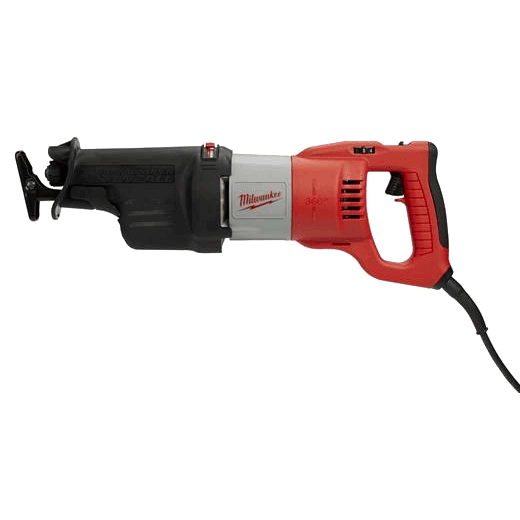
The Milwaukee 6523-21 is a 13 Amp 360-degree Rotating Handle Orbital Super SAWZALL. Its exact U.S. page lists one saw and a carrying case. A 120 V AC cord supplies power; this is not a battery kit. The model's official product data gives a 2010 launch date, so it is treated here as an earlier-generation model. That classification does not say whether a seller has current stock or whether an old example is in good condition.
The unusual feature is at the rear grip. The handle rotates continuously and locks at eight positions, one every 45 degrees. In principle, that lets the operator set the hand angle to a different orientation before a cut. It is not a rotating blade head, a telescoping body or an increase in reach. The official manual says to unplug the saw, press the handle-rotation button, choose an angle and release the button; verify that the handle is locked before running the tool. Do not use it if the handle will not lock.
Specifications and what they can support
The manual's exact row for 6523-21 lists 120 V AC, 13 A, a 1-1/4-inch stroke and 0-3,000 no-load strokes per minute. The product page also identifies orbital cutting, speed dial, variable-speed trigger, counterbalance, gear-protecting clutch and a Quik-Lok clamp. Milwaukee's listed values are useful for identification and comparison, but they do not prove a particular cut speed, vibration level or service life. Material, blade, tooth configuration, work support and access determine whether a saw can be controlled for a given cut. This assessment contains no measured cut or vibration test.
Compared with the 6536-21, the 6523-21 shares a 13 A supply, 1-1/4-inch stroke and 3,000 SPM maximum; its documented distinction is the rotating handle. The 6536-21 page also claims counterbalance, so the older rotating model's own product page is the evidence for its counterbalance rather than a transferred assumption. The 6538-21 instead uses a 15 A motor and a different 0-2,800 SPM limit. These numbers do not establish a ranking.
Orbital control, adjustable shoe and blade fit
The operator manual covers 6523-21 explicitly and describes an orbit switch that ranges between straight and orbital action. It recommends straight reciprocation when a smoother cut is desired and describes orbital action as more aggressive. That is a setting choice to evaluate against the material and blade, not a promise that one mode is best for every task. The same instructions show a six-position adjustable pivot shoe. Its forward/back travel can use a different section of a blade or aid low-clearance work, but the shoe must remain installed and seated against the work as directed.
Milwaukee's Quik-Lok clamp permits collar-operated blade changes; isolate the corded saw before changing a blade, remove debris that could interfere with clamping and check that the blade is locked. The manual says to use a blade long enough to extend beyond both the shoe and work throughout the stroke and not to use one under 3-1/2 inches. It does not give a shank measurement, so verify the blade's actual fit rather than rely on the brand name. Do not use the shoe adjustment to make a blade that is too short safe.
Where grip adjustment helps—and its limits
The handle may be the deciding factor when straight-on hand placement is awkward. The maker's position range lets a buyer consider whether a chosen grip angle could make the approach more natural in a particular space. That is a reason to inspect the tool's shape and manual, not a claim that it is compact or reaches behind an obstruction. The head, blade, shoe, cord and work still need physical clearance; the rotating handle does not alter blade orientation relative to the shoe.
Before use, confirm that a detent holds, maintain a secure two-handed grip, support the work and keep the cord away from the blade. For a blind or plunge cut, check for hidden wires and pipes before starting. Milwaukee's safety guidance is not a substitute for assessing the actual work surface. If the handle can move after the rotation button is released, the manual says not to operate the saw until it is repaired.
The case may help protect the tool in storage, but its contents are limited to the exact page list and it does not supply a cordless battery system. This corded model is a more natural fit in a workspace with a suitable mains connection and planned cable routing than on a ladder or in a moving work zone. The linked manual provides extension-cord sizing information; a long cord is not automatically suitable.
Evidence limits
Milwaukee's reviewed page and manual do not establish bare-tool weight, overall length, a work light, a hang hook or a lock-on trigger for the exact 6523-21. The case does not supply a total package weight. If lifting load or narrow clearance is a hard constraint, leave those fields unresolved until the exact manufacturer's documentation or the specific tool confirms them.
The 6523-21 is a distinctive earlier corded Sawzall in the reviewed library because the handle angle is adjustable while its documented stroke and orbital controls remain those of a full-size reciprocating saw. It should be considered only if that configuration, the 120 V corded plan and the remaining known unknowns fit the work. No hands-on use, ownership, measurement, cut test or customer experience is claimed, and no price or present retailer availability is inferred.
Key specifications
Key details at a glance
| Saw format | Full-size, two-handed saw |
|---|---|
| Power source | Corded mains power |
| Motor current | 13 A |
| Stroke length | 1.25 in |
| No-load stroke rate | 3000 SPM |
| Pivot shoe positions | 6 |
| Tool-free blade change | Yes |
| Selectable orbital action | Yes |
| Battery in this package | No |
| Charger in this package | No |
Use the exact model’s instructions for operating limits, supplied equipment and version differences.
Sources for this review
Sources for this assessment
Match the saw to your actual work.
Use the finder to compare verified requirements, then read each exact model assessment before deciding.