
Your needs, this model
Does it fit your priorities?
What is specifically included with the 6536-21?
Milwaukee's exact U.S. page identifies one 6536-21 13 Amp Orbital Super Sawzall and one carrying case. It does not list a battery or charger; the model is corded 120 V mains equipment. Do not use a retailer's package photo or another suffix to infer extra contents.
Explore this need in the finder →How is orbital action useful on the 6536-21?
The model-matched manual provides an orbit-control switch that ranges from straight reciprocation to orbital motion. It recommends straight mode when a smoother cut is wanted and describes orbital action for aggressive cuts. The exact workpiece, blade, support and cut approach still determine the result; the manual's setting range is not a promise of finish quality or speed.
Explore this need in the finder →Is the 6536-21's 13 A motor the same configuration as 6538-21?
No. Both are corded models covered by the same four-model operator manual, but the table assigns 6536-21 a 13 A motor, 1-1/4 in stroke and 0-3,000 no-load SPM; 6538-21 is separately rated 15 A and 0-2,800 SPM, with Constant Power Technology described on its own page. Do not substitute one SKU's details for the other.
Explore this need in the finder →6536-21: the 13-amp orbital configuration
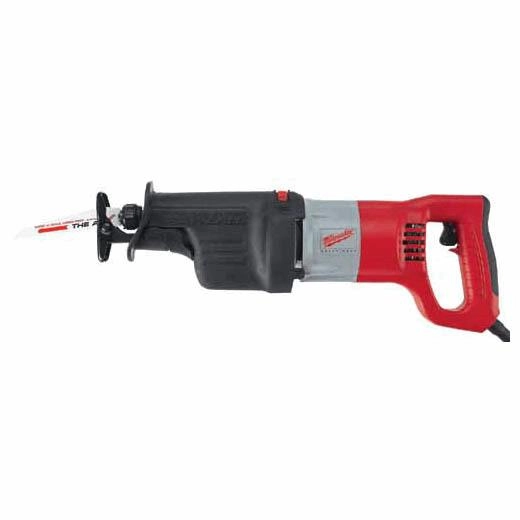
The exact Milwaukee U.S. page identifies the 6536-21 as a 13 Amp Orbital Super SAWZALL Recip Saw. Its in-box list names the saw and a carrying case. It is a corded tool, not a battery kit; the operator's manual specifies 120 V AC mains. The separately numbered models in this generation should not be treated as interchangeable package suffixes. The 6538-21 is a distinct 15 A model, the 6520-21 has a shorter stroke, and the 6523-21 has a rotating rear handle.
Milwaukee's structured product record gives the 6536-21 a 2010 launch date. Here it is labeled an earlier model because it belongs to an earlier generation, not because the official detail page proves a current seller's stock or the condition of a particular saw. A surviving manufacturer page is valuable identity and operating evidence but not a used-tool inspection.
How its published figures compare
The operator manual names the exact 6536-21 and lists 13 A, 120 V AC, a 1-1/4-inch stroke and a top no-load rate of 3,000 strokes per minute. Milwaukee's product overview repeats the stroke and speed and says the saw is counterbalanced for smoother operation with less vibration. Treat the counterbalance statement as a manufacturer description, not a measured vibration result. Likewise, no-load SPM does not tell you how long a cut will take. Blade type, tooth pitch, material thickness, work support and applied pressure all change the work, and the proper choice may be a different tool altogether.
Compared with the 6538-21, the 6536-21 has a 13 A rather than 15 A motor but a higher stated no-load maximum; both manual rows list 1-1/4-inch stroke. The manual does not convert those differences into a ranking. The 6520-21's row has a 1-1/8-inch stroke and a 2,800 SPM maximum. These are distinct model values, not measured performance in matched cuts.
Selectable motion and six-position shoe
The exact page calls this model orbital, and the linked manual's cover includes 6536-21 among its four catalog numbers. The manual describes a switch that can move between straight reciprocation and orbital motion. Milwaukee's operating instructions associate straight motion with a smoother cut and orbital motion with more aggressive cutting. The operator must choose for the job; the manual does not promise that orbital action suits every material, especially where a controlled finish matters.
A Quik-Lok clamp and six-position adjustable pivot shoe make the front end more configurable than a fixed-shoe design. The shoe can slide forward or backward, including for low blade clearance, but the manual cautions that it must remain fitted. It also says a blade shorter than 3-1/2 inches will not project beyond the shoe for the full stroke. Choose an appropriate blade, check that its length exceeds the work depth, seat it securely and verify it before starting. Unplug the tool before blade changes, keep chips out of the clamp and do not handle a hot blade carelessly.
The shoe is a contact point for controlling the saw against the work, not a guide rail or guarantee against blade binding. Stabilize the workpiece and keep the tool's shoe bearing steadily where the manual requires. For plunge cuts, first identify hidden services and use the technique and blade type allowed by the manual. No feature label removes those checks.
When this corded package is a practical candidate
The case and mains format may make sense for planned work in a shop or renovation area where an appropriate outlet is close and the cord can be routed out of the blade path. The case stores the tool, but its presence says nothing about a current supply of replacement blades or parts. The cord can be a drawback on ladders, outdoors, around multiple obstacles, or anywhere a safe cord route cannot be maintained. The manual discusses extension-cord sizing and cautions against undersized leads. Follow its instructions and the tool's nameplate instead of assuming that any long cord preserves rated performance.
In a buying comparison, the 6536-21's explicit counterbalance statement and 1-1/4-inch stroke separate it from the documented facts for the 6520-21, while the handle adjustment on 6523-21 solves a different setup question. The 6538-21 page describes Constant Power Technology and a 15 A motor; that claim is not listed for this 6536-21, so it is not transferred here. The current assessment library keeps these four catalog numbers as independent products because the motor, speed/stroke pair and special feature claims differ.
Unknowns and limits
Milwaukee's exact page and linked manual do not establish bare-tool weight, overall length, a work light, a hang hook or a lock-on switch for the 6536-21. The manual does not state a blade-shank measurement, either. Leave those facts unknown rather than treating absent specification fields as proof of absence or borrowing a number from an adjacent model. If weight or a precise clearance envelope is essential, seek a clearly labeled manufacturer value for this exact SKU or verify it from the actual tool.
This is a source-based assessment, not a field review: there was no ownership, hands-on use, cut test, vibration reading or measured comparison. The published speed and comfort language is not a customer-experience report. The best fit is therefore a buyer who has usable 120 V power, wants a documented orbital/straight selector and accepts an earlier corded tool; it is not a promise that this saw is the fastest or smoothest choice for a particular cut.
Key specifications
Key details at a glance
| Saw format | Full-size, two-handed saw |
|---|---|
| Power source | Corded mains power |
| Motor current | 13 A |
| Stroke length | 1.25 in |
| No-load stroke rate | 3000 SPM |
| Pivot shoe positions | 6 |
| Tool-free blade change | Yes |
| Selectable orbital action | Yes |
| Battery in this package | No |
| Charger in this package | No |
Use the exact model’s instructions for operating limits, supplied equipment and version differences.
Sources for this review
Sources for this assessment
Match the saw to your actual work.
Use the finder to compare verified requirements, then read each exact model assessment before deciding.