
Your needs, this model
Does it fit your priorities?
Can the CMES300 fit a job where I can use a corded saw?
Yes, as a documented mains-powered choice: the exact CRAFTSMAN page identifies a corded 7.5-amp saw with a 1-1/8-inch stroke and variable trigger. Plan the cord path and a suitable outlet; the evidence does not establish cordless operation.
Explore this need in the finder →Does the CMES300 package supply a blade identified for cutting metal?
No. Its exact Includes list names one wood blade only. The manual has a separate metal-cutting section, but a suitable metal blade must be selected for that task; the included blade description does not establish one.
Explore this need in the finder →Can I slide the CMES300 shoe to a new depth without a wrench?
No. The shoe is adjustable, but the manual says to loosen its two screws with an M4 (5/32-inch) hex wrench, slide the shoe and retighten securely. This differs from the tab-operated, tool-free blade release.
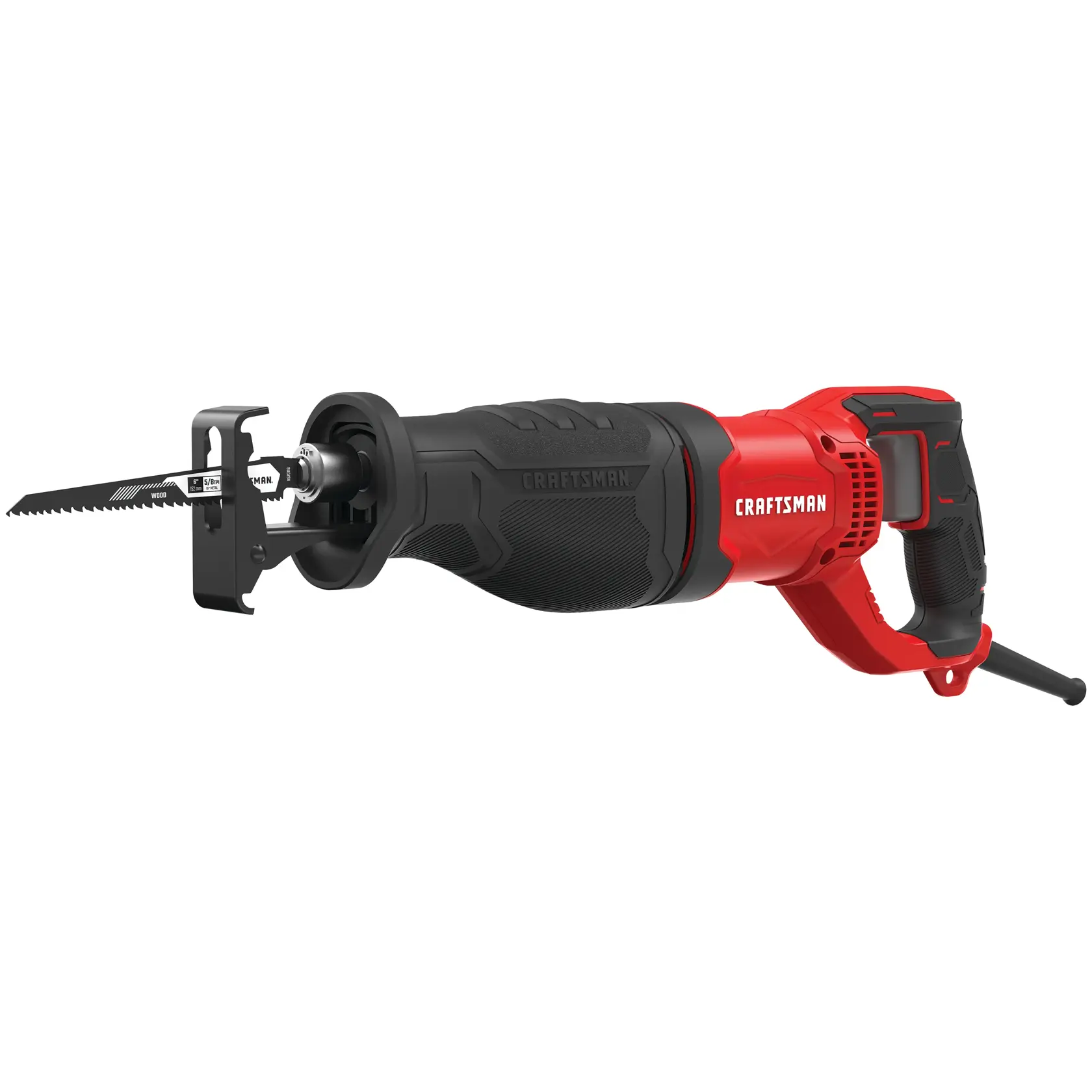
Explore this need in the finder →The CRAFTSMAN CMES300 is a 7.5-amp corded reciprocating saw with a 1-1/8-inch stroke, variable-speed trigger and tool-free blade release. Its exact package page lists one wood blade. The model-matched manual adds an important fit constraint: it shows a main handle and a secondary front grip and directs two-handed operation. This is a documentary assessment of the U.S. CMES300, not a hands-on test.
Power and speed claims in context
The product page calls the CMES300 corded and specifies a 7.5-amp motor. It lists a trigger range of 0–3,200 RPM and a 1-1/8-inch stroke. Those figures describe the manufacturer's published control and stroke, not a measured cut rate or a promise about how the saw will behave in a particular material. CRAFTSMAN labels the speed in RPM; I do not silently convert it to strokes per minute for comparison with saws whose makers state SPM.
There is a data inconsistency on the product page: while its title and “Cordless or Corded” field identify this model as corded, one generic “Power Source” field reads “Integrated Batteries.” That conflicts with the exact product framing, the 7.5-amp mains designation, the manual's corded-tool instructions and the package list. I treat the CMES300 as corded and do not infer a battery package. A mains cord removes battery-platform questions, but it also means you need an appropriate outlet and a cord route that stays clear of the blade, workpiece and foot traffic.
Two-hand grip and shoe setup
The CMES300 is not the one-handed compact option in this library. The manual identifies both the main handle and the secondary gripping handle, requires one hand on each and says to hold the saw with both hands while cutting. That guidance matters more than a phrase elsewhere about the motor housing's compact design for flush cuts. If your work regularly requires balancing material with one hand while cutting with the other, look for a saw whose manual actually establishes that operating arrangement rather than treating the CMES300's housing wording as permission.
The shoe is both a support and a setup item. CRAFTSMAN's manual describes a pivoting shoe for close or flush cutting, and says to keep the shoe against the work when possible to help control jumping and vibration. The shoe also slides to limit cutting depth, but that adjustment is not tool-free: loosen its two screws with an M4 (5/32-inch) hex wrench, move the shoe, then retighten it securely. The sources do not give indexed shoe positions or a travel measurement. The blade collar, by contrast, opens with a tab and seats a blade without a separate blade-change tool. Disconnect the saw before changing the blade or adjusting the shoe.
What comes in the exact package
The written Includes list names one CMES300 saw and one wood blade. It does not list a battery or charger, and the charger field says No. The included blade description does not state a length or tooth count. The manual discusses both wood and metal cutting, but a buyer planning metal work should choose a separate blade suited to that material rather than assume the supplied wood blade covers every task. The manual's table lists cutting capacities of 6 inches in wood and 5/16 inch in steel; these are manufacturer-published limits, not results from testing this tool here.
For cutting, the manual says to secure the workpiece, select the blade for the material and use the shortest blade suitable for its thickness. It warns that the blade must extend beyond both the shoe and workpiece during the stroke, and specifically says not to use jigsaw blades. For metal, the manual calls for a finer blade in ferrous material and a coarse blade in non-ferrous material, with additional support guidance for thin sheet. These are setup distinctions that matter more than treating the included wood blade as a universal accessory.
CMES300 versus the V20 CMCS300 packages
CRAFTSMAN's near-matching model numbers can invite a package mix-up. CMES300 is the corded E-series saw; CMCS300B is the V20 tool-only package around a cordless CMCS300 body, and CMCS300M1 is a different V20 kit that lists a battery and charger. Their body specifications, power arrangement and included equipment should not be carried over to the CMES300. Choose by the complete model number, especially if a retailer's title shortens it to “Craftsman reciprocating saw.”
The CMES300's strongest documented fit is a two-handed demolition or rough-cutting job where mains power is practical and the user wants a variable trigger, a 1-1/8-inch stroke, a pivoting support shoe and a quick collar release. Its cord limits where it can work without a safe extension setup, and its 7.5-amp rating alone does not prove that it will cut faster or slower than another saw. The page and manual reviewed here do not establish bare-tool weight, overall length, an SPM figure, selectable orbital action or an indexed shoe setting. Those are unknowns, not reasons to fill in specifications from a sibling model.
Fit judgment
Consider the CMES300 if a corded two-hand saw and its documented package fit your setup. Check that the exact offer is CMES300, plan for a suitable mains supply and cord path, and obtain the correct blade for the material. If weight is a hard handling limit, the available exact-model sources do not establish a bare-tool value, so this assessment cannot clear the numeric ceiling. Confirm the box list, warranty and seller terms before ordering. No current price, stock, measured performance, durability, vibration level or customer experience is claimed.
Key specifications
Key details at a glance
| Saw format | Full-size, two-handed saw |
|---|---|
| Power source | Corded mains power |
| Motor current | 7.5 A |
| Stroke length | 1.12 in |
| Tool-free blade change | Yes |
| Battery in this package | No |
| Charger in this package | No |
Use the exact model’s instructions for operating limits, supplied equipment and version differences.
Sources for this review
Sources for this assessment

Match the saw to your actual work.
Use the finder to compare verified requirements, then read each exact model assessment before deciding.