
Your needs, this model
Does it fit your priorities?
Does the CRS180-B15 include both power components?
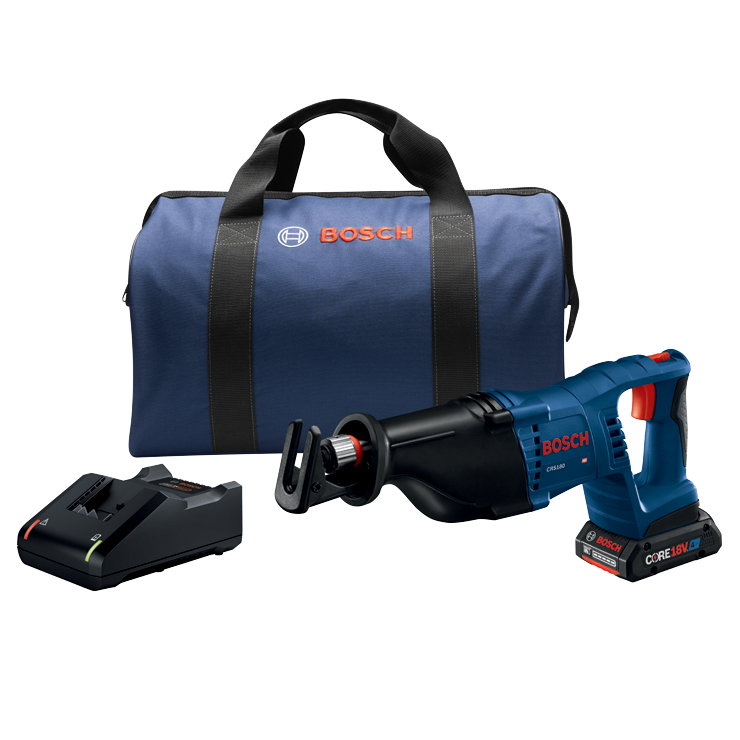
Yes. Bosch's exact CRS180-B15 Includes list names one GBA18V40 4 Ah battery and one GAL18V-40 charger, along with the saw, two bi-metal blades and a carrying bag. The sibling CRS180B bare-tool listing names only the saw and blades, so those power components must not be transferred to its package.
Explore this need in the finder →What weight should I use for the CRS180-B15 in the bare-tool limit?
Bosch lists the CRS180 saw at 6.35 lb and explicitly says that figure excludes the battery. The page does not publish the complete kit weight or the assembled saw-and-pack weight, so the finder uses 6.35 only for its bare-tool threshold and does not present it as the carrying weight of the kit.
Explore this need in the finder →Will the CRS180-B15 operate on any 18V pack or charger?
No universal compatibility claim is made. Bosch's linked CRS180 battery list names Bosch 18V packs and chargers, while the newer B15 kit page identifies a Bosch CORE18V GBA18V40 pack and a GAL18V-40 charger and describes AMPShare compatibility. Check the current CRS180 instructions for the exact pack and charger before combining equipment from another maker.
Explore this need in the finder →The Bosch CRS180-B15 is a U.S. kit built around the compact-bodied 18V CRS180 D-handle reciprocating saw. Its product page lists one 4 Ah GBA18V40 CORE18V battery, a GAL18V-40 charger, two bi-metal blades and a carrying bag. The saw body is listed at 6.35 lb without a battery, with a 1-1/8-inch stroke and two speed ranges up to 2,700 SPM. This review evaluates the exact kit rather than assuming that every CRS180 package includes the same power equipment.
Start with the saw’s operating format
Although Bosch describes the body as compact, the CRS180 operating manual directs a two-handed grip: one hand on the switch handle and the other on the insulated front boot. That places this saw in the finder’s two-handed group, not its compact one-hand group. The manual’s “one-handed” language for LockJaw describes the blade clamp operation only. Buyers choosing a saw for a one-hand cutting routine should not use that feature claim as a proxy for how Bosch instructs the tool to be held.
Bosch lists the tool at 17.7 inches long. A shorter body may be relevant in a confined setup, but the available dimensions do not establish required working clearance, access around a particular pipe, or a safe cut in an unseen wall. The manual calls the footplate pivoting and tells users to maintain work contact. It does not specify adjustable projection positions, so the adjustable-shoe filter does not treat this as a confirmed sliding or length-adjustable foot.
Control choices and blade-change procedure
The manufacturer lists two speed ranges—0–2,400 and 0–2,700 strokes per minute—and a variable-speed trigger. In the manual, the lower range is associated with harder materials, precision work and plunge cuts; the higher range is described for softer material and quicker coarse wood cuts. Those directions make the speed controls easier to interpret, but they do not establish a guaranteed cutting rate, quality or runtime. A reciprocating saw’s blade, tooth pattern, workpiece support and operator technique affect the result.
The LockJaw collar is documented as a tool-free blade holder. Bosch’s manual says to remove the battery before accessory changes, insert the blade until the collar locks, and check retention by pushing and pulling the blade. It also says to clamp the material and keep the footplate against the work. Bosch lists two bi-metal blades in this package, without naming their exact blade numbers or lengths. Check those details in the supplied box and use a blade that remains long enough to clear the footplate throughout the stroke.
The kit distinction is concrete
The CRS180-B15 page’s “Includes” list is unusually useful for package comparison: one CRS180 saw, one GBA18V40 lithium-ion 4 Ah battery, one GAL18V-40 standard charger, two bi-metal blades and one carrying bag. Its “Case Type” field says Bag. The CRS180B bare-tool page, by contrast, lists a saw and two blades, with no case, battery or charger. Bosch gives both retail configurations the same 3601F4J010 saw part number and the same core stroke and body-weight figures, but the distinct retail suffixes reflect different package contents.
That makes the B15 more complete for someone without a compatible battery and charger, while potentially duplicating equipment for an existing Bosch-system owner. The battery sheet linked from this kit names supported Bosch 18V packs and chargers; the kit page calls the battery system AMPShare-compatible. Compatibility is not a safe assumption from voltage alone. Match the exact pack and charger against the current tool instructions, especially when the battery comes from another brand.
Interpret the weight carefully
Bosch labels 6.35 lb as the CRS180 tool-only figure and expressly excludes the battery. That makes it usable for the site’s bare-tool ceiling, including a 6.5 lb maximum. It is not the weight of this kit in the bag or the saw with the included pack attached. The kit page does not state an assembled weight or complete-package weight, so those values stay unknown rather than being estimated by adding separate component numbers.
The page and manual reviewed here do not establish selectable orbital action, a work light, a hang hook, exact blade lengths, or shoe projection adjustment. That is not evidence that a different saw lacks those features; it is a limit of this exact CRS180 record. Bosch makes no independent cut, vibration or runtime result available in these sources, and this assessment is not a hands-on test. For a buyer who wants a current-reference Bosch 18V two-handed saw with a specifically named 4 Ah battery, charger, blades and bag in the box, the B15 has a legible in-box case. Confirm the exact -B15 suffix and package contents before ordering; do not rely on an image alone.
Primary references: Bosch CRS180-B15 U.S. product page, the linked CRS180 operating instructions, the linked Bosch 18V battery and charger list, and the GAL18V-40 charger instructions.
Key specifications
Key details at a glance
| Saw format | Compact-bodied, two-handed saw |
|---|---|
| Power source | Cordless battery |
| Battery platform | Bosch 18V |
| Stroke length | 1.12 in |
| No-load stroke rate | 2700 SPM |
| Tool-free blade change | Yes |
| Bare-tool weight | 6.35 lb |
| Overall length | 17.7 in |
| Trigger lock-on switch | No |
| Battery in this package | Yes |
| Charger in this package | Yes |
Use the exact model’s instructions for operating limits, supplied equipment and version differences.
Sources for this review
Sources for this assessment
- Exact Bosch U.S. CRS180-B15 product page
- Bosch CRS180 operating and safety instructions, linked from the exact CRS180-B15 page
- Bosch battery and charger compatibility sheet linked from the exact CRS180-B15 page
- Bosch GAL18V-40 charger operating and safety instructions linked from the exact CRS180-B15 page
- Bosch U.S. reciprocating-saw category snapshot with the CRS180-B15 card
- Exact Bosch U.S. CRS180-B15 kit gallery image

Match the saw to your actual work.
Use the finder to compare verified requirements, then read each exact model assessment before deciding.