
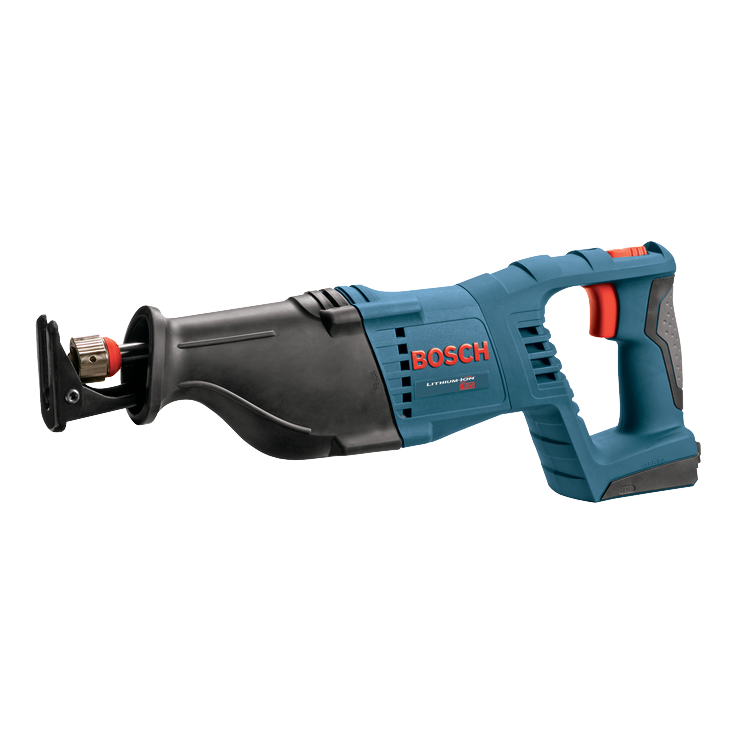
Your needs, this model
Does it fit your priorities?
Is the CRS180B a compact one-handed saw?
No. Although Bosch describes its body as compact, the CRS180 operating instructions direct the user to hold the switch handle with one hand and the insulated front boot with the other. The finder classifies it as a compact-bodied two-handed saw. A one-handed blade change is not evidence of one-handed saw operation.
Explore this need in the finder →What must I already own for the CRS180B bare tool?
Bosch lists the exact CRS180B box as one saw and two bi-metal blades; it lists no battery, charger or carrying bag. The linked battery list names supported Bosch 18V packs and chargers for CRS180, but compatibility should be checked against the current manual and the exact battery you own. Do not infer a battery or charger from the shared CRS180 saw body or from the separate CRS180-B15 kit.
Explore this need in the finder →Does the CRS180B have an adjustable pivot shoe or selectable orbital mode?
The linked manual calls the front a pivoting footplate, but it does not document projection positions or an extension mechanism. The page and manual reviewed here do not establish selectable orbital action either. Those unknowns are not treated as confirmed features; check the exact tool and current instructions if either is essential.
Explore this need in the finder →The Bosch CRS180B is the bare-tool package for Bosch’s compact-bodied 18V CRS180 D-handle saw. Its U.S. product page lists a 1-1/8-inch stroke, two no-load speed ranges ending at 2,400 and 2,700 SPM, a variable-speed trigger, a LockJaw blade holder and a 6.35 lb tool-only weight. Bosch separately identifies the CRS180-B15 as a kit using the same CRS180 saw body; the package contents are not interchangeable.
Compact body, but still a two-handed saw
Bosch calls the 17.7-inch-long CRS180 a compact reciprocating saw and promotes it for work in tight areas and overhead. Those are manufacturer descriptions, not results from a hands-on test. More important for fit, the linked CRS180 manual tells the operator to hold the switch handle with one hand and the insulated front boot with the other. That is why this guide places the machine in the two-handed format even though the body is compact. The manual’s description of a one-handed blade change refers to the LockJaw clamp, not to operating the saw with one hand.
The manual also makes the footplate part of the control routine: keep it firmly against the work to limit jumping and vibration, and clamp the workpiece rather than holding it in a hand or across the legs. The diagram calls the plate pivoting, but the reviewed page and manual do not give a projection range or number of shoe positions. If adjustable shoe travel is essential, this evidence does not establish it.
Speed control is useful information, not a cut-rate promise
The exact product page lists a variable trigger and two speed ranges. Bosch’s manual explains the low range, up to 2,400 strokes per minute, for harder materials, precision work and plunge cutting; the high range, up to 2,700, is described for softer material and faster coarse wood cuts. The trigger varies the rate within the selected range. This gives a buyer documented control choices, but it does not predict performance on a particular pipe, nail-embedded lumber, plastic or demolition assembly. Blade selection, stock support and technique remain central.
The page identifies LockJaw as a tool-free blade-change system, and the manual describes the collar opening and ejecting the blade. Bosch instructs users to disconnect the battery before changing accessories, then verify that a blade is securely retained. These steps matter even though the clamp does not require a separate wrench. The public page lists two bi-metal reciprocating-saw blades but does not give their lengths or exact part numbers; check the package and select a blade suitable for the material.
What the CRS180B package does—and does not—supply
Bosch’s exact CRS180B Includes list contains one CRS180 saw and two bi-metal blades. Its technical table says “No Case Included.” The listing does not include a battery, charger or carrying bag. A buyer who already owns a compatible Bosch 18V setup may prefer that exact bare-tool arrangement; someone starting from zero should compare the complete cost of the correct power equipment rather than treating the tool price as a ready-to-run total.
The sibling CRS180-B15 page lists the same CRS180 saw body but adds one GBA18V40 4 Ah battery, one GAL18V-40 charger and a carrying bag. The two Bosch retail model numbers therefore identify distinct package configurations. Verify the full suffix and the written in-box list on an offer; a gallery photo, reseller title or reference to “CRS180” alone cannot show whether power equipment is included.
Compatibility, weight basis and remaining unknowns
The CRS180B page identifies an 18V Bosch battery system, and Bosch’s linked battery sheet names compatible Bosch 18V packs and chargers. Bosch’s kit page also describes the wider AMPShare relationship. Do not read that as universal compatibility with every 18V pack: consult the current tool and battery instructions for the exact battery and charger. The listed 6.35 lb figure is expressly the saw without its battery. Bosch does not publish a complete carrying weight for this bare-tool package, and no assembled weight is inferred here.
The evidence reviewed here does not establish selectable orbital action, a work light, a hang hook, a projection-adjustable shoe or a kit weight. Their absence from this assessment is not a claim that a nearby saw or another configuration has the same specification. For an existing Bosch 18V owner who wants this exact compact-bodied two-hand form and does not need a bag or new battery system, the CRS180B has a clear package case. For everyone else, weigh the separately purchased power equipment and the documented handling requirements against the CRS180-B15 kit and other assessed formats. No ownership, cutting test, measured runtime, vibration test or durability claim is made.
Primary references: Bosch CRS180B U.S. product page, its linked CRS180 operating instructions, and the linked battery and charger list.
Key specifications
Key details at a glance
| Saw format | Compact-bodied, two-handed saw |
|---|---|
| Power source | Cordless battery |
| Battery platform | Bosch 18V |
| Stroke length | 1.12 in |
| No-load stroke rate | 2700 SPM |
| Tool-free blade change | Yes |
| Bare-tool weight | 6.35 lb |
| Overall length | 17.7 in |
| Trigger lock-on switch | No |
| Battery in this package | No |
| Charger in this package | No |
Use the exact model’s instructions for operating limits, supplied equipment and version differences.
Sources for this review
Sources for this assessment

Match the saw to your actual work.
Use the finder to compare verified requirements, then read each exact model assessment before deciding.