
Your needs, this model
Does it fit your priorities?
Which DEWALT cordless platform does DCS369B use?
The exact product page identifies a 20V MAX cordless one-handed saw. DEWALT states the 20V MAX figure is maximum initial voltage measured without workload and gives 18V nominal. This B SKU is tool-only with two blades and a belt hook; confirm the exact 20V MAX pack and charger compatibility in the manual.
Explore this need in the finder →Does DCS369B meet a requirement for an included battery and charger?
No. The exact DCS369B page says the battery and charger are sold separately and its Includes list names only the saw, two blades, and belt hook. The separate DCS369P1 package lists a 5.0Ah battery and charger; do not substitute a kit listing for this B SKU.
Explore this need in the finder →Does DCS369B document the shoe movement that a fixed shoe cannot provide?
Yes. The exact DCS369 page calls the shoe pivoting, and the North American manual names it as a pivoting shoe and advises keeping it against the material where possible. No number of locked adjustment positions is stated. The tool remains a compact one-handed design and still requires supported work.
Explore this need in the finder →A 20V MAX compact one-handed tool-only option
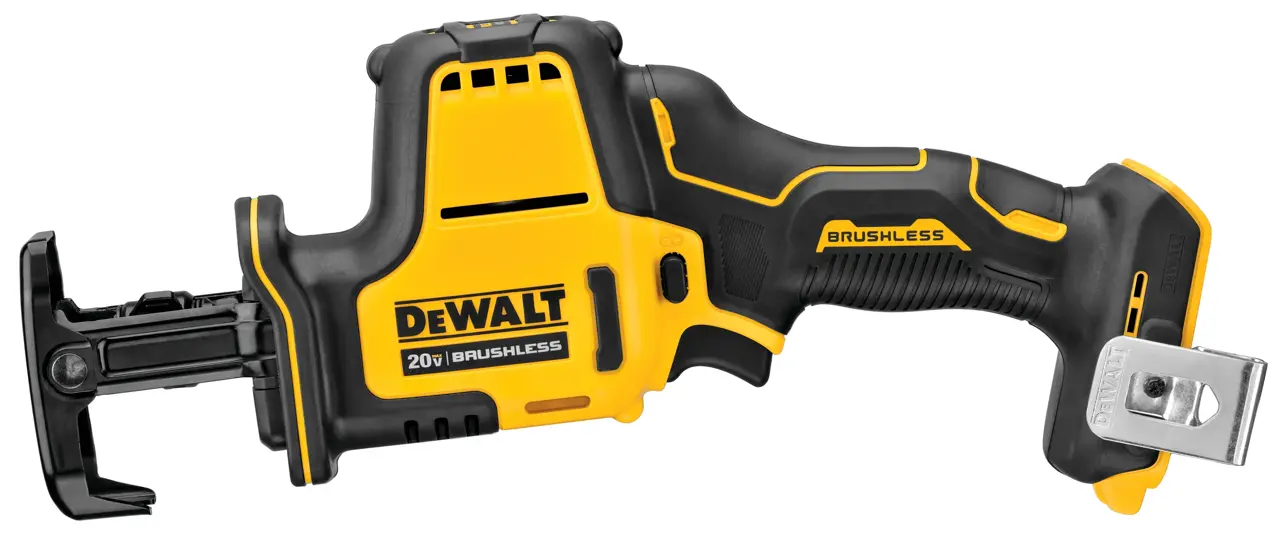
The DCS369B is DEWALT's ATOMIC 20V MAX brushless cordless one-handed reciprocating saw sold without a battery or charger. The exact US product page describes a 12.5-inch front-to-back body, up to 2,800 SPM, variable-speed trigger, LED work light, tool-free blade release, and a pivoting shoe. The in-box list names two blades, one belt hook, and the saw. This combination gives the model a different role from a full-size two-handed reciprocating saw: it is arranged for compact access and lighter handling rather than a long body and two-hand stance.
DEWALT says the shoe pivots to provide more points of contact than a fixed shoe. Its manual reinforces that distinction by identifying a pivoting shoe and advising that it be held firmly against the material when possible to reduce jumping, vibration, and blade breakage. That is useful, specific evidence for a shoe that can follow the cut surface. It is not a count of indexed positions, nor a substitute for supporting and clamping the work. The tool-free blade clamp, work light, and trigger are directly described; selectable orbital action is not. A missing claim is left unknown rather than filled from a larger DEWALT saw.
Weight and performance claims need context
The page's short product description calls the saw 3.13 pounds, but does not label that number as bare-tool weight. Its structured product record separately lists an “Assembled Product Weight” of 3.7 pounds. The kit page repeats 3.13 pounds while listing an “Assembled Product Weight” of 7.4 pounds. These source fields do not provide a clean, consistent bare-tool basis; accordingly, the strict bare-tool weight matcher field remains unknown for DCS369B. A buyer with a hard lifting ceiling should not assume either number answers that question. DEWALT's page also gives a 37% lighter comparison with its DCS367 reference, but this is manufacturer copy, not a test we performed.
The 2,800-SOP line is a maximum no-load specification, not a measured cut speed or proof that the saw suits every material. The exact product-page summary and manual provide that stroke-rate ceiling, but the reviewed sources do not establish a DCS369 stroke length or named cut-capacity table. Blade choice, contact with the shoe, material thickness, stock support, and control affect an actual cut. No claims about cut rate, vibration levels, runtime, or superiority are made here.
Handle control, blade reach, and safe support
Although the product is marketed for one-handed use, the manual's proper hand-position section depicts both the main handle and hand grip, or a single hand on the main handle only when the work is properly clamped. That is a practical distinction: a one-handed format can leave a hand available for a separate task, but it does not justify holding loose material against the blade. Clamp stock to a stable support, keep the shoe in contact where possible, and plan the blade path so it clears the supporting hand and surrounding obstructions. Check for concealed services before making a blind cut.
For installation, open the clamp fully, seat the blade, release the clamp, and tug lightly to check retention. Remove the battery before adjustments or blade changes and allow a used blade to cool before handling it. The manual calls for a blade longer than 3-1/2 inches that extends beyond the shoe and the workpiece throughout the stroke, and expressly says not to use jigsaw blades. The variable-speed trigger lets the operator meter the start; the manual warns that sustained very slow speed is not recommended. The LED illuminates the immediate work area, not a whole room.
Choose a package around the battery system
DCS369B is the tool-only version. It includes two blades and a belt hook, but not a battery or charger. DEWALT's 20V MAX* label refers to maximum initial voltage without workload; the manufacturer states 18V nominal. If compatible 20V MAX equipment is already in the shop, the B suffix makes the package difference clear. If not, the DCS369P1 kit adds one 5.0Ah battery, a charger, bag, belt hook, and the two blades listed on its own page. Do not assume the belt hook is the only hanging feature: the DCS369 manual also identifies a hang cleat integrated into the saw's shoe, but package contents remain a separate exact-page question.
The 12V DCS312B is another compact DEWALT one-handed tool with a similar 2,800 SPM headline, but uses the 12V MAX platform and its exact sources do not document the same pivoting-shoe feature. The platform requirement and shoe evidence may therefore be more useful buying separators than the no-load rate. Neither tool should be mistaken for a full-size two-hand saw just because both use reciprocating blades.
Who should keep it on the list
Keep DCS369B in view when compact one-handed handling, a documented pivoting shoe, a tool-free clamp, an LED, and DEWALT 20V MAX compatibility match the work. Skip this tool-only SKU if the purchase must include a battery and charger, and do not select it on the assumption that 3.13 pounds is a verified bare-tool weight. Stroke length, exact adjustment positions, runtime, loaded cutting performance, and rated material capacities are not established by the evidence used for this assessment. Check the precise DCS369B model, battery and charger compatibility, blade length, and package list before ordering. No hands-on use, ownership, testing, measurement, price, or stock claim is being made.
Key specifications
Key details at a glance
| Saw format | Compact, one-handed saw |
|---|---|
| Power source | Cordless battery |
| Battery platform | DEWALT 20V MAX |
| Motor type | Brushless |
| No-load stroke rate | 2800 SPM |
| Tool-free blade change | Yes |
| Work light | Yes |
| Hang hook | Yes |
| Overall length | 12.5 in |
| Trigger lock-on switch | No |
| Battery in this package | No |
| Charger in this package | No |
Use the exact model’s instructions for operating limits, supplied equipment and version differences.
Sources for this review
Sources for this assessment
Match the saw to your actual work.
Use the finder to compare verified requirements, then read each exact model assessment before deciding.