
Your needs, this model
Does it fit your priorities?
Is the compact DCS387B intended for one-handed cutting?
No. DEWALT calls the saw compact and describes access between studs, but the exact DCS387 manual says to hold the saw firmly with both hands for all cutting operations. Its compact body is a clearance feature, not a one-handed classification; secure the workpiece independently.
Explore this need in the finder →What does the DCS387B tool-only box include compared with its kits?
The exact DCS387B in-box list names one saw and the page says the 20V MAX battery and charger are sold separately; it does not list a blade or bag. DCS387D1 is a separate kit with a 2.0Ah DCB203 battery, DCB112 charger and bag; DCS387P1 is a different 5Ah configuration. Check the exact suffix and retailer contents before buying.
Explore this need in the finder →Does DCS387B fit a tight cut and meet a bare-tool weight limit?
The page describes a 14-inch total-length design and its structured data lists 14.56 inches assembled length and 5.58 lb assembled product weight. Those figures are not specified bare-tool dimensions or weight. The manual says to use a blade longer than 3-1/2 inches and keep it extending beyond the shoe and workpiece; the 4-position clamp can orient the blade horizontally for close flush cuts, but it does not guarantee clearance for a particular setup.
Explore this need in the finder →Compact body, two-handed saw
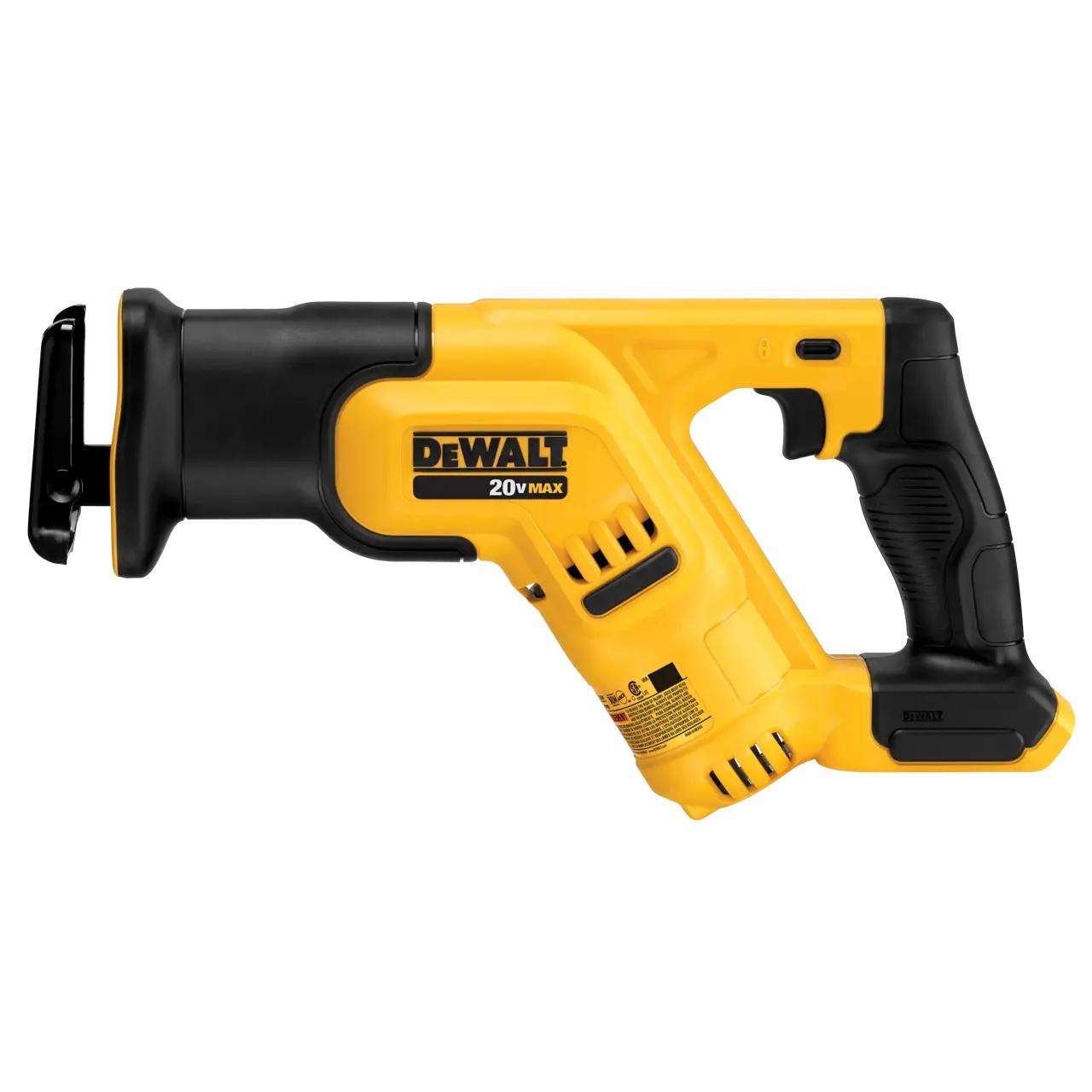
The DEWALT DCS387B is a 20V MAX tool-only reciprocating saw with a compact body aimed at working between studs and in other confined places. “Compact” describes the body and access role, not a one-handed operating method. The DCS387 Type 1 manual linked from this exact B page tells the operator to hold the saw firmly with both hands for every cutting operation. In the finder it therefore belongs with two-handed saws, including compact-bodied models—not with one-handed pruning tools.
The page lists a four-position blade clamp, tool-free blade changes, a 1-1/8-inch stroke, variable trigger from 0 to 2,900 SPM, an LED and a pivoting shoe. The four blade positions can help orient the blade for a flush cut or a different approach angle, and the manual explains that a horizontal blade position can reach close to floors, walls or ceilings where clearance is limited. That is a useful geometry option, but it cannot create clearance where the blade path, shoe or rear body still contacts the surrounding structure. Set up a representative cut safely rather than relying on the label “between studs.”
Tool-only means more than choosing a 20V label
The exact DCS387B page says its battery and charger are sold separately. Its in-box list names the saw but does not list a blade or bag. That differs from two separately assessed DCS387 kits: DCS387D1 lists a 2.0Ah DCB203 pack, DCB112 charger and bag, while DCS387P1 lists a 5Ah DCB205 pack and charger. Their package contents are not inherited by the B SKU, so check the whole model suffix and box list. If you already have a compatible DEWALT 20V MAX battery and charger, the tool-only route avoids duplicating those items; a new system buyer needs to account for them and for a suitable reciprocating blade.
The manual’s blade guidance is concrete: use a blade longer than 3-1/2 inches, keep it extending past the shoe and the full workpiece thickness throughout the stroke, and do not use a jigsaw blade. The clamp accepts the blade in a horizontal orientation for flush cutting, but the page does not document a named cut-capacity range or selectable orbital action. The source also does not identify the motor type, so a brushed or brushless comparison would be unsupported here.
What the published length and weight do—and do not—say
DEWALT’s product page describes the saw as 14 inches in total length and says that this design fits between studs. Its structured specification lists 14.56 inches as assembled-product length. The two values are not the same wording or precision; neither is separately identified as a bare saw-body clearance measurement. The page lists 5.58 pounds as assembled-product weight, not tool-only weight. Do not use that number as proof that the saw meets a strict bare-tool weight ceiling, and do not add a battery-on estimate without a documented battery-and-tool measurement.
For setup, install a compatible pack only after checking its model, lock the trigger when carrying, and remove the pack before blade changes. Clamp or support the workpiece rather than holding it in a free hand. Keep the shoe against the work where practical; the manual notes that blade pressure from angle or scroll cuts can increase vibration, kickback and blade breakage. Wear appropriate eye and hearing protection, take particular care overhead, and investigate concealed services before making a blind cut.
Who should compare the DCS387B?
The strongest documented case is a buyer already equipped for DEWALT 20V MAX who wants a compact-bodied, two-handed saw with a four-position tool-free clamp and pivoting shoe. The package may be a poor fit for someone expecting a battery, charger, blade or bag in the box, and the source set does not establish a bare-tool weight, motor type, orbital mode or exact clearance for a particular opening. Compare DCS387B against D1 and P1 by the components actually supplied, not by a shared family name. Confirm model suffix, battery, charger and blade separately before ordering. This is a catalog-based assessment, not a report of personal use or cutting tests.
Key specifications
Key details at a glance
| Saw format | Compact-bodied, two-handed saw |
|---|---|
| Power source | Cordless battery |
| Battery platform | DEWALT 20V MAX |
| Stroke length | 1.12 in |
| No-load stroke rate | 2900 SPM |
| Tool-free blade change | Yes |
| Work light | Yes |
| Trigger lock-on switch | No |
| Battery in this package | No |
| Charger in this package | No |
Use the exact model’s instructions for operating limits, supplied equipment and version differences.
Sources for this review
Sources for this assessment
Match the saw to your actual work.
Use the finder to compare verified requirements, then read each exact model assessment before deciding.