
Your needs, this model
Does it fit your priorities?
Is DCS387P1 a compact one-handed saw?
No. The exact page calls it compact, but the model-linked DCS387 manual explicitly instructs a firm two-handed grip for cutting. Treat the compact body as an access distinction, not a one-handed classification.
Explore this need in the finder →Does the DCS387P1 package have a pivoting shoe and tool-free blade changes?
Yes. The exact P1 page documents the four-position tool-free blade clamp and a pivoting shoe. Neither statement supplies a specific shoe-position count or a selectable orbital mode.
Explore this need in the finder →Does the 5.0Ah P1 kit have a verified bare-tool weight under 9 lb?
No strict numeric match is supported. The exact page gives 9.3 lb as assembled-product weight but does not provide a separate tool-only weight; the matcher leaves tool_weight_lb unknown rather than treating a battery-on kit value as the saw-only mass.
Explore this need in the finder →A compact DCS387 kit with a larger named pack
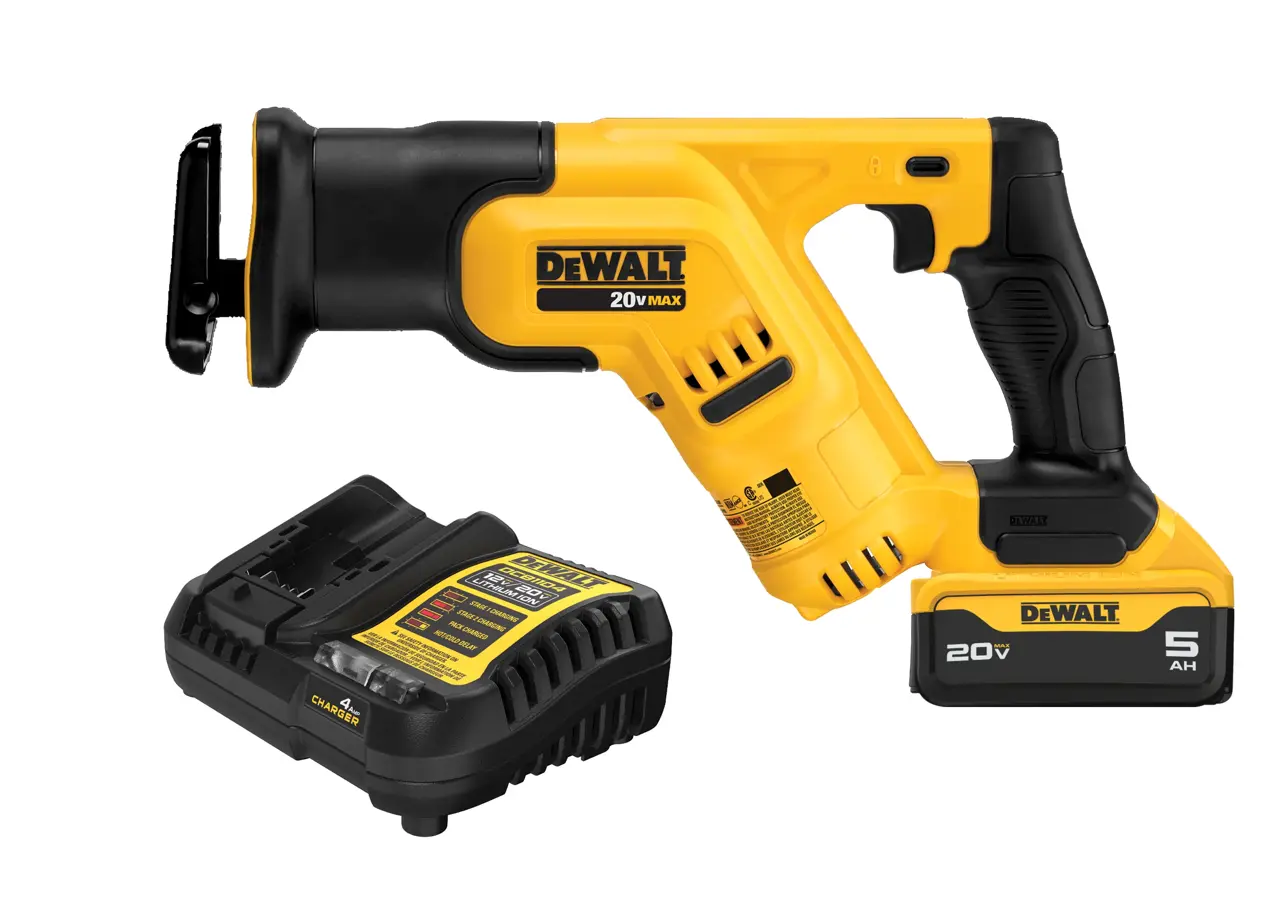
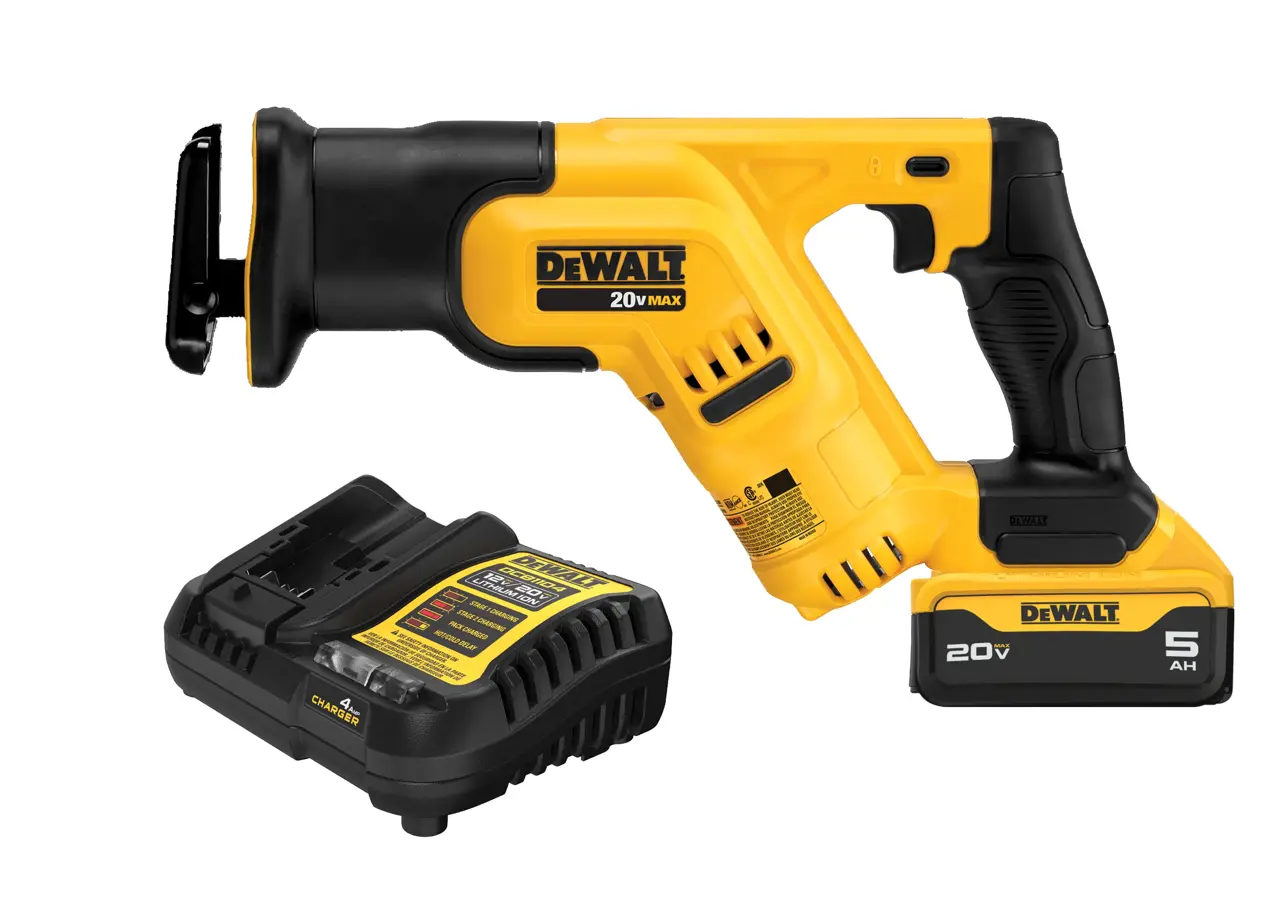
The DCS387P1 is a cordless 20V MAX compact reciprocating-saw kit built around the DCS387 saw. DEWALT lists a single DCB205 5.0Ah battery and a charger with the saw. The exact page does not identify the charger model, so that detail should be checked in the written offer rather than borrowed from another kit. The exact gallery image shows the saw, battery and charger; the included-items list does not name a bag. That makes this P1 package distinct from DCS387D1, whose own manufacturer page lists a smaller DCB203 2.0Ah pack, DCB112 charger and bag. A “DCS387” search result is not enough to know which bundle is in front of you.
The body is advertised as 14.5 inches long for work between studs and in other confined areas, but compact does not mean one-handed. The Type 1 manual for the DCS387 says to hold the saw firmly with both hands for cutting. It is a full-size-in-use, compact-bodied two-handed tool in the finder. That distinction matters for pruning or overhead work: choose a model whose instructions and grip arrangement fit the job rather than assuming the shorter housing makes the cut a one-handed task.
Clamp and shoe control
The P1 product page lists a four-position blade clamp for flush cutting and tool-free blade changes, a pivoting shoe, LED work light, 1-1/8-inch stroke, and a variable-speed trigger with a stated 0–2,900 SPM range. These are concrete control and access features. The multiple blade positions can make it easier to approach a cut with the blade pointing in a useful direction; the pivoting shoe can maintain contact as the angle changes. Neither feature tells you that a certain pipe diameter or lumber thickness is within a guaranteed capacity, because the page does not provide a named cut-capacity range.
The feature list does not identify a brushless motor, so the review does not assume that the DCS387 has the DCS367P1’s brushless claim. Conversely, nothing about the 5Ah battery establishes runtime on a particular job. A larger capacity label gives the package a different battery specification from the D1 kit, not a measured number of cuts. The listed 9.3 lb assembled-product weight and 16.75-inch assembled length are package/product fields; DEWALT does not give a separate bare-tool weight for this P1 page. Do not use 9.3 lb as the saw-only weight in a handling comparison or strict tool-weight filter.
What the P1 suffix changes
The DCS387P1 is most relevant if you want the DCS387’s compact two-handed format and an included 5.0Ah DCB205 pack and charger. Someone with a suitable DEWALT 20V MAX system may instead prefer to compare a tool-only configuration, where paying for another pack may not be useful. If package accessories matter, verify the exact model number, number of batteries, charger make/model and any bag or blade listed by the actual seller. This is particularly important because the closely named DCS387D1 contents differ: its own page specifies a 2.0Ah DCB203 battery and DCB112 charger, and lists a bag.
The exact product page identifies the saw and one DCB205 pack, but leaves the P1 charger unnamed and gives no basis for a bare-tool mass. Those are meaningful unknowns, not reasons to invent equivalence with another configuration. Its 2,900 SPM figure is a product-page speed specification, not a load-tested cutting rate. The assessment reads DEWALT’s documentation and package description; it does not claim ownership, testing or personal experience.
Setup is still a two-handed cutting operation
Use the DCS387 manual for blade installation and cutting setup. Disconnect the battery before adjusting or servicing the saw, retain the blade correctly, and choose a blade that remains beyond the shoe and workpiece throughout the reciprocation. Keep the shoe controlled against supported stock where practical, clamp the workpiece when possible, and check for hidden wiring or plumbing before opening a wall or floor. The pivoting shoe and tool-free clamp make adjustments more convenient; they do not reduce kickback, vibration or blade-breakage risks.
In short, the DCS387P1 trades a documented bare-tool weight for a clearly useful kit configuration: one 5Ah battery, charger, pivoting shoe and tool-free multi-position clamp in a compact-bodied two-handed saw. It suits buyers who value those included items and the DCS387 form. It is less suitable when a verified brushless specification, named charger model, one-handed handling or a strict bare-tool weight threshold is essential. Check the P1 package against DCS387D1 and other compact kits before choosing a seller’s listing.
Key specifications
Key details at a glance
| Saw format | Compact-bodied, two-handed saw |
|---|---|
| Power source | Cordless battery |
| Battery platform | DEWALT 20V MAX |
| Stroke length | 1.12 in |
| No-load stroke rate | 2900 SPM |
| Tool-free blade change | Yes |
| Work light | Yes |
| Overall length | 14.5 in |
| Battery in this package | Yes |
| Charger in this package | Yes |
Use the exact model’s instructions for operating limits, supplied equipment and version differences.
Sources for this review
Sources for this assessment
Match the saw to your actual work.
Use the finder to compare verified requirements, then read each exact model assessment before deciding.