
Your needs, this model
Does it fit your priorities?
What is the package difference between DCS389X1 and DCS389X2?
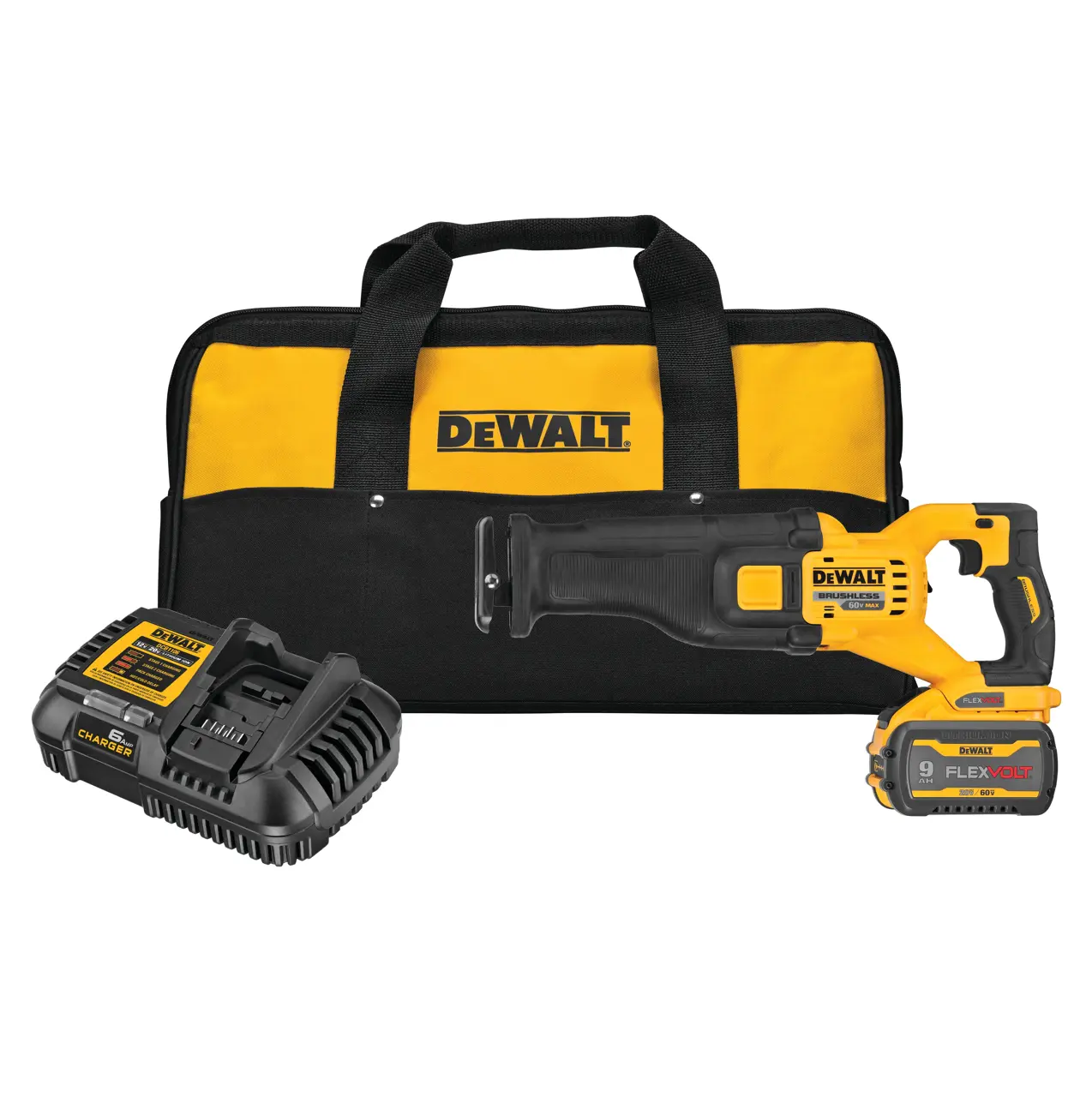
The exact X1 page lists one DCB609 9.0Ah FLEXVOLT battery, one charger, blade, bag and the DCS389 saw. X2 lists two DCB609 batteries with the same saw, charger, blade and bag. Confirm the X suffix rather than assuming two packs.
Explore this need in the finder →Is DCS389X1 a 20V saw because its FLEXVOLT battery has a 20V label too?
The kit page identifies the saw itself as 60V MAX cordless and the included DCB609 as a 20V/60V FLEXVOLT pack. A FLEXVOLT pack's dual-voltage label does not make this 60V saw a 20V MAX model; follow the DCS389 manual's compatible-battery list.
Explore this need in the finder →Does DCS389X1 meet a bare-tool weight limit?
The reviewed exact page lists a 15.7 lb assembled-product figure for the kit but no separate saw-only weight. The numeric matcher does not use the package-level number as bare-tool mass.
Explore this need in the finder →The one-battery 60V MAX package
The DEWALT DCS389X1 is a full-size 60V MAX brushless reciprocating saw kit, not a 20V MAX saw merely because the supplied FLEXVOLT battery also carries a 20V/60V label. The exact U.S. page names the DCS389 saw, one DCB609 9.0Ah FLEXVOLT pack, a charger, one blade and a kit bag. Its exact image depicts the one-battery arrangement. X1 is the package suffix to check; the separately observed DCS389X2 includes two DCB609 packs with the same saw. The manufacturer page says “60V MAX” for the tool, so select the 60V option when this platform is a hard requirement.
The kit page advertises a brushless motor, 1-1/8-inch stroke, variable trigger from 0 to 3,000 SPM, keyless lever-action clamp, pivoting shoe, LED work light and rubber overmold grip. These features make the saw a documented two-handed demolition-style format with conventional shoe support and quick blade changes. The Type 1 DCS389 manual explicitly says to hold the saw firmly with both hands while cutting. It is not a compact one-handed pruning tool, regardless of battery portability.
Battery platform and the package choice
The included DCB609 is a 9.0Ah FLEXVOLT battery listed for 20V/60V MAX use, while the saw itself is identified as 60V MAX. The DCS389 manual lists compatible DEWALT battery pack families, including DCB606, DCB609 and DCB612. That is the useful compatibility bridge; do not infer that any pack carrying a “20V MAX” mark can operate this 60V saw. Confirm the exact pack and charger in the seller’s package list and the current manual if you are combining equipment already on hand.
For one pack in the box, X1 is the precise kit. If a spare pack matters more than minimizing the package contents, compare X2: its page lists two DCB609 batteries, a charger, blade and bag. The extra pack is a real package difference, but it does not prove a runtime multiplier or a certain amount of work. Battery capacity, charge state, cut material, blade selection, load and operator technique all affect work per charge. The manufacturer’s statement of up to 19% more power than DCS388 is its own comparative claim, not a result from an independent test here.
Performance figures and fit limits
The 0–3,000 SPM range and 1-1/8-inch stroke describe trigger-controlled reciprocation, not a measured loaded speed or guaranteed cutting rate. The exact listing also states 1,874 UWO, but the sources do not turn that number into an expected cut count through a given material. There is no independently verified saw-only weight in the exact product page. It reports 15.7 lb as assembled-product weight for the X1 SKU, which is a package/product value and should not be labeled bare-tool weight. Likewise, the 20.9-inch assembled length should not be used as a measured body clearance for the saw itself.
The page calls the shoe pivoting and the blade clamp keyless, but does not document selectable orbital action or a named cutting-capacity range. Buyers who require orbital mode should not infer it from high output or brushless marketing. If weight overhead or tight access is central, compare the size, grip and verified weight basis of compact models rather than treating a 60V MAX label as a proxy for all-around suitability.
Blade choice and controlled setup
The manual cautions that the blade should be longer than 3-1/2 inches and extend beyond the shoe and the workpiece during the cut; it also warns not to use jigsaw blades. Choose the tooth pattern for the material, clamp or otherwise support the stock, and keep the shoe controlled against it where practical. Remove the battery before changing a blade or making an adjustment, and lock the trigger before carrying or storage. Keep both hands on the saw and clear of the blade path, and investigate concealed services before demolition work. A pivoting shoe can support different cutting approaches, but it does not make an unsupported pipe or stud safe to cut.
DCS389X1 is a sensible assessment to read when a buyer already has, or deliberately chooses, DEWALT’s 60V MAX FLEXVOLT platform and wants one high-capacity pack included. Its strongest buying distinction is package specificity, not an independently demonstrated speed or runtime advantage. Verify that the offer is the X1 SKU, that it includes the DCB609 pack, charger, blade and bag, and that you are comfortable with a full-size two-handed tool. This is a source-based review, not a hands-on test report.
Key specifications
Key details at a glance
| Saw format | Full-size, two-handed saw |
|---|---|
| Power source | Cordless battery |
| Battery platform | DEWALT 60V MAX |
| Motor type | Brushless |
| Stroke length | 1.12 in |
| No-load stroke rate | 3000 SPM |
| Tool-free blade change | Yes |
| Work light | Yes |
| Battery in this package | Yes |
| Charger in this package | Yes |
Use the exact model’s instructions for operating limits, supplied equipment and version differences.
Sources for this review
Sources for this assessment

Match the saw to your actual work.
Use the finder to compare verified requirements, then read each exact model assessment before deciding.