
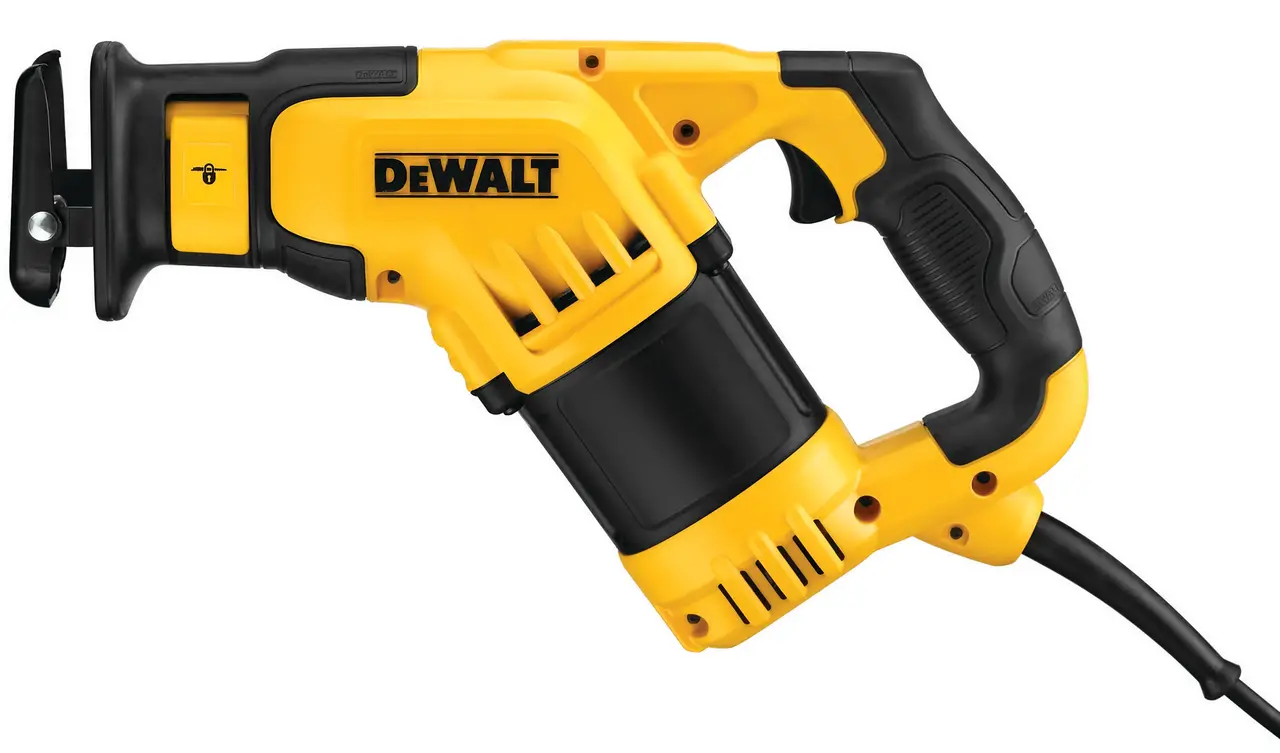
Your needs, this model
Does it fit your priorities?
Does DEWALT's compact label make the DWE357 a one-handed saw?
No. The DWE357 is called compact by DEWALT, but its Type 3 manual specifies one hand on the main handle and the other on the forward grip. It is recorded as compact-bodied and two-handed, not as the compact one-handed reciprocating-saw form. Confirm the actual body clearance separately.
Explore this need in the finder →Can I select an adjustable shoe position on the DWE357?
The DWE357 product page uses the phrase pivoting shoe, while the Type 3 instruction manual identifies the supplied shoe as fixed and not adjustable. That manual does not establish user-set positions, so this assessment does not count it as an adjustable-pivot-shoe match. A rotating/pivoting contact during a cut is not the same as an adjustable reach setting.
Explore this need in the finder →What is included with the DWE357 corded package?
The exact DEWALT DWE357 page lists one compact reciprocating saw and one contractor bag; it does not list a battery or charger. The saw uses corded mains power, so the cord path and supply are the operating constraints to verify rather than an M18 or other battery-platform match.
Explore this need in the finder →Compact body, but not a one-handed saw
DEWALT calls the DWE357 a 12-amp compact reciprocating saw. The label describes its body, not a one-handed operating plan. Its Type 3 instruction manual calls for one hand on the main handle and the other on the forward grip. In this library it is therefore treated as a compact-bodied, two-handed configuration—not as a compact one-handed saw. That distinction matters if the buyer is choosing the tool for a narrow access route: body size does not remove the need for two-hand control, a secure workpiece, and a safe space for the free hand.
The product page states 0–3,000 strokes per minute and a 1-1/8-inch stroke. These are maker specifications, not measured cut results. No-load rate does not predict cutting speed by itself, and the DWE357 should not be called faster simply because its published maximum is higher than the DWE304 or DWE305. Blade choice, material, support, access, and control remain central.
Check the shoe description against the manual
The DWE357 product page lists a pivoting shoe, but the Type 3 manual says the shoe is fixed and not adjustable. For a buyer requiring an adjustable pivot shoe, that manual's explicit operating description is the safer basis: this assessment records no user-adjustable shoe. A shoe that pivots in contact with a workpiece is not necessarily a shoe the user can reposition to gain reach. Do not count the DWE357 as satisfying an adjustable-shoe requirement; compare the exact review and the manual wording if the retailer uses a different document revision.
The manual and manufacturer page both describe a lever-operated, keyless four-position blade clamp. Blade orientation options can help with flush-to-surface work, including a horizontal orientation in restricted clearance, but that is distinct from adjusting the shoe. The manual says to use a blade longer than 3-1/2 inches and long enough to extend beyond the shoe and workpiece through the stroke. Because that is a strict "longer than" instruction rather than an inclusive minimum, this assessment does not convert it into a bare 3-1/2-inch minimum field. The manual also says not to run the saw without its shoe and describes blade changes with power disconnected. Select for the material and confirm blade fit rather than assuming every recip blade is safe for every cut.
Short body, real cord, and two-hand setup
The manufacturer promotes the DWE357 as a compact model and lists a 14.5-inch total length in its feature copy, while the same product page's assembled-product specification records 16.75 inches. Those source entries do not agree, so I have not chosen one as a definitive working envelope. Use the current model page and your own clearance plan to verify where the tool body, shoe, blade, and cord can travel. The compact-body designation can guide which model to investigate, but it is not a guarantee that the assembly will fit behind a particular pipe or between a specific pair of studs.
It is a corded 12-amp tool with no battery or charger in its reviewed package. The Type 3 manual identifies 120-volt AC use, cautions that the nameplate and power supply must agree, and supplies wire-gauge guidance by extension-cord length and amperage. Route the lead well away from the cut path and use an extension arrangement appropriate to the manual and local requirements. For a moving job where an outlet and safe lead path cannot be maintained, the DWE357 is the wrong power format regardless of its shorter body.
Useful comparisons and operating limits
Compared with the two conventional corded DWE models, the DWE357 has the highest published no-load rate in this assessed group (3,000 SPM) and is described as compact by the manufacturer. The DWE304 is rated 10 amps/2,800 SPM and the DWE305 12 amps/2,900 SPM; all three list a 1-1/8-inch stroke. These figures make a clear model comparison, not a promise that one will deliver a cleaner, faster, or more durable cut. The DWE357's fixed shoe and two-hand grip are equally important differences from its compact appearance.
The manual's work instructions call for a firm grip, stable material support, and keeping the shoe against the material when possible. It warns to pay attention to the cut direction, hidden lines, and overhead debris. A plunge or pocket cut is a deliberate operation, not a shortcut through an unknown wall: the DWE357 manual describes pocket cutting in wood and says to keep the shoe planted while the blade enters. Use suitable eye protection and follow the source manual rather than translating a demonstration image into a safe method.
Package and weight checks
DEWALT's DWE357 page lists the saw and one contractor bag. It does not list a battery or charger; those are not operating requirements for this corded model. The same product data reports an assembled-product weight of 8.9 pounds, but does not label it as a bare-tool weight. This assessment leaves the strict bare-tool weight field unknown instead of treating that package-level phrase as equivalent. If a lifting ceiling is important, obtain a model-specific, clearly defined weight and verify it against the exact product edition.
Overall, the DWE357 is a candidate for a buyer who wants a compact-bodied 12-amp corded reciprocating saw and can use it as a two-handed mains tool. It is not a one-handed alternative, not an adjustable-shoe match in this assessment, and not a verified low-weight option. Before ordering, confirm the model suffix, actual body clearance, bag contents, cord and supply requirements, manual revision, and blade setup.
Key specifications
Key details at a glance
| Saw format | Compact-bodied, two-handed saw |
|---|---|
| Power source | Corded mains power |
| Motor current | 12 A |
| Stroke length | 1.12 in |
| No-load stroke rate | 3000 SPM |
| Tool-free blade change | Yes |
| Battery in this package | No |
| Charger in this package | No |
Use the exact model’s instructions for operating limits, supplied equipment and version differences.
Sources for this review
Sources for this assessment
Match the saw to your actual work.
Use the finder to compare verified requirements, then read each exact model assessment before deciding.