
Your needs, this model
Does it fit your priorities?
What is in the Bosch GSA18V-126N box?
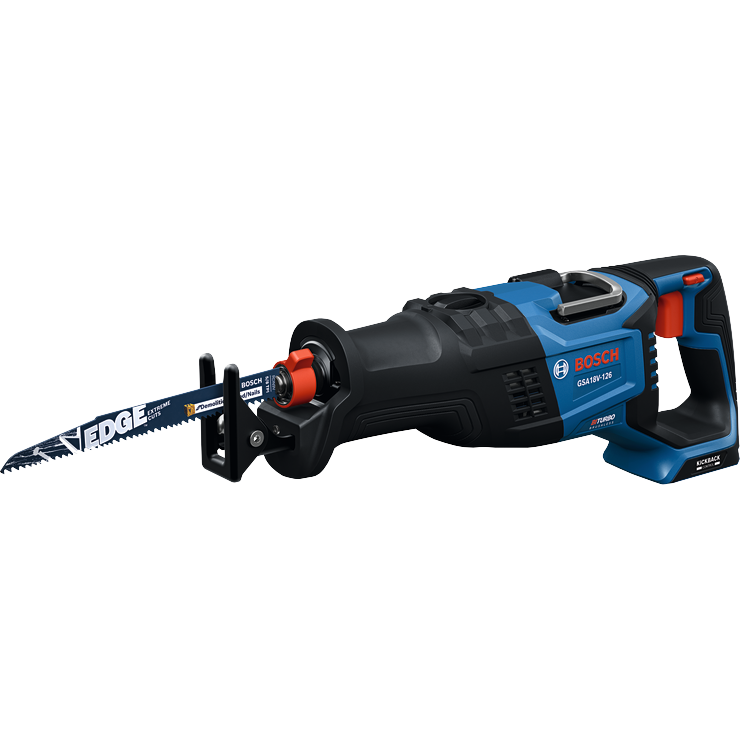
Bosch's exact U.S. page lists one GSA18V-126 saw and one wood-with-nails blade. It is identified as the bare-tool N configuration; no battery or charger is listed. The page does not give a confirmed case inclusion or an explicit weight basis for its 8.1 lb data field.
Explore this need in the finder →What controls distinguish the GSA18V-126 from the earlier GSA18V-110?
The GSA18V-126 page and its matched manual document a 1.25/1.26-inch-class stroke, 0–3,000 SPM, six speed settings, tool-free blade lever, orbital selector, three-position footplate, LED, adaptive speed control, end-of-cut control and optional KickBack Control. The GSA18V-110 has a 1-1/8-inch-class stroke and 0–2,900 SPM; its manual uses a hex key for continuous 1-1/4-inch shoe adjustment. These source differences describe the controls and specifications, not a tested speed advantage.
Explore this need in the finder →Does the GSA18V-126N meet an 8.5 lb bare-tool limit?
The exact product page reports 8.1 lb but does not say that is bare-tool weight. The -N bare-tool package designation does not convert an ambiguous table field into a documented saw-only measurement, so the weight matcher cannot certify this limit.
Explore this need in the finder →Bosch’s GSA18V-126N is a current U.S. 18V PROFACTOR bare-tool package around the GSA18V-126 saw body. The exact page lists the saw and one wood-with-nails blade, not a battery or charger. This is a distinct model from the earlier 1-1/8-inch-class GSA18V-110 family: the 126 body has a longer stated stroke, a six-position speed dial and several user-interface modes. Those are documented features, not evidence from a comparative cut test.
Know which saw body and package you are comparing
The page reports a 1.25-inch stroke in one table field and 1.26 inches in another; the GSA18V-126 manual specifies 1.26 inches (32 mm). It also lists a 0–3,000 strokes-per-minute no-load range. The same page shows an 18.5-inch length, 6.3-inch height and 3.5-inch width. Bosch calls the motor BITURBO Brushless and says the system is designed to take advantage of CORE18V high-power packs, but the included equipment list contains no pack. For a cordless saw, battery weight and platform compatibility are part of the working setup, even though they are not part of this N package.
The saw is instructed for two-handed use: one hand on the handle, the other on the insulated front boot. Bosch’s manual says to secure and support the workpiece, maintain the adjustable footplate firmly against it, and choose an appropriate speed. That is a more useful way to think about the tool than to treat a longer stroke as a promise of faster work in every material. Blade selection, access, support and control still determine whether a particular cut is appropriate.
Speed and electronic modes are separate choices
A variable-speed trigger is paired with a six-setting speed dial. The dial sets a maximum stroke rate and the trigger controls operation within that range. The page and manual also describe Adaptive Speed Control, which starts at a slower rate to position the blade, then changes speed as resistance is sensed. Stop Control is a separate option that can shut the tool off when resistance drops as the blade exits the work. Bosch cautions that it can also switch off on thin or soft material; the manual says to deactivate that mode in that circumstance. It is not a cut-depth detector, a workpiece clamp or a substitute for watching the blade path.
KickBack Control is another selectable function. The manual says the electronics respond when a blade-bind situation is detected by stopping further blade movement, but explicitly notes that this does not prevent kickback. It is a limit on one response to binding, not a guarantee against reaction or loss of control. Grip, support, blade choice and safe workholding remain essential.
The orbital/in-line switch offers a different kind of control. Bosch’s instructions describe orbital motion for more aggressive cutting in softer materials, while straight action is the setting for thin or harder materials such as sheet metal or steel. The recommendations are use-case guidance, not measured finish or productivity claims. The model also has a tool-free blade release lever, LED work light, saw hook and dual vibration-damping claim. Bosch does not publish a vibration measurement on the page reviewed here.
Footplate and blade service
The footplate tilts to keep more of its surface in contact with angled work, and a push-button release moves it among three positions. The manual connects repositioning with blade life and limiting blade protrusion, such as near a wall or large pipe. A repositionable shoe does not determine the correct blade, establish a cutting capacity or hold the workpiece still. The page describes a tool-free blade lever; disconnect the battery before service and verify the blade is seated before cutting.
Package and weight caveats
On Bosch’s exact GSA18V-126N listing, the included list is one GSA18V-126 saw and one wood-with-nails blade. Battery and charger are not included in the written list. The listing does not clearly resolve case inclusion, so do not assume a hard case from another Bosch kit or from a gallery picture. Bosch recommends GBA18V60, GBA18V80 and GBA18V120 battery packs for maximum performance; check the exact current battery/charger compatibility instructions when building the operating setup.
The page’s technical table says 8.1 lb but does not identify whether it means tool-only, battery-installed, or another configuration. Since this is a bare-tool package, a buyer might expect the number to describe the saw, but that inference is not a documented measurement basis. The bare-tool matcher therefore treats the value as unknown. It should not be presented as a verified carry weight or compared directly with products that explicitly state a tool-only weight.
How it compares with the GSA18V-110N
The GSA18V-110N shares the Bosch 18V platform and a conventional two-hand arrangement, but its exact page and manual describe a 1-1/8-inch-class stroke, 0–2,900 SPM and footplate adjustment along 1-1/4 inches using a hex key. The GSA18V-126N adds a longer stroke specification, a three-position button-adjusted footplate, LED, six speed settings, Adaptive Speed and Stop Control modes, and selectable KickBack Control. Its package list is also different: the 126N lists one blade rather than the 110N’s two named blades. The GSA18V-125N is yet another body with its own package and manual; similarly named Bosch saws should be compared by exact SKU and source list, not transferred features.
What this assessment can support
The 126N is worth considering for an existing Bosch 18V user who wants a two-handed saw and expects to use selectable speed, orbital action, footplate repositioning and the documented electronic modes. It is not a match for someone who requires a battery-and-charger kit, a confirmed low bare-tool weight or a compact one-handed form. The tool length and battery platform should be checked against the working space and current kit inventory.
This is document-based research, not hands-on use. No test cut, field measurement, ownership, runtime result, vibration measurement, customer-rating analysis, price or stock claim is made. Review Bosch’s GSA18V-126 operating and safety instructions before using the saw, especially the work-support, blade-selection, Stop Control and binding cautions.
Key specifications
Key details at a glance
| Saw format | Full-size, two-handed saw |
|---|---|
| Power source | Cordless battery |
| Battery platform | Bosch 18V |
| Motor type | Biturbo brushless |
| Stroke length | 1.25 in |
| No-load stroke rate | 3000 SPM |
| Pivot shoe positions | 3 |
| Tool-free blade change | Yes |
| Selectable orbital action | Yes |
| Work light | Yes |
| Hang hook | Yes |
| Overall length | 18.5 in |
| Trigger lock-on switch | No |
| Battery in this package | No |
| Charger in this package | No |
Use the exact model’s instructions for operating limits, supplied equipment and version differences.
Sources for this review
Sources for this assessment

Match the saw to your actual work.
Use the finder to compare verified requirements, then read each exact model assessment before deciding.