
Your needs, this model
Does it fit your priorities?
Does the SR 10-22 fit a 7.5 lb bare-tool ceiling when I want a current full-size Hilti Nuron saw?
Yes. Its exact manual lists 7.1 lb without battery and two-handed use. The SR 6-22 is a lighter 6.8 lb comparison in the same platform; the compact SR 4-22 is a different format.
Explore this need in the finder →Will it fit if the bare-tool ceiling is 7 lb?
No. The SR 10-22 manual lists 7.1 lb without battery, above 7 lb; at 7 lb the SR 6-22 remains the matching full-size Hilti comparison.
Explore this need in the finder →Is the body configuration ready to cut with an included battery, charger and blade?
That is not established: the U.S. configurator treats batteries and charger as optional, and reviewed page/manual do not state a blade is included. Confirm the exact package in writing.
Explore this need in the finder →Hilti Nuron cordless reciprocating saw · SR 10-22 · full-size two-handed format
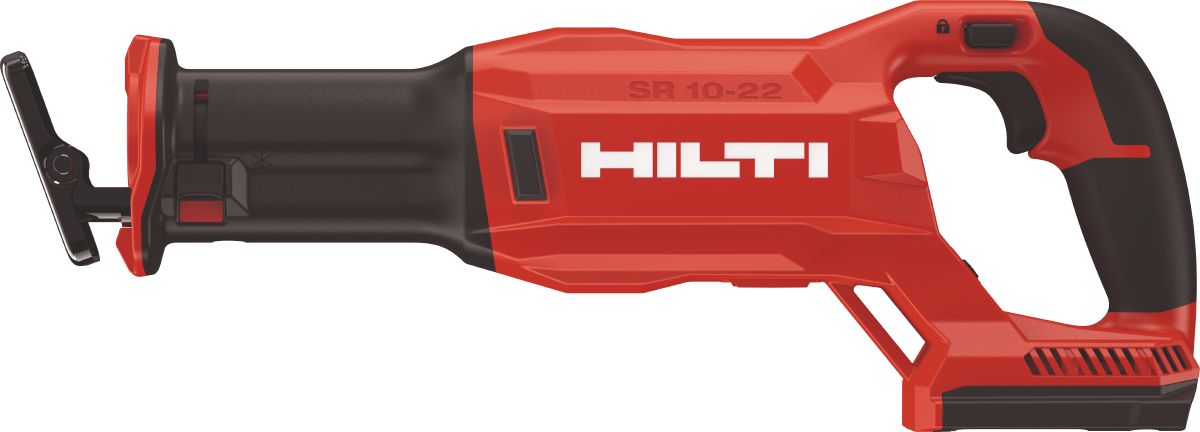
The Hilti SR 10-22 is an active U.S. model page for a two-handed Nuron reciprocating saw, although it did not appear among the five reciprocating-saw cards in the captured Hilti Saws filter. Hilti’s U.S. wood-saws guide does name the SR 10-22 alongside the SR 6-22 and SR 4-22, and its direct product page offers a tool configuration. I treat it as a distinct current model based on that exact page and its model-matched operating instructions, not as a sixth card in the filter result. The manual identifies a 7.1-pound weight without battery and a six-stage speed range from 1,400 to 2,800 strokes per minute. These are maker-listed specifications; no hands-on test or ownership is claimed.
A heavier two-handed choice with staged speed
The SR 10-22’s six selectable speed stages range from 1,400 to 2,800 strokes per minute. The U.S. page positions it for extra-heavy demolition. Its manual says it is designed for two-handed operation. Bare weight is 7.1 pounds, excluding the B 22 battery. The SR 6-22 is slightly lighter at 6.8 pounds, with a 1.3-inch stroke and 2,600 SPM. The compact SR 4-22 is much lighter at 4 pounds, one-handed design, with a shorter 0.91-inch stroke. These differences sort the family by handling and control needs, not tested cutting performance.
The SR 10-22 manual lists work in wood, wood-like material, metal and plastic; the U.S. product page additionally describes demanding demolition applications. Its speed selector gives a clear way to choose among fixed stage ceilings, while the variable trigger allows less than the selected maximum. Those controls do not amount to a measurement of cutting speed or a promise of better blade life. Hilti’s claim that selected speeds can help optimize blade life remains a manufacturer claim to assess against the right blade and workpiece.
What the shoe and clamp add
The operating instructions describe a 1/2-inch blade holder with a locking lever, plus a contact shoe that can be set in three positions. The shoe can be moved, but it is not a track or a cutting-depth gauge. Before a blade change, remove the battery, release the holder, fit the blade from the front and pull on it to ensure it has locked. The manual calls for a blade long enough to extend through the full stroke beyond the workpiece. As with any recip saw, blade selection, support and clearance above and below the material determine whether the cut is controlled; this review does not infer material capacity from the product name.
The manual also describes an optional cutting adapter for stabilizing some one-handed or precision cuts. That accessory does not change the base tool’s intended two-handed operation. Hilti lists dust removal as available for this model, but it is an attachment and vacuum arrangement to verify separately. The direct source page’s category mismatch is worth keeping visible: the currently captured filtered listing says five products and omits this SR 10-22, while the model page and current U.S. guide identify it. That is a catalog presentation difference, not a reason to merge it with SR 6-22 or to claim the filter’s count is wrong.
Power system and package boundary
The manual says to use only Hilti Nuron B 22-series batteries and compatible Hilti chargers. Its 21.6 V rated voltage is not a cross-brand compatibility statement. The U.S. product page offers the saw through a configurator; battery, charger and inserts are optional additions rather than implied contents of the tool body. The page does not specify an included blade count. Before buying, confirm the exact selected configuration, battery and charger requirements, dust attachment, and whether the seller’s package includes any consumables. The manual’s 7.1-pound tool weight excludes the battery and is not a carry-weight figure for the complete setup.
The manual’s instructions call for two-handed handling, securing the workpiece, using the shoe to support the cut and checking for concealed electrical, gas or water services where appropriate. It cautions the operator not to cut into unknown materials. A reciprocating saw is flexible, but the lack of a guided base means it is not a substitute for a controlled finish saw where straightness or surface quality is critical.
Who may prefer another Hilti model?
For a current Nuron user planning demanding two-handed work and wanting staged speed control, the SR 10-22 is the family’s most distinct option in this three-model comparison. If a hard bare-tool ceiling is 7 pounds, its documented 7.1-pound weight does not fit; the SR 6-22’s manual-listed 6.8 pounds does. If the buyer’s priority is tight access or a truly compact body, the one-handed SR 4-22 is the more relevant comparison. If no Nuron battery is already available, total system cost and the exact included charger matter more than the saw-body-only price field, which this guide intentionally does not reproduce.
Selection checks
Verify the exact SR 10-22 model and its product number 2480639, since this page is a separate current listing not present in the captured five-card Saws filter. Confirm the B 22 battery, compatible charger and any dust or cutting adapter separately. Check whether your weight cap is for the bare body or a battery-installed tool; do not treat 7.1 pounds as a ready-to-cut measurement. Match the blade to the material and secure the workpiece. The practical tradeoff is straightforward: six stage settings and a robust two-hand layout versus a 7.1-pound bare body, separate platform equipment and no evidence in the reviewed U.S. sources for an included blade. This is an original source-based assessment, not a performance test.
Key specifications
Key details at a glance
| Saw format | Full-size, two-handed saw |
|---|---|
| Power source | Cordless battery |
| Battery platform | Hilti Nuron |
| No-load stroke rate | 2800 SPM |
| Pivot shoe positions | 3 |
| Tool-free blade change | Yes |
| Work light | Yes |
| Bare-tool weight | 7.1 lb |
| Battery in this package | No |
| Charger in this package | No |
Use the exact model’s instructions for operating limits, supplied equipment and version differences.
Sources for this review
Sources for this assessment
- Hilti U.S. Saws category, current 23-product page
- Hilti U.S. Saws category filtered to reciprocating saws
- Hilti U.S. Wood Saws guide, SR range reference
- Exact Hilti U.S. SR 10-22 product page, product 2480639
- Hilti SR 10-22 generation-01 operating instructions, page-linked PDF
- Hilti SR 10-22 page-associated bare-tool reference photograph

Match the saw to your actual work.
Use the finder to compare verified requirements, then read each exact model assessment before deciding.