
Your needs, this model
Does it fit your priorities?
Does the SR 2-A12 fit a compact one-handed, current Hilti B 12 saw requirement?
Yes. Its matched manual says one-handed design and use only Hilti B 12-series batteries; the exact U.S. page labels the product cordless 12V, while the manual rates it at 10.8V.
Explore this need in the finder →Does a 3.5 lb bare-tool ceiling admit the SR 2-A12?
No. The exact manual and U.S. page support 4 lb without battery, so 3.5 lb excludes it; do not treat the body figure as loaded weight.
Explore this need in the finder →Will the base-body selection include a B 12 battery and charger?
No. Hilti marks the battery and C4/12 charger as optional additions to the tool-body selection; verify a separate exact kit if those items must be boxed with the saw.
Explore this need in the finder →Hilti cordless reciprocating saw · SR 2-A12 · compact one-handed format
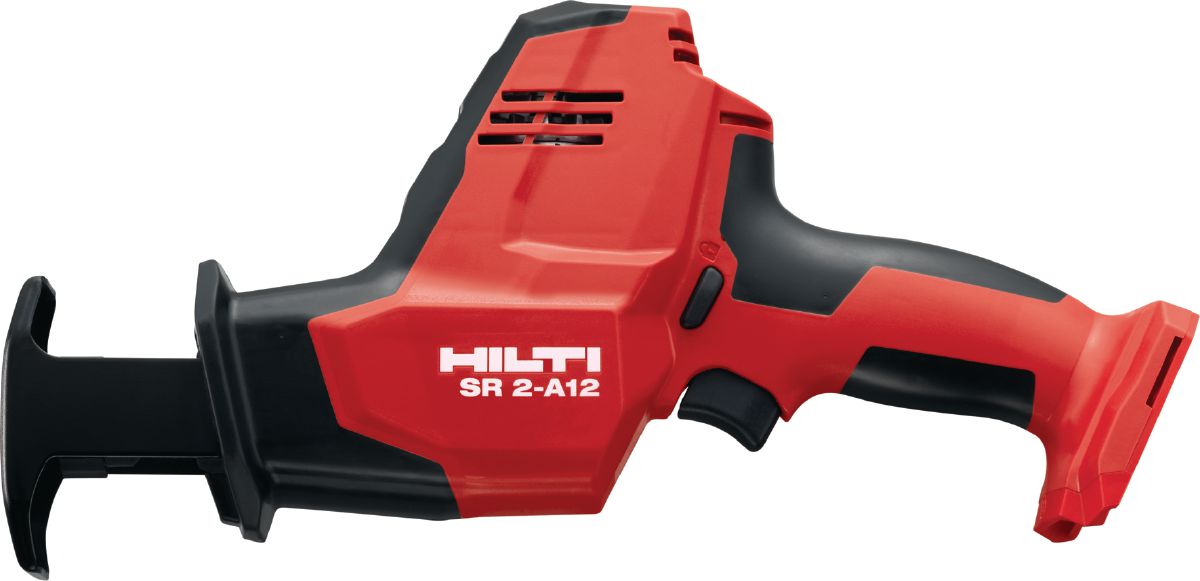
The Hilti SR 2-A12 is the compact 12-volt reciprocating saw appearing in Hilti’s U.S. saw catalogue. Hilti describes it for light-duty demolition and work in cramped or hard-to-reach locations, and the model-specific operating instructions explicitly say it is designed for one-handed operation. That intended format does not make every cut a one-hand task: Hilti still instructs users to support the workpiece securely, hold the saw correctly, use a suitable blade and keep the contact shoe against the work. This review is a comparison of the exact U.S. product page and its linked SR 2-A12 manual, not a hands-on test or ownership report.
A compact tool with its own battery family
The body is rated at 4.0 pounds without a battery in the manual, and the U.S. page repeats a four-pound “without battery” weight. This is a bare-tool figure, not the mass of a saw ready to cut. The SR 2-A12 uses Hilti’s B 12 battery series; the manual lists a 10.8-volt rated voltage while Hilti’s current U.S. product copy calls it a 12V saw. Those are two manufacturer descriptions of the same system, not permission to treat a B 12 battery as interchangeable with a Nuron B 22 pack. Buyers who already own Hilti batteries should check the exact battery series and charger family before counting this saw as compatible.
That distinction matters beside the newer SR 4-22. Both are compact one-handed-design saws and both have a four-pound bare-tool figure, but the SR 4-22 belongs to Nuron B 22 rather than B 12. The manuals and product pages document separate system families. Neither platform label predicts the tool’s usable runtime, and the posted body weight excludes the battery that will add mass during actual work.
Stroke and speed figures need a careful read
The product page lists a 5/8-inch stroke and a 2,900-strokes-per-minute rate. The linked manual gives the stroke as 16 mm (printed as 0.6 in) and describes no-load rate from zero to 3,000 per minute. Hilti’s two public sources do not give a perfectly identical pair of rounded figures. I preserve both descriptions instead of collapsing the difference into a single claimed measured rate: check the nameplate and current manual for the exact tool generation. These are specification values, not a demonstrated cutting speed through a particular pipe, nail-embedded board or sheet material.
The manual identifies a standard half-inch accessory holder with a keyless chuck. That supports conventional reciprocating-saw blades with the stated shank; it does not establish that a blade is inside the box. The hand guard and blade instructions also matter more than a compact outline alone. Use a blade long enough to remain beyond the workpiece through the full stroke, and keep the saw planted rather than pulling it backwards while the blade is moving.
What the base configuration does—and does not—settle
Hilti’s U.S. configurator presents the SR 2-A12 as a tool-body selection, with battery, charger and inserts or accessories offered as separate additions. The base body is not the same thing as a battery-and-charger kit. The reviewed page and manual do not establish a blade count for the base configuration, so confirm the exact retailer box list and obtain a compatible blade. A buyer starting from no Hilti B 12 equipment should cost the complete setup by checking a B 12 battery and C4/12 charger model rather than comparing tool-body listings alone.
The product page calls out a brushless motor, keyless blade clamp, LED work light and low-vibration handling. It positions the saw for wood up to 30 mm thick, thin-walled steel pipe up to 30 mm in diameter, plastic, drywall and sandwich panel. Those are Hilti’s stated application notes, not a guarantee for an unknown material, a particular blade, or a cut performed with poor support. The instructions warn against cutting masonry, concrete, natural stone or tile, against cutting pipes that still contain liquid, and against sawing into unknown materials. Dust collection is not listed as available for this exact model, so do not assume it accepts the SR DRS system shown for other Hilti saws.
Where the SR 2-A12 makes sense in a shortlist
The useful reason to consider this model is its small one-handed design paired with a defined B 12 battery route. The equally light SR 4-22 is a different Nuron saw with a different battery platform; the larger SR 6-22 and SR 10-22 are explicitly two-handed formats and have longer strokes. The older corded WSR 1000 and heavy-duty corded SR 30 are not substitutes if a compact cordless setup is essential. Conversely, a buyer who has no B 12 packs should compare the cost and availability of the whole system rather than treating the saw body as ready to operate.
Before buying, verify the complete model code SR 2-A12, the B 12 battery and C4/12 charger compatibility, whether the box includes a blade, the electrical and workpiece conditions in the manual, and whether the cutting area is appropriate for a compact saw. If your work needs an exact weight with battery, a specific runtime or a guaranteed rate through a named material, the reviewed sources do not establish that outcome. The grounded choice is narrower: a 4-pound bare body, B 12 cordless system, one-handed design, keyless half-inch blade holder and modest manufacturer-stated application range.
Key specifications
Key details at a glance
| Saw format | Compact, one-handed saw |
|---|---|
| Power source | Cordless battery |
| Battery platform | Hilti B 12 series |
| Motor type | Brushless |
| Stroke length | 0.62 in |
| Tool-free blade change | Yes |
| Work light | Yes |
| Bare-tool weight | 4 lb |
| Battery in this package | No |
| Charger in this package | No |
Use the exact model’s instructions for operating limits, supplied equipment and version differences.
Sources for this review
Sources for this assessment

Match the saw to your actual work.
Use the finder to compare verified requirements, then read each exact model assessment before deciding.