
Your needs, this model
Does it fit your priorities?
Does the Hilti SR 30 exact U.S. box fit a two-handed corded saw requirement?
Yes. Hilti identifies box 2228923 as SR 30 Corded 120V and the matched manual specifies two-handed operation. It is not SR 30-A36.
Explore this need in the finder →Does the SR 30 meet a 10 lb bare-tool weight ceiling?
No. The matched manual lists 10.6 lb (4.8 kg), exceeding a 10 lb limit; that is a tool-only figure, not the weight of a vacuum setup.
Explore this need in the finder →Can I require adjustable shoe and tool-free blade change together?
Yes. The exact manual describes a three-position contact shoe and locking-lever release for standard half-inch blades; unplug before adjustments or blade changes.
Explore this need in the finder →Hilti corded reciprocating saw · SR 30 · U.S. 120V box configuration
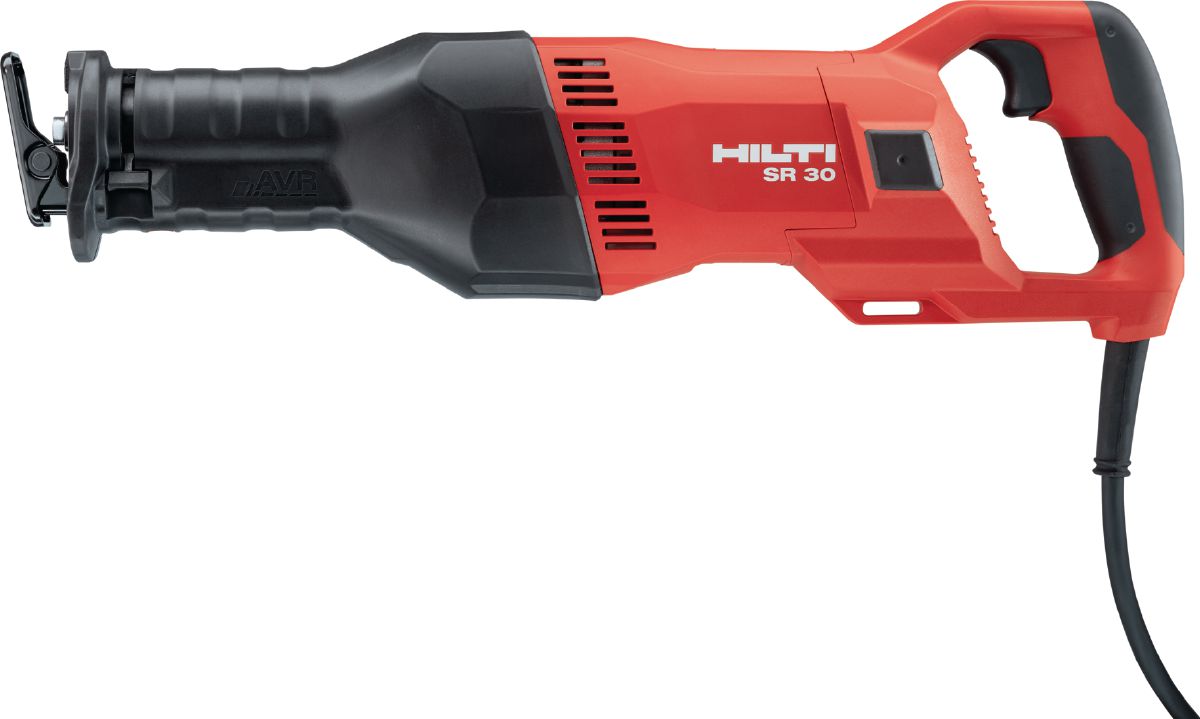
The Hilti SR 30 is Hilti’s heavy-duty reciprocating saw in the captured U.S. saw listings, but the exact U.S. product configuration reviewed here is a corded 120V package—not the separate SR 30-A36 cordless model found in other manuals and accessory listings. The page-associated operating instructions are titled for “SR 30,” while Hilti’s configurator identifies the exact box as SR 30 Corded 120V and lists the saw with a dust-removal module. Keeping that identity straight matters: voltage, battery compatibility and package contents cannot be borrowed from an SR 30-A36 document just because the names are similar.
This assessment uses the exact Hilti U.S. product page, its SR 30 manual and the captured saw-category result. It is not a test, demo, purchase or ownership report. The available sources support a large two-handed corded saw with a long stroke, a locking-lever blade holder, an adjustable contact shoe and Hilti’s Active Vibration Reduction label. They do not establish how quickly it cuts a specific beam or how it feels during a shift.
Large two-handed layout, corded supply
Hilti’s product page identifies this box as a 120V corded reciprocating saw. That makes the SR 30 different from the Nuron SR 6-22 and the older SR 30-A36 battery saw even though the product-family name is similar. It also makes extension-cord selection and access to suitable mains power part of setup. A corded saw avoids the need to match a battery pack for operation, but it does not remove cord-routing hazards or the need to plan a safe power connection at the job.
The manual calls the SR 30 a two-handed tool. Its 4.8 kg / 10.6 lb weight and 32 mm (1.3 in) stroke place it in a substantial format, while the page and manual give 2,650 strokes per minute. Hilti lists a locking-lever blade release and says the contact shoe can be placed in three positions. The page also identifies Active Vibration Reduction and applications including heavy demolition, structural steel, thick timber with metal inserts, chrome steel and cast-iron structures. These are the manufacturer’s descriptions of intended use and features, not proof of speed or comfort on any particular cut.
The exact box matters for dust management
For the current U.S. configurator selection, Hilti lists one SR 30 corded 120V reciprocating saw and one dust-removal module in the box. The product copy also calls the module an optional connection and says to connect a compatible vacuum cleaner. The safe interpretation is that this exact page configuration includes the module, but the vacuum is a separate system item and a different retailer package may not include the same module. Verify the box list and compatible vacuum before relying on dust extraction. No source reviewed here says the included module captures all dust or replaces appropriate respiratory protection and site controls.
By contrast, the WSR 1000 is a lighter, simpler corded Hilti option. Its manual lists a 7.28 lb weight and 28 mm stroke, and Hilti says no dust-removal system is available for it. That is a meaningful documented distinction, not a claim that one saw is faster or more suitable for a project. Buyers who need a long stroke, a corded setup, or the SR 30’s listed dust module can use the specific differences to narrow the shortlist. Those who need battery mobility should compare Hilti’s actual cordless models instead.
Blade changes, shoe positions and work limits
The page and manual describe a keyless holder operated through a locking lever. The contact shoe can be moved among three positions; Hilti’s manual gives the adjustment procedure and requires the saw to be unplugged before adjustments or accessory changes. The manufacturer recommends maintaining firm shoe contact with the workpiece and uses the manual to warn about blade binding, kickback and hidden electrical, gas or water services. Those instructions are more important than a convenient clamp or claimed material list.
Hilti describes the saw for heavy demolition and names structural metal, cast iron, mixed materials and thick-walled pipe among its applications. The operator manual still prohibits cutting bricks, concrete, cellular concrete, natural stone or tiles; it also says not to cut pipes containing liquid and not to saw into unknown materials. Check the exact blade’s material range, secure the workpiece, inspect the cut path and use the manual’s safety procedure. “Heavy-duty” is Hilti’s product positioning, not a blanket authorization for every hard material.
Buying checks and bottom line
The model is a plausible fit when a two-handed 120V corded tool is acceptable and the buyer wants the long-stroke, adjustable-shoe arrangement documented for this configuration. It is a poor paper match if the work depends on cordless reach, low carry weight or a battery platform. Its bare-tool listing is 10.6 lb; the included dust module and vacuum setup are not a quoted complete carry weight. The reviewed source material does not publish a measured loaded weight or current draw for this exact U.S. tool, so neither is inferred here.
Before purchase, confirm the package identifier and 120V corded variant, the saw and dust-module box list, the compatible vacuum and hose connection, blade shank and blade selection, and the extension-cord guidance in the SR 30 manual. Do not confuse this unit with SR 30-A36, SR 6-A22 or SR 6-22. The current source-backed identity is specifically Hilti SR 30 corded 120V, 10.6 lb in the manual, 32 mm stroke, 2,650 strokes per minute, three-position contact shoe and keyless lever holder.
Key specifications
Key details at a glance
| Saw format | Full-size, two-handed saw |
|---|---|
| Power source | Corded mains power |
| Stroke length | 1.3 in |
| No-load stroke rate | 2650 SPM |
| Pivot shoe positions | 3 |
| Tool-free blade change | Yes |
| Bare-tool weight | 10.6 lb |
| Battery in this package | No |
| Charger in this package | No |
Use the exact model’s instructions for operating limits, supplied equipment and version differences.
Sources for this review
Sources for this assessment

Match the saw to your actual work.
Use the finder to compare verified requirements, then read each exact model assessment before deciding.