
Your needs, this model
Does it fit your priorities?
Which current Hilti Nuron model fits a full-size, two-handed choice with a 7 lb bare-tool ceiling?
The SR 6-22 is a documented fit: its manual states two-handed use and 6.8 lb without battery. The same Hilti-platform full-size result includes the SR 10-22 only when the ceiling reaches 7.5 lb.
Explore this need in the finder →Can the SR 6-22 fit if the ceiling is 6.5 lb for the bare saw?
No. The manual-listed 6.8 lb bare-tool mass exceeds 6.5 lb; battery mass is not included in that figure.
Explore this need in the finder →Does the body configuration satisfy a requirement for both an included battery and charger?
No. The configurator treats battery and charger as optional additions; this body configuration does not establish that either is included.
Explore this need in the finder →Hilti Nuron cordless reciprocating saw · SR 6-22 · full-size two-handed format
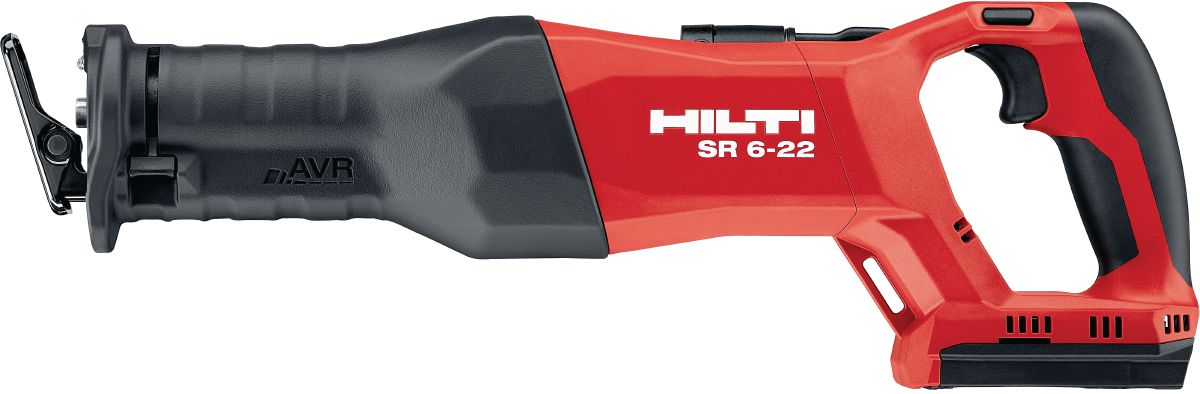
The Hilti SR 6-22 is the current two-handed Nuron reciprocating saw in Hilti’s U.S. Saws catalogue, with a longer stroke than the compact SR 4-22. The model-matched manual makes the format decision explicit: it says the SR 6-22 is designed for two-handed operation. Hilti’s product page presents it for heavy demolition and mixed-material cutting, while its technical data give a 32 mm (1.3 in) stroke, 2,600 strokes per minute and 6.8 pounds without a battery. Those are manufacturer specifications, not a test result. This assessment is based on Hilti’s U.S. product page and SR 6-22 operating instructions; no ownership or hands-on use is claimed.
Where the SR 6-22 sits in the family
The SR 6-22 is heavier than the compact, one-handed-design SR 4-22, whose manual lists 4 pounds, a 0.91-inch stroke and up to 3,000 SPM. It is lighter on the published bare-tool measure than the SR 10-22 at 7.1 pounds, but the SR 10-22 uses six speed stages and is also explicitly two-handed. The SR 6-22’s 6.8-pound bare mass and 1.3-inch stroke put it between those approaches: longer stroke and a firm two-hand layout without the SR 10-22’s greater weight and extra speed-stage selection. These comparisons are useful for planning handling and fit; they do not predict cut time, runtime or vibration in a particular job.
Hilti’s product page lists wood, nail-embedded wood, metal, plastic, drywall, masonry, sandwich panel and other base materials. It also lists a dust-removal system and a Cut Assist attachment as available accessories. “Available” does not mean included in the tool-body package. If cutting involves a sensitive surface or airborne dust concern, check the correct accessory, vacuum and work method rather than treating the saw’s listing as a complete dust-control system.
Contact shoe, clamp and operating setup
The manual specifies a 1/2-inch blade holder and a tool-less locking lever. It describes the contact shoe as removable and usable in three positions; the shoe must be installed and seated correctly before cutting. For blade changes, Hilti instructs the user to remove the battery, raise the locking lever, fit the blade from the front and then pull it to confirm the lock. Use an appropriate blade whose length remains beyond the workpiece over the entire stroke. The adjustable shoe can help maintain contact as the nose approaches a surface, but it is not a guide rail and does not promise a particular maximum cutting depth.
Hilti lists an LED, its Advanced Vibration Reduction system, and better balance as handling features. The page’s “up to 26% lower vibration” is a manufacturer comparison, not a universal result across materials or grip styles. I do not convert that statement into a numeric matcher field. The operating instructions separately warn about prolonged vibration exposure and require protective equipment. They also direct the operator to keep hands clear of the blade, brace the shoe at the work and avoid lifting the saw from the cut before the blade has stopped. The product should be held by its provided grips, in the two-hand arrangement stated in the manual.
Nuron batteries and base package
The SR 6-22 is a 21.6 V rated tool on Hilti’s Nuron system. Its manual limits compatible packs to Hilti Nuron B 22-series batteries and identifies compatible chargers for those batteries. Confirm the pack and charger model against the current manual rather than equating “22 V” with another manufacturer’s platform. In Hilti’s U.S. configurator, the starting selection is a tool body; battery, charger and inserts are listed as optional additions. The page identifies a cardboard box for the body configuration. The saw’s 6.8-pound weight is expressly without battery and must not be presented as the ready-to-cut weight. The material reviewed does not verify a saw blade in the box, so blade inclusion remains an exact-package check.
A buyer already equipped with the Nuron battery system can assess the body separately from those platform costs. A new-system buyer should add the appropriate battery and charger before treating the setup as complete. Neither the capacity printed on a battery nor the manual’s recommended pack alone proves a particular number of cuts per charge; that depends on blade, material and job conditions that are not tested here.
Practical limits to keep in view
This is a demolition-style saw rather than a finish-cutting substitute for a guided saw. Hilti itself directs users toward saws intended for accurate repeat cuts when precision is the priority. The SR 6-22’s listed heavy-duty role, shoe contact and range of blades support a flexible rough-cutting plan, but the page does not supply a universal capacity guarantee across pipes, beams or masonry. The model documentation reviewed here does not establish selectable orbital action, so do not assume it from the reciprocating-saw category. The product does support a connected dust attachment, but it is an optional accessory and should be verified as the correct SR DRS version.
Checks before choosing this exact model
Confirm SR 6-22 and the specific package option; verify a compatible B 22 battery, matching charger and any required dust or Cut Assist attachment. Check the blade shank, blade length and tooth pattern against the work. If the practical weight limit includes the battery, obtain the mass for the exact pack rather than treating 6.8 pounds as loaded weight. Follow the manual’s two-hand, workpiece-support and blade-change instructions. The SR 6-22 is a strong paper fit for a current Nuron user seeking a two-handed demolition saw with a 1.3-inch stroke and adjustable three-position shoe. Its important limitations are separate power-system items, unknown blade contents in the base configuration and specifications that cannot guarantee job-specific performance. This is original source-based assessment, not a laboratory or field test.
Key specifications
Key details at a glance
| Saw format | Full-size, two-handed saw |
|---|---|
| Power source | Cordless battery |
| Battery platform | Hilti Nuron |
| Stroke length | 1.3 in |
| No-load stroke rate | 2600 SPM |
| Pivot shoe positions | 3 |
| Tool-free blade change | Yes |
| Work light | Yes |
| Bare-tool weight | 6.8 lb |
| Battery in this package | No |
| Charger in this package | No |
Use the exact model’s instructions for operating limits, supplied equipment and version differences.
Sources for this review
Sources for this assessment

Match the saw to your actual work.
Use the finder to compare verified requirements, then read each exact model assessment before deciding.