
Your needs, this model
Does it fit your priorities?
Does the WSR 1000 match a current two-handed 120V corded-saw need?
The U.S. Hilti page currently identifies the WSR 1000 120V USA configuration, and its operating instructions describe two-handed operation. This evidence does not guarantee stock at every seller.
Explore this need in the finder →Does it meet a 7 lb bare-tool limit?
No. The manual gives 7.28 lb and the U.S. product page rounds to 7.3 lb without battery, above a 7 lb maximum; its manual stroke is separately 28 mm.
Explore this need in the finder →Does the manual support a five-position pivoting shoe and tool-free holder?
Yes. The exact WSR 1000 manual describes a keyless holder and five contact-shoe positions; unplug before adjusting the shoe or changing blades.
Explore this need in the finder →Hilti corded reciprocating saw · WSR 1000 · U.S. 120V model
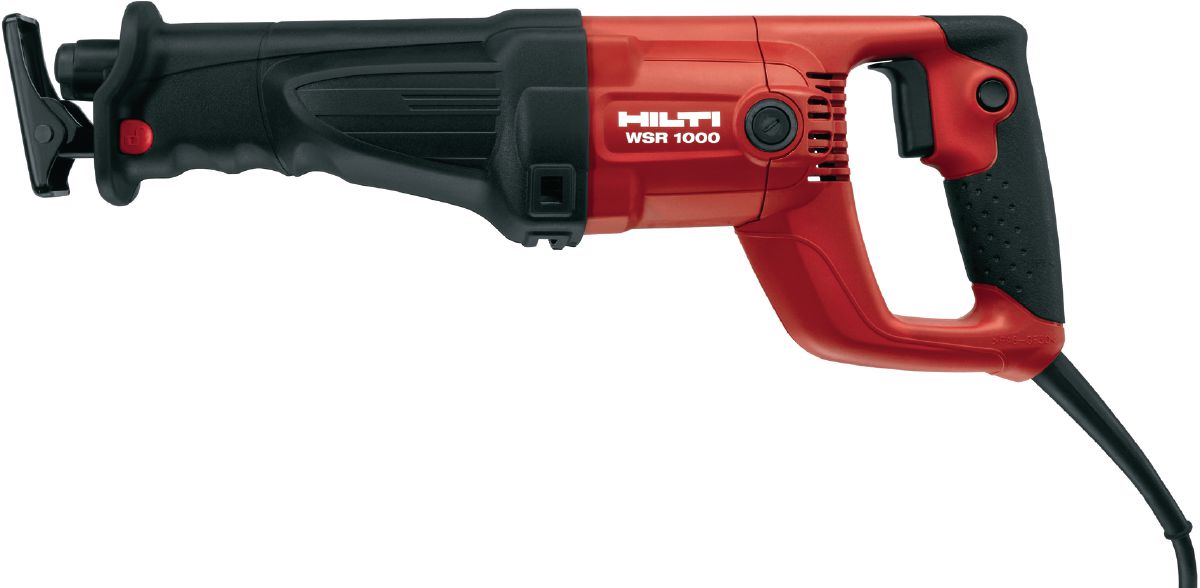
The Hilti WSR 1000 is a compact-bodied but explicitly two-handed reciprocating saw in Hilti’s U.S. listings. Hilti’s exact U.S. product page identifies the WSR 1000 120V USA configuration, and the linked operating instructions describe a 120V, 9A mains tool. The manual is dated from an earlier product era, but the captured U.S. page still identifies an active product configuration; I therefore describe it as a currently listed reference rather than silently treating it as discontinued. This is a source-based comparison, not a claim of hands-on testing, ownership or present inventory.
Compact in outline, not a one-hand saw
The manual says the WSR 1000 is designed for two-handed operation even though Hilti calls it “compact” and shows a relatively narrow body. Its weight is 3.3 kg (7.28 lb) in the model manual, while the U.S. page rounds the manufacturer’s no-battery weight to 7.3 lb. That figure describes the tool only, not a box, blade, extension cord or ready-to-work setup. The 17.8-inch length, 3.82-inch width and 6.69-inch height in the manual provide more context than a bare weight alone when checking a storage space or access route.
This distinction separates it from the compact one-handed Hilti SR 2-A12 and the Nuron SR 4-22. The WSR 1000 has a rear handle and forward grip, a corded power lead and a manual instruction for two hands. A compact silhouette does not change the operating format. Hilti’s manual still tells the operator to secure the workpiece, use an appropriate blade and maintain safe control of the saw.
Power and published stroke figures
The U.S. manual lists 120V, 9A, 60 Hz, 1,000W and a continuously variable no-load rate up to 2,800 strokes per minute. This is a corded system, not a Hilti battery platform. The manual gives a 28 mm stroke; the Hilti category page instead lists a 1-1/4-inch stroke. Those measurements do not convert to the same length, so the discrepancy remains explicit here. I use the manual’s 28 mm figure when describing the manual, retain the page’s listing as a separate page claim and do not imply that either number came from a test. Buyers should confirm the exact model and current product documentation rather than assume the online summary and manual match.
The manual also lists a keyless holder for standard half-inch blades and a lockable control switch. The contact shoe has five positions at quarter-inch intervals, according to the same instructions. Hilti says no dust-removal system is available for this model. The U.S. page describes a 1,000W compact heavy-duty saw; the operating instructions present wood, wood-like materials, metals and plastics as intended materials. Those statements are not an independent rating for every cut or blade.
What the U.S. box includes
Hilti’s product page lists a single WSR 1000 120V USA reciprocating saw. The model manual’s standard-supplied-items list names one power tool, one saw blade, operating instructions and a cardboard box. No battery or charger belongs in this corded package. If a retailer lists a different blade or storage arrangement, verify that exact SKU’s contents instead of transferring details from another Hilti kit.
The one supplied blade should be treated as a starting accessory, not proof that it suits a particular material. A reciprocating-saw blade’s tooth pitch, length and construction affect its intended application; Hilti’s safety text says to use an appropriate blade length and warns against forcing a blade into binding. If a specialized cut is planned, choose a separate blade based on its own instructions and the material maker’s requirements.
Position relative to the SR 30
The current Hilti SR 30 corded configuration is a heavier two-handed option with a 10.6 lb manual weight, 32 mm stroke and a box listing that includes a dust-removal module. WSR 1000 is listed at about 7.3 lb and its manual says 28 mm, with no dust-removal system available. Both are mains tools, but their documented weight, package and dust options differ. This comparison can help distinguish a more portable tool-body listing from a heavier package; it does not establish which one would cut a particular beam more quickly, or which is more comfortable over a workday.
The WSR 1000 has a lockable switch and five-position shoe, which may matter if the feature set matches a buyer’s workflow. The manual requires unplugging the tool before making adjustments or changing accessories. For generator or transformer use it supplies specific conditions and warns against running other appliances from the same source at the same time. Those power instructions are part of the fit decision for a corded saw away from a normal outlet.
Use limits and final checks
Hilti’s manual explicitly says not to use the WSR 1000 to cut bricks, concrete, cellular concrete, natural stone or tile, to cut pipes containing liquid, or to saw into unknown materials. It also emphasizes checking for concealed utilities and securing the workpiece. This is not a general-purpose substitute for a masonry cutter, nor does the manufacturer’s “heavy-duty” description override the use limits in the instructions. A compact shape does not eliminate kickback risk or replace stable support and the right personal protection.
Before buying, verify the exact WSR 1000 120V USA model, power availability, a compatible extension cord if required, the supplied blade, the five-position shoe, and the manual-page conflict over stroke length. If a dust-extraction connection is essential, this is not the Hilti model to assume will support it. The grounded specification picture is a corded 1,000W, 9A two-handed saw, 7.28 lb in its manual, keyless half-inch blade holder, adjustable shoe and one listed blade in the manual’s standard package.
Key specifications
Key details at a glance
| Saw format | Full-size, two-handed saw |
|---|---|
| Power source | Corded mains power |
| Motor current | 9 A |
| No-load stroke rate | 2800 SPM |
| Pivot shoe positions | 5 |
| Tool-free blade change | Yes |
| Bare-tool weight | 7.28 lb |
| Overall length | 17.8 in |
| Trigger lock-on switch | Yes |
| Battery in this package | No |
| Charger in this package | No |
Use the exact model’s instructions for operating limits, supplied equipment and version differences.
Sources for this review
Sources for this assessment

Match the saw to your actual work.
Use the finder to compare verified requirements, then read each exact model assessment before deciding.