
Your needs, this model
Does it fit your priorities?
What comes with the JR3051T, and does it need a battery?
Makita's US product page lists a corded saw with one 6 in wood blade and one 6 in metal blade. It is not a battery-platform tool. Check the exact JR3051T package and nameplate, and plan for a suitable mains outlet and safe cord route; the two listed blades do not establish a particular cut-capacity result.
Explore this need in the finder →Is the JR3051T shoe adjustable like the JR3050TZ shoe?
The US press release calls the JR3051T shoe pivoting and fixed, while its product page and model manual do not document the five-position adjustment published for JR3050TZ. This assessment leaves the adjustable-shoe filter unknown rather than treating the two mechanisms as identical. In every case, the manual requires firm shoe contact against a supported workpiece while cutting.
Explore this need in the finder →Does the JR3051T meet a 7.5 lb bare-tool limit?
Yes, on Makita's published numbers: the US product page lists 7.3 lb net weight, and the model manual gives a 7.1–7.3 lb range depending on attachments. This is not the weight of the boxed package, a case, extension cord or other carried equipment.
Explore this need in the finder →Makita · current-reference 12 A corded reciprocating saw · exact model JR3051T
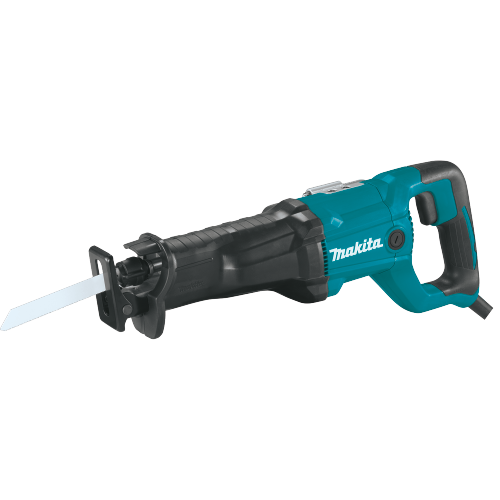
The JR3051T is a distinct Makita model, not a revised label for the older JR3050T or its JR3050TZ companion. Makita identifies it as the replacement for the discontinued JR3050T. The U.S. product page specifies a 12-amp, corded saw with a longer 1-3/16-inch stroke and a variable-speed trigger. Those are useful ways to separate the models on a listing; they are not evidence that this saw will cut a particular material a stated percentage faster in a reader's job. This is a comparison based on maker documentation, not hands-on use or a cutting test.
What the exact U.S. model establishes
Makita lists a maximum no-load rate of 0–3,000 strokes per minute, a 17-5/8-inch overall length and a net weight of 7.3 pounds. Its model manual gives the same 1-3/16-inch stroke and describes the net weight as 7.1–7.3 pounds depending on attachments. The upper product-page figure is the right comparison point for a strict 7.5-pound tool-weight ceiling, but neither number is a boxed or ready-to-carry weight. The manual's separate cutting-capacity figures—up to 5-1/8 inches in pipe and 10 inches in wood—are specified with an 11-3/4-inch blade. The U.S. page lists two 6-inch blades, one for wood and one for metal, so those capacity figures should not be assumed from the included blades alone.
Corded power is a work-area decision
This model is for a user who can keep a suitable mains supply close enough and route the cord away from the blade path, sharp edges and footing. It avoids choosing a battery ecosystem, but it is a poor fit where the saw must move freely around a vehicle, climb to a roof edge or reach a remote cut without a carefully planned extension. Makita's manual includes extension-cord gauge guidance by ampere rating and length; check that table and the exact tool nameplate instead of assuming any household extension is adequate. A corded tool also needs to be disconnected before blade work or adjustment.
The two-handed form is supported by the manual's instruction to hold the insulated front surface with one hand and the switch handle with the other. Its 17-5/8-inch length and 7.3-pound net weight are relevant when judging clearance and overhead handling, but a spec-sheet size is not a substitute for checking the space, stance and material support at the cut.
Trigger and blade setup
The variable-speed trigger changes speed with trigger pressure; Makita lists no separate variable-speed dial. The product page also lists no selectable orbital setting. That makes it a simpler speed-control proposition than a saw with a separate orbit mode, but it does not establish smoothness or cut quality across wood, metal or demolition stock. A slower start to establish a groove, followed by a deliberate increase in trigger pressure, is consistent with the manual's operating guidance. Do not force the blade or twist it through a cut.
Makita advertises a tool-less blade change, and the manual describes the clamp lever and sleeve. Tool-less does not mean risk-free: disconnect mains power, clear chips from the clamp, insert the blade fully and verify that it is locked before use. The package list names two 6-inch blades, but buyers should check the current written contents of an exact JR3051T offer rather than infer a case or additional accessories from a product image.
Fixed pivoting shoe, not a five-position adjustment claim
Makita's 2020 U.S. announcement calls the JR3051T's shoe “pivoting” and “fixed.” The U.S. product page and model-specific manual do not describe the five-position, tool-less shoe adjustment documented for the JR3050TZ. This assessment therefore does not count JR3051T as an established adjustable-shoe match; the distinction is about what the available exact-model documentation supports, not a claim that the shoe cannot contact an angled surface. Whichever saw you choose, the manual says to press the shoe firmly against the workpiece. Support the work, keep the blade clear of hidden wiring, pipe and your free hand, and do not cut with the shoe removed or held away from the stock.
How it differs from the JR3050 models
The discontinued JR3050T and the JR3050TZ are separate 11-amp, 1-1/8-inch-stroke saw records. Makita's replacement identification and exact model specifications make the JR3051T's 12 amps, 1-3/16-inch stroke and 3,000 SPM ceiling the meaningful published changes. The JR3050TZ's five-position shoe is documented; the JR3050T's exact older package and lock-on control are different questions that should not be transferred to JR3051T. Its U.S. manual includes general instructions for versions with and without a lock button, so this assessment leaves the JR3051T lock-on field unresolved rather than guessing from a shared manual or a retailer description.
Who should keep looking
Choose another arrangement if the job needs a cordless platform, a clearly documented selectable orbital mode, a multi-position adjustable shoe or unrestricted reach. The JR3051T can make sense on paper for a corded two-hand routine with convenient tool-less blade changes and a known 7.3-pound net figure, provided the buyer confirms the exact package and can follow the manual's supply, support and blade rules. It is not a universal demolition answer, and manufacturer capacity and no-load speed figures are not independent test results.
Key specifications
Key details at a glance
| Saw format | Full-size, two-handed saw |
|---|---|
| Power source | Corded mains power |
| Motor current | 12 A |
| Stroke length | 1.19 in |
| No-load stroke rate | 3000 SPM |
| Tool-free blade change | Yes |
| Selectable orbital action | No |
| Bare-tool weight | 7.3 lb |
| Overall length | 17.62 in |
| Battery in this package | No |
| Charger in this package | No |
Use the exact model’s instructions for operating limits, supplied equipment and version differences.
Sources for this review
Sources for this assessment
Match the saw to your actual work.
Use the finder to compare verified requirements, then read each exact model assessment before deciding.