
Your needs, this model
Does it fit your priorities?
What does the P2530 kit add to the saw?
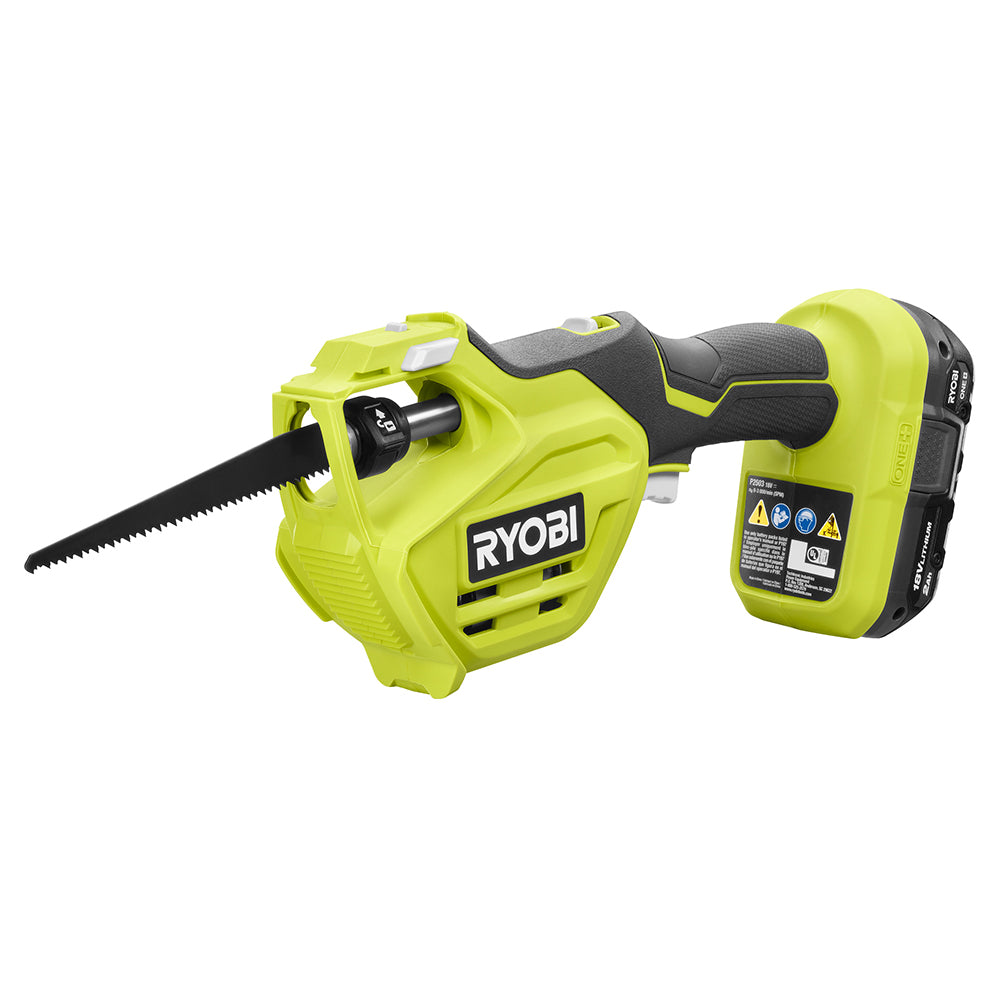
The exact kit page lists one P2503BTL pruning reciprocating saw, one PBP006 2Ah ONE+ battery and one P118B charger. It is not the same package as P2503BTL tool-only. The image shows a battery attached to the saw but not the charger; the written Includes list establishes the charger.
Explore this need in the finder →What branches is the P2530 intended to prune?
RYOBI labels the application as small limbs up to 3 inches, and the P2503 manual says not to cut material larger than 3 inches. The manual also warns against cutting from a ladder and gives additional line-clearance and bystander-distance cautions; this is not advice to work overhead or near energized lines.
Explore this need in the finder →Can the P2530 meet a 3 lb bare-tool limit?
The kit’s included P2503BTL saw is also sold tool-only, and its exact tool-only page publishes 2.6 lb. That documented saw weight is within a 3 lb cap; the P2530 kit’s separate 3.6 lb listing is not labeled as a bare-tool weight.
Explore this need in the finder →This is a research-based review of the exact RYOBI P2530 kit, not a test of pruning performance. It is a compact one-handed pruning saw package built around the P2503BTL tool. The distinction between the kit and the related tool-only SKU matters: the P2530 page lists a 2Ah battery and charger, while P2503BTL is the separate saw-only option.
A pruning tool with a clear application boundary
RYOBI positions the P2530 for small limbs up to three inches and describes a one-handed ergonomic design. Its published tool specifications are a 0.78-inch stroke and a no-load range up to 2,600 SPM. Those details place it on the compact end of this category. The short stroke and lower top-line rate than a full-size saw are not, by themselves, proof of poor cutting or superior control; they help define what kind of format the maker is offering. The pruning use is more important than the headline numbers. The P2503-family manual says the saw is intended for pruning small limbs and branches and warns not to cut material larger than three inches. It also advises removing long branches in stages, planning where they may fall, maintaining footing and not cutting from a ladder. The manual gives additional clearance warnings for overhead electrical lines and bystanders. Those cautions belong in the buying decision: a one-handed saw is not a license to work from an unstable position or reach into an unsafe cut.Branch hook and blade control
RYOBI lists a removable branch hook for control and reduced vibration and an easy-release blade lever for changes. In the manual’s procedure, the user places the hook in front of the limb and uses it while pruning; it is a work-support feature, not a hanging hook. The lever gives a convenient release, but safe changes still require removing the battery and checking that the replacement blade is fully retained. The exact P2530 page does not specify a blade in its electronic Includes list. The related P2503 manual describes a six-inch blade in its packing/features discussion, so the sources do not provide a clean, exact kit-specific statement about blade supply. I would verify the exact box with the seller rather than assume the blade is included because it appears in a product photo or in a manual for the saw family. The manual and blade maker remain the authority for compatible blade fit and material use.What comes in the P2530 box
The exact U.S. [P2530 page](https://www.ryobitools.com/products/46396040305) lists one P2503BTL pruning saw, one PBP006 2Ah ONE+ battery and one P118B charger. That is a meaningful difference from [P2503BTL tool-only](/reviews/p2503btl/), which is the same saw without the power equipment. The image for P2530 shows the saw with a battery attached but does not show the charger; the written package list, not the photo, establishes the included charger. The kit page shows a 3.6-pound weight field for the P2503BTL saw, but it does not say whether that figure is bare-tool, battery-on or another basis. The exact P2503BTL tool-only page publishes 2.6 pounds for that saw. For a strict bare-tool comparison, the latter is the appropriate figure; do not report the kit-page 3.6 pounds as the P2530’s total box weight or bare-tool weight. The manual’s blade discussion and the page’s ambiguous kit weight should be treated as details to confirm, not filled in from assumption.Battery system, not runtime promise
P2530’s one PBP006 battery is rated at 2Ah, and the kit includes a P118B charger. The capacity is a package fact, not a runtime forecast. Branch type, diameter, blade condition, battery temperature and cutting method all change how much work a pack can do. If you already own compatible ONE+ batteries, compare the kit against P2503BTL tool-only; if not, the included equipment reduces the number of separately sourced pieces but still does not establish a number of cuts per charge. The P2530 is a different proposition from the P519 full-size reciprocating saw or the brushless PSBRS02. It is specifically a compact pruning form with a branch hook and a maker-stated three-inch limit. A buyer needing a longer conventional body for varied demolition or construction cuts should compare a two-handed model instead of stretching this intended application.Who should shortlist it
Shortlist P2530 if your work is small-limb pruning, you prefer a compact one-handed format and you want the listed 2Ah pack and P118B charger included. Pause if the task exceeds the stated three-inch boundary, if elevated cutting is involved, or if you need the exact blade contents confirmed before purchase. Verify the P2530 suffix and the manual’s safety limits, and do not treat the maker’s application claim as an independent test.Key specifications
Key details at a glance
| Saw format | Compact, one-handed saw |
|---|---|
| Power source | Cordless battery |
| Battery platform | RYOBI 18V ONE+ |
| Stroke length | 0.78 in |
| No-load stroke rate | 2600 SPM |
| Tool-free blade change | Yes |
| Bare-tool weight | 2.6 lb |
| Battery in this package | Yes |
| Charger in this package | Yes |
Use the exact model’s instructions for operating limits, supplied equipment and version differences.
Sources for this review
Sources for this assessment

Match the saw to your actual work.
Use the finder to compare verified requirements, then read each exact model assessment before deciding.