
Your needs, this model
Does it fit your priorities?
Is this the compact one-handed pruning saw?
No. The PCL515B is a full-size two-handed saw; RYOBI separately labels the PCL510 and P2503 pruning tools as one-handed formats.
Explore this need in the finder →Does this B package include power equipment?
No. The exact page identifies tool-only PCL515B; it must not inherit PCL515K1’s PBP005 battery or PCG002 charger.
Explore this need in the finder →Can its bare-tool mass be verified under 4 lb?
No. The exact page and PCL515 manual reviewed do not give a bare-tool weight, so an essential 4 lb cap remains unsupported.
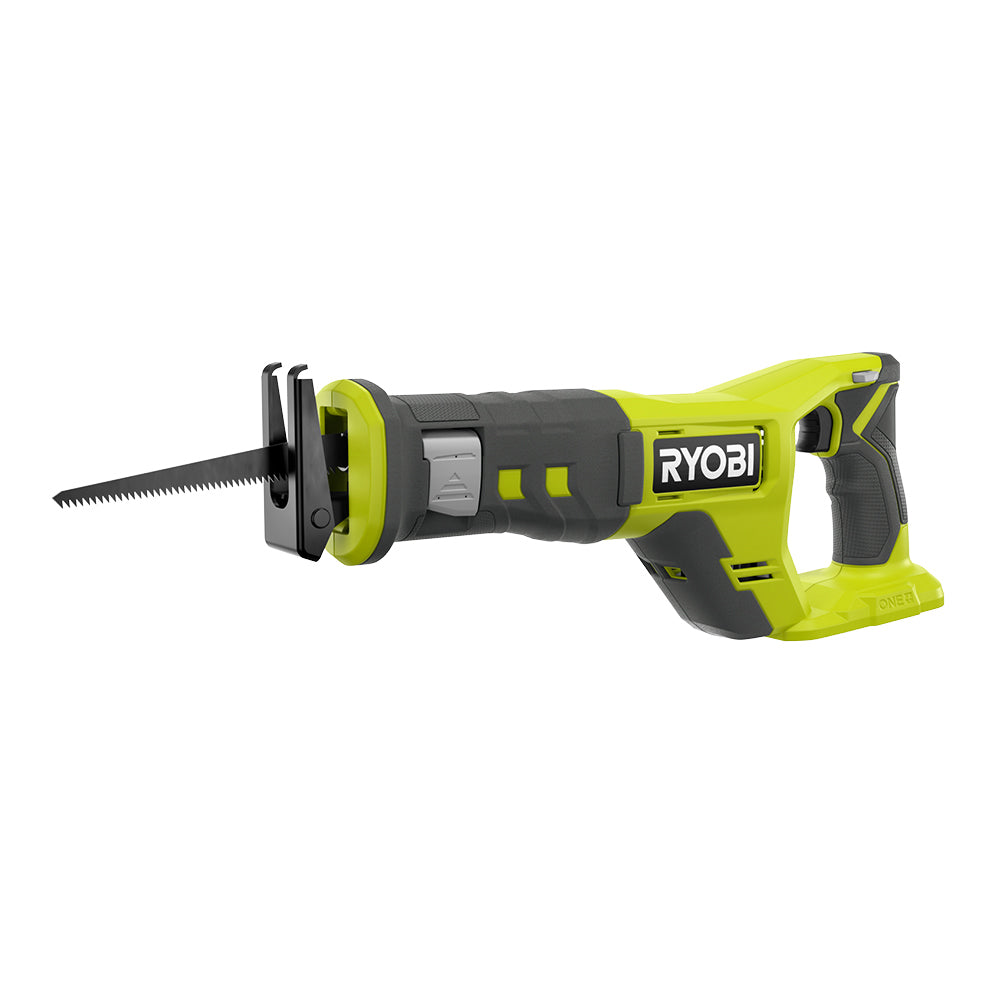
Explore this need in the finder →The PCL515B is the tool-only version of RYOBI’s conventional two-handed 18V ONE+ reciprocating saw. It is not the PCL510 one-handed pruning saw, and it is not the PCL515K1 battery-and-charger package. Those distinctions matter more than the similar-looking family names: this assessment applies to the exact PCL515B saw with no battery or charger in its box.
A familiar full-size format, without a published tool weight
RYOBI lists a one-inch stroke and a no-load range up to 3,400 strokes per minute, with a variable-speed trigger. That gives a useful sense of the machine’s reciprocating motion, not a measured cutting rate. Material, blade tooth pattern, support and feed technique still determine how a real cut proceeds. The maker describes an easy blade-release lever and a pivoting shoe; its operator manual says the shoe pivots in both directions. I do not treat that wording as proof of an adjustable-depth shoe, so the finder leaves its adjustable-shoe field unknown.
The two-hand grip and ordinary reciprocating-saw proportions make this the more natural choice among the current RYOBI compact-tool families for general rough cuts where a longer saw body can be braced. It is not a pruning-specific tool with a branch hook or a short one-hand body. The exact product page does not publish a bare-tool weight, so a buyer with a strict weight ceiling should not substitute a nearby RYOBI model’s figure or infer mass from the image.
Blade and shoe controls are practical, but not a cut-quality promise
The release lever avoids a separate hex key for blade swaps. Before changing a blade, the PCL515 manual directs the user to remove the battery pack; after insertion, confirm that the blade is locked in the clamp. The guide’s pivoting-shoe wording is useful for keeping the nose supported at different contact angles, but the manual does not establish indexed depth positions. Likewise, the listed 3,400 SPM ceiling and one-inch travel do not prove that the saw will cut faster than another tool in a particular pipe, nail-embedded board or branch.
RYOBI also promotes a “145 cuts per charge” result on its product page. That is a manufacturer claim tied to its own test context, not a guarantee for a buyer’s battery, blade or workpiece. The current U.S. page does not give the PCL515B’s bare-tool mass, and neither the page nor the reviewed manual documents selectable orbital action or a work light. Those unknowns remain unknown rather than becoming advantages by assumption.
Who should compare this with the kit
The exact PCL515B page labels it Tool Only and presents a separate 4Ah battery/charger option as another package. If you already own compatible RYOBI 18V ONE+ batteries and a charger, the B suffix avoids buying a duplicate power set. If you do not, compare it with the separate PCL515K1 kit and count all required components before choosing; their saw mechanisms are the same PCL515, but their purchase contents are not.
The PCL515’s one-inch stroke and 3,400 SPM figure also distinguish it from the brushless PBLRS01B, whose longer 1¼-inch stroke and lower 3,200 SPM maximum belong to a different saw design. Neither set of catalog numbers is a complete performance verdict, and neither exact PCL515 B/K1 page establishes bare-tool weight here. Buyers wanting a smaller one-handed branch saw should instead compare the separately assessed P2503 pruning tool and its explicitly limited use case.
Before buying or making the first cut
Confirm the exact PCL515B model and that the box is tool-only; separately budget a compatible ONE+ battery and charger if needed. The exact B page does not provide a sufficiently clear in-box blade count for this assessment, so verify the seller’s package list rather than relying on a blade pictured in a gallery image. Select a blade for the material and tooth pattern, check that it is seated, secure the workpiece, keep the shoe against the work, and follow the manual’s warnings about blade clearance and plunge cutting. A longer blade can whip during plunging, and RYOBI warns against plunging with a blade longer than six inches. This is source-based product analysis, not a hands-on test or a claim about an individual unit’s reliability.
Key specifications
Key details at a glance
| Saw format | Full-size, two-handed saw |
|---|---|
| Power source | Cordless battery |
| Battery platform | RYOBI 18V ONE+ |
| Stroke length | 1 in |
| No-load stroke rate | 3400 SPM |
| Tool-free blade change | Yes |
| Battery in this package | No |
| Charger in this package | No |
Use the exact model’s instructions for operating limits, supplied equipment and version differences.
Sources for this review
Sources for this assessment

Match the saw to your actual work.
Use the finder to compare verified requirements, then read each exact model assessment before deciding.