
Your needs, this model
Does it fit your priorities?
How does R30022 differ from the one-handed RIDGID R3031?
R30022 is the compact-bodied two-handed format: its exact page lists 10 A, a 3/4-inch stroke, a 12-foot cord, a variable-speed trigger and an adjustable pivoting shoe. R3031 is the one-handed barrel-grip saw with a 6 A motor, 1/2-inch stroke and 8-foot cord. These catalog differences do not establish comparative cut speed or endurance.
Explore this need in the finder →Does R30022 document an adjustable shoe and tool-free clamp?
Yes. The exact current R30022 U.S. product page lists an adjustable/pivoting shoe and tool-free blade change, as well as selectable orbital action. It does not publish a fixed number of shoe positions or the clamp's operating steps; inspect the exact R30022 instructions and isolate the tool before a blade change.
Explore this need in the finder →Can I count R30022 under an 8 lb bare-tool ceiling?
Not on the evidence reviewed. The current exact product page lists 8.2 lb Product Weight, while the older official R30022 page lists 7 lb; neither supplies a bare-tool basis. The 10 A specification does not convert those two unlabeled weights into a strict bare-tool measurement.
Explore this need in the finder →Compact-bodied, but not the one-handed R3031 format
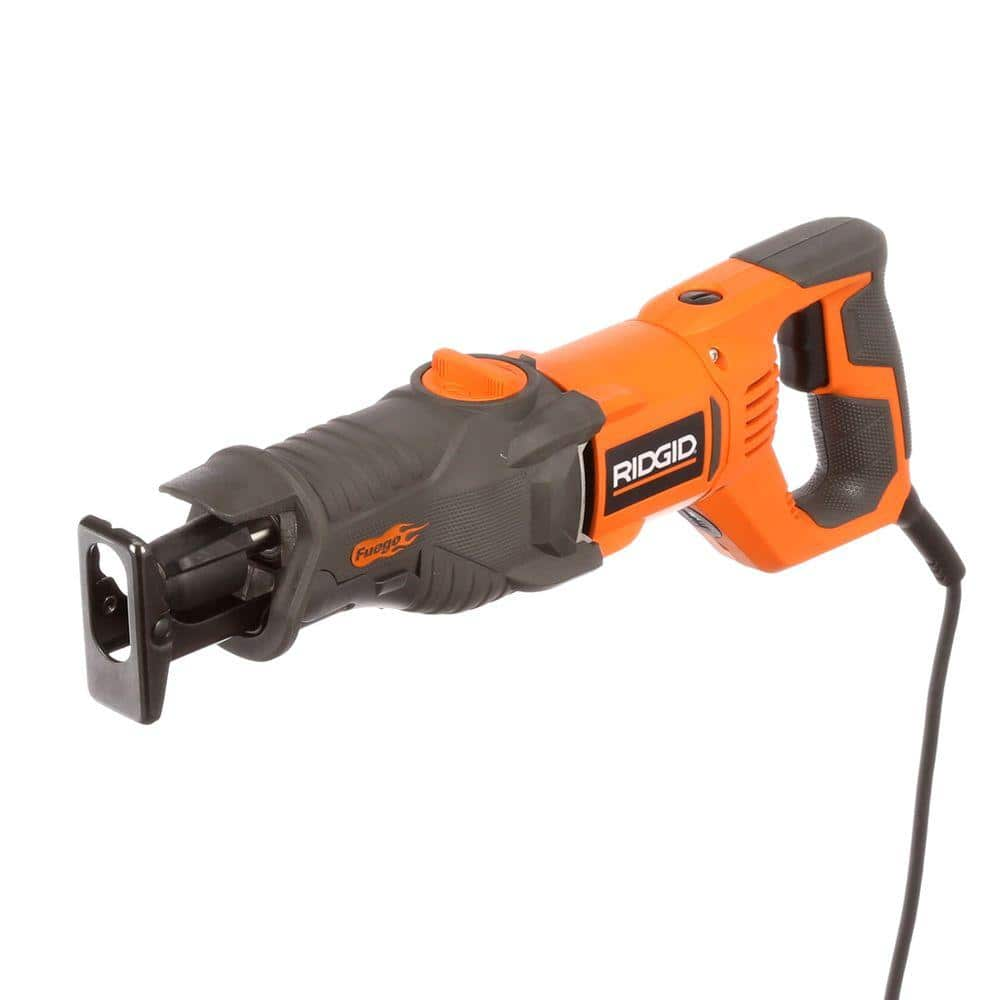
RIDGID's current U.S. page identifies the R30022 as a Fuego 10-amp corded orbital reciprocating saw. A separate RIDGID U.S. page calls this exact model a “Compact Orbital Reciprocating Saw.” The product image, however, shows the familiar front grip and rear D-handle arrangement. For the finder, I treat it as a compact-bodied two-handed design—not the one-handed barrel-grip format used by RIDGID's R3031. “Compact” in the marketing name should not be read as proof that the tool has the same handling arrangement as a one-handed saw.
RIDGID's exact R30022 product page lists a 10 A motor, three-quarter-inch stroke, 3,500 strokes per minute, 12-foot cord, variable-speed trigger, tool-free blade change and adjustable/pivoting shoe. A separate U.S. RIDGID page for R30022 describes 120 V AC, 10 A power and 0–3,500 no-load strokes per minute. These are manufacturer specifications, not an independent comparison test. They do not tell us how quickly this saw will cut a given material, how long it will last or how much force a cut requires.
Orbital mode and support points
The exact current page calls out on/off orbital action and describes the saw's adjustable, pivoting shoe as a way to maintain cutting stability. It also lists tool-free blade change and a variable-speed two-finger trigger. Those features make R30022 a sensible comparison when the buyer wants a conventional two-handle body with selectable motion and a movable shoe. The page does not state a number of shoe positions or give the blade clamp's precise procedure.
RIDGID's official support search for “R30022” returned an operator's manual whose cover says “R3002,” not R30022. That manual documents a 10 A, 120 V, three-quarter-inch-stroke family saw and includes orbital-mode and blade guidance. Because it does not identify the exact R30022 SKU on its cover, I keep that manual as a source bridge rather than silently assigning every R3002 instruction to R30022. In particular, verify the exact instructions supplied with the saw before applying the R3002 manual's metal-blade, selector, cord, or clamp procedures to a specific R30022 offer. A manual-search result that is close in number is not a substitute for checking the model printed on the tool and its manual.
Plan for a cord, not a battery platform
The R30022 is mains powered. Its 12-foot cord offers a different reach constraint from the R3031's listed 8-foot cord, but neither length removes the need to keep the cord away from the blade and the work area. The reviewed sources do not identify any battery platform or battery/charger package, and the saw does not need those cordless components for its corded operating plan. Check the outlet, extension-cord guidance and working clearance before treating corded power as a convenience.
The source pages discuss wood and metal cutting, and RIDGID says the orbital mechanism is intended for faster cutting action. But the exact current product page does not spell out a complete material-specific procedure or the R30022 manual's exact blade limitations. Do not infer that any orbital setting or blade is suitable for metal simply because both appear in the catalog. Use the model-specific manual supplied with the exact saw, follow its instructions for the selected blade, and secure the workpiece before cutting.
Package contents need a closer check
The current exact page's “Includes” line identifies the R30022 saw, while a separate generic “Included” field says blades and tool bag without a count or model. An older official RIDGID R30022 page lists an R3002 saw, five reciprocating-saw blades, contractor bag and operator's manual. These records do not give a clean, consistent item list for the exact current package. I do not claim that five blades, a bag or a particular manual are in every offer. Before ordering, check the package suffix and the seller's written box contents, then confirm that the manual actually matches R30022.
The product-weight fields also conflict: the current exact detail page says 8.2 lb Product Weight; the older RIDGID page says 7 lb Weight. Neither source defines whether that includes a blade, cord or other components, so neither can be treated as a bare-tool weight. The matcher leaves a strict bare-tool ceiling unconfirmed. If lifting weight or overhead use is a deciding factor, ask for an exact, comparable measurement rather than selecting the lower number.
Comparison with the R3031
The same-brand R3031 is the more distinct format: a one-handed barrel grip, 6 A motor, half-inch stroke and 8-foot cord, with a model-specific manual. R30022 is a compact-bodied two-handed configuration rated 10 A with a three-quarter-inch stroke and 12-foot cord, plus a documented adjustable/pivoting shoe. Both pages list orbital capability and tool-free blade change, but the R3031 manual's detailed warnings are specific to R3031. Do not transfer its pruning prohibition or orbital/blade procedure to R30022 unless the exact R30022 instructions confirm them.
In practical terms, choose between these configurations only after matching the grip style, mains access, cord route, blade and package you will actually use. This is a research-based assessment of RIDGID's documents, not a hands-on review: no cut-speed, fatigue, vibration, service-life or noise test was performed, and no cut-capacity figure was established. The official page's feature list can help identify a candidate; the exact tool and its own operating manual must decide whether it fits the job.
Key specifications
Key details at a glance
| Saw format | Compact-bodied, two-handed saw |
|---|---|
| Power source | Corded mains power |
| Motor current | 10 A |
| Stroke length | 0.75 in |
| No-load stroke rate | 3500 SPM |
| Tool-free blade change | Yes |
| Selectable orbital action | Yes |
| Battery in this package | No |
| Charger in this package | No |
Use the exact model’s instructions for operating limits, supplied equipment and version differences.
Sources for this review
Sources for this assessment
- RIDGID U.S. Cutting collection filtered to Reciprocating Saws, page 1
- Exact RIDGID U.S. R30022 Fuego product page
- RIDGID official manual search for R30022
- RIDGID R3002 reciprocating saw operator's manual returned by the R30022 support search
- RIDGID U.S. Compact Orbital Reciprocating Saw page identifying R30022
- RIDGID manufacturer recall notices reviewed for the R8647 group
- RIDGID R30022 exact U.S. product-page image

Match the saw to your actual work.
Use the finder to compare verified requirements, then read each exact model assessment before deciding.