
Your needs, this model
Does it fit your priorities?
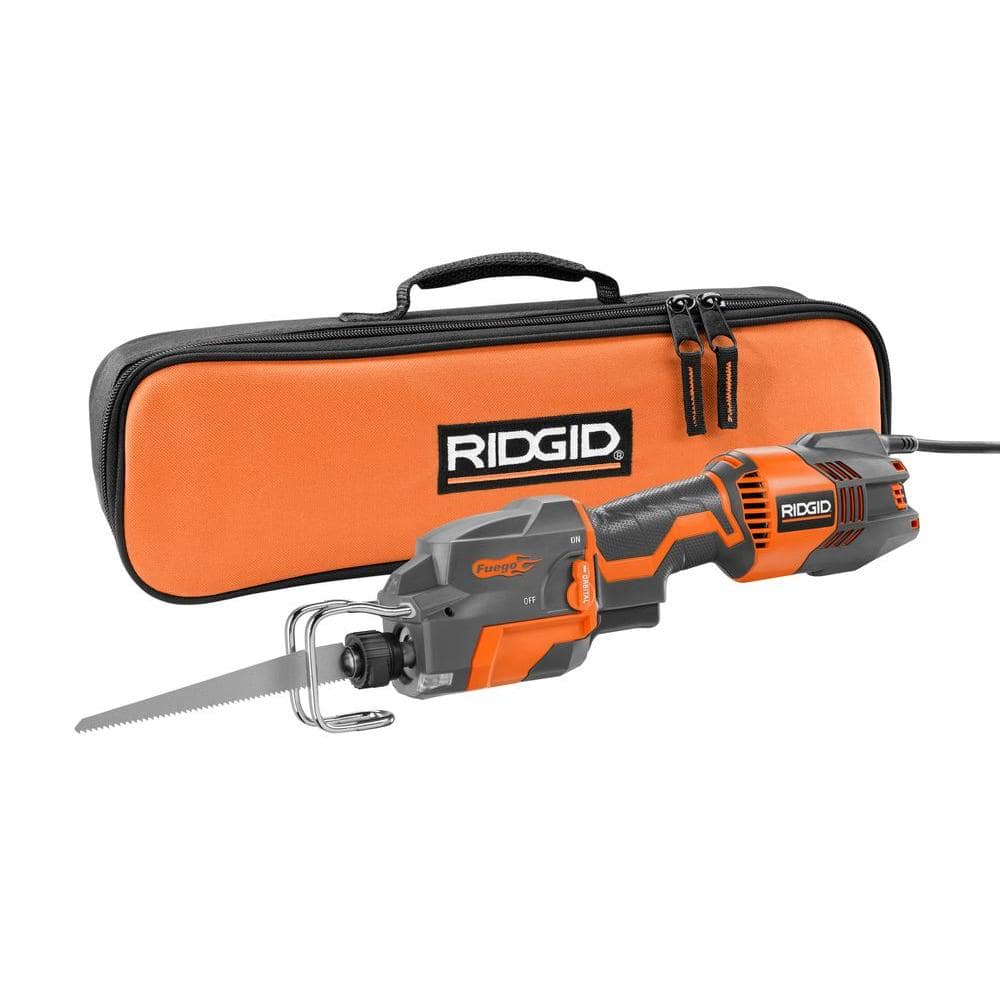
What does RIDGID list in the R3031 box?
The exact R3031 operator manual's packing list names the saw, one blade, a tool bag and the manual. RIDGID's current product page summarizes the package less precisely, so compare the physical offer and its exact R3031 suffix rather than treating a gallery image as a complete box list.
Explore this need in the finder →What limits matter for the R3031's orbital and blade choices?
The exact R3031 manual says to use linear motion for smooth or metal cuts and orbital action for faster wood cutting. It says not to use orbital mode with a metal-cutting blade, to stop the motor before changing the selector, and not to use this saw for pruning or with a pruning blade. Unplug it before opening the blade clamp and secure the workpiece.
Explore this need in the finder →Can the R3031 be counted under a 5 lb bare-tool limit?
Not from the figures reviewed. The exact R3031 page labels its number 5 lb Product Weight, while the exact manual says 4.4 lb Net Weight; neither defines the weight basis. The strict matcher therefore leaves bare-tool weight unknown, so a hard 5 lb ceiling cannot be certified from these fields.
Explore this need in the finder →A corded one-hand format, not a pruning-saw claim
The R3031 is the Thru Cool, 6-amp, corded one-handed reciprocating saw in RIDGID's U.S. catalog. Its exact product page identifies model R3031 and a one-handed design; the model-specific operator's manual calls the barrel-style grip a one-handed grip. That is a real distinction from the conventional rear D-handle/front-grip layout of the larger corded R30022. It is a format description, not permission to hold unstable stock in one hand: RIDGID tells the operator to secure the workpiece and keep the saw under control.
The reviewed sources identify the R3031 as a corded 120 V AC, 60 Hz tool rated at 6 A. RIDGID lists an 8-foot cord. That makes the work area, outlet position and a safe cable route part of the setup; it is not a cordless backup for a location without suitable mains power. The manual calls for outdoor-rated extension cords when working outdoors, says to inspect cords, and warns that an undersized extension cord can cause voltage drop and overheating. Keep the cord outside the cutting path and never use a damaged one.
Shorter stroke and selectable motion
The exact R3031 manual specifies a half-inch stroke, variable-speed switch trigger and no-load speed of 0–3,500 strokes per minute. Those figures describe the mechanism and the manufacturer's no-load rating; they are not a measured cut rate or a guarantee about a particular blade, material or workpiece. The trigger varies speed with pressure. That offers a way to moderate starts, but the documents do not quantify how quickly or accurately a user can control a cut.
A selector switches between linear and orbital motion. The manual says linear motion is for smoother cuts or metal, while orbital action is for faster wood cutting. It specifically warns not to use orbital mode with a metal-cutting blade and to stop the motor before moving the selector. It also says the R3031 should not be used for pruning or with a pruning blade. That is an important boundary for a one-handed saw: do not treat the grip shape as a substitute for a model-approved pruning tool.
Blade choice still matters. RIDGID's manual gives general tooth-count guidance—about 10 teeth per inch for wood, 14 for plastics and soft metals, and 18 for hard metals—and describes cutting wood, plastic, drywall and several metals among the saw's applications. Match the blade to the material and follow its own limits; this review does not establish a maximum cut depth or prove that every material in those broad categories is suitable in every setup.
Blade changes and the unproven shoe details
The R3031 manual describes a clamp that does not need a blade wrench. Its sequence is still a safety procedure: unplug the saw, open and hold the clamp, seat the blade fully, then release the clamp. “Tool-free” removes a separate wrench, not the need to isolate power or verify the blade is secure. The reviewed R3031 manual does not establish an adjustable or pivoting shoe, so I do not count that feature for a hard shoe requirement. Nor did the exact sources give a fixed number of shoe positions, overall dimensions or a bare-tool length.
The manual lists built-in LED worklights that turn on with the trigger. That can be useful in a dim area, but a light does not make concealed wiring, plumbing or the blade path safe. RIDGID's warnings about hidden utilities and stable support remain relevant, especially for close-in work.
Package list and weight are not as clean as the headline
The exact product page names the R3031 saw in its “Includes” line and has a general included-items field for blades and a tool bag. The model-specific manual's packing list is clearer: saw, one saw blade, tool bag and operator's manual. Compare the offer's actual R3031 suffix and box list before buying; a retailer photo alone is not proof that a replacement or used package still has each listed item. This is a corded tool, so no battery or charger is needed or included.
Weight is unresolved for a hard lifting ceiling. The exact page labels 5 lb as “Product Weight,” while the exact R3031 manual states 4.4 lb “Net Weight.” Neither source defines whether the cord, blade, bag or other parts are included in its figure. I therefore do not convert either value into a bare-tool weight. If that boundary matters to overhead or sustained work, seek a directly stated, comparable weight for the exact configuration rather than relying on the lower number.
How it differs from R30022
Both are corded RIDGID saws with selectable orbital action and a tool-free blade change, but their format and published specifications differ. R3031 is the one-handed barrel-grip 6 A model with a half-inch stroke and an 8-foot cord. R30022 is a compact-bodied two-handed arrangement with a front grip and rear handle; its exact current page lists 10 A, a three-quarter-inch stroke, a 12-foot cord and an adjustable pivoting shoe. Those differences can guide a shortlist when you already know which grip, reach or shoe behavior you need. They do not prove that R30022 cuts faster or that R3031 is easier to control for a particular user—the category has no independent cutting test for these models.
Neither assessment is based on hands-on use. Treat the manufacturer's operating instructions, compatible blade, secure work support, clear cord route and exact package as the decision-critical checks. The R3031's own manual limits pruning use, requires unplugging for blade changes, and reserves orbital action for the permitted blade/material combinations; the exact R30022 instructions should be checked separately rather than inferred from the R3031.
Key specifications
Key details at a glance
| Saw format | Compact, one-handed saw |
|---|---|
| Power source | Corded mains power |
| Motor current | 6 A |
| Stroke length | 0.5 in |
| No-load stroke rate | 3500 SPM |
| Tool-free blade change | Yes |
| Selectable orbital action | Yes |
| Work light | Yes |
| Battery in this package | No |
| Charger in this package | No |
Use the exact model’s instructions for operating limits, supplied equipment and version differences.
Sources for this review
Sources for this assessment
- RIDGID U.S. Cutting collection filtered to Reciprocating Saws, page 1
- Exact RIDGID U.S. R3031 Thru Cool 6 Amp corded one-handed saw page
- RIDGID official manual search for R3031
- RIDGID R3031 one-handed reciprocating saw operator's manual
- RIDGID manufacturer recall notices reviewed for the R8647 group
- RIDGID R3031 exact U.S. product-page image

Match the saw to your actual work.
Use the finder to compare verified requirements, then read each exact model assessment before deciding.