
Your needs, this model
Does it fit your priorities?
Does the RJ03R1 kit actually include the power parts to start with?
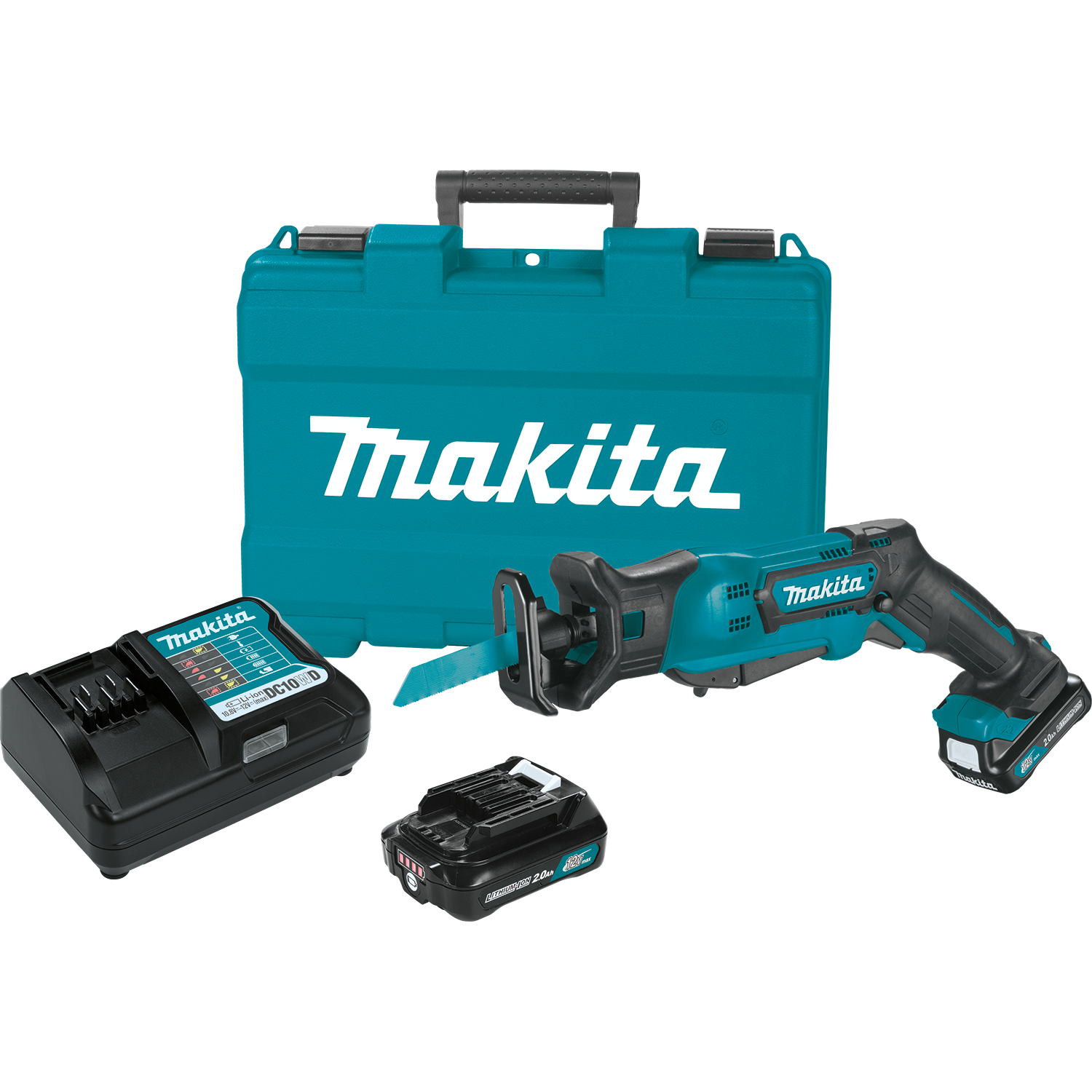
Makita's exact U.S. RJ03R1 list names two BL1021B 2.0Ah CXT batteries and a DC10WD charger, along with the RJ03Z saw body, case and listed blade packages. That makes this a distinct CXT kit, not the RJ03Z tool-only configuration. Check the exact suffix and the seller's box list before relying on a historical page for a present offer.
Explore this need in the finder →Will RJ03R1 work with Makita 18V LXT batteries?
No. The RJ03R1 is a 12V max CXT kit. Makita distinguishes CXT slide-style packs from 18V LXT; the RJ03 manual says battery and charger compatibility is model-specific. Do not treat shared brand or a nominal voltage label as cross-platform compatibility. The finder therefore does not count this saw as an 18V LXT match.
Explore this need in the finder →Does the RJ03 meet a strict 3 lb bare-tool ceiling?
Makita's RJ03 specifications report 2.9 lb with the BL1016 or BL1021B battery and 3.3 lb with the larger BL1041B. The manual's weight table explicitly includes the battery cartridge; no bare-tool mass is supplied. The 2.9 lb kit figure cannot establish that the saw body itself is below a 3 lb bare-tool limit.
Explore this need in the finder →The exact kit matters more than the shared saw name
Makita's U.S. RJ03R1 listing identifies a 12V max CXT reciprocating-saw kit and names the saw body inside it as RJ03Z. That is a useful package bridge, not permission to merge the two retail configurations. The RJ03R1 page lists two BL1021B 2.0Ah slide-style batteries, a DC10WD charger, a case, one 4-inch 18-TPI metal blade and a 5-pack of 4-inch 6-TPI wood blades. The RJ03Z page, by contrast, is marked discontinued and says tool only. If a current offer uses either suffix, check the actual box inventory and model plate rather than relying on a family photo or this historical manufacturer record.
The kit is therefore the more complete starting point for a buyer who lacks the CXT power parts, but it is not a universal battery-system purchase. Makita's page and manual identify the 12V max CXT slide-pack family; the manual explicitly cautions that the tool is not compatible with the company's 12V pod-style tools, batteries and chargers. A Makita 18V LXT owner should not assume that a shared brand name makes a pack or charger fit. Confirm battery and charger part numbers in the exact instruction manual.
Compact body, but not a one-hand claim
Makita presents the RJ03 as an ultra-compact saw intended for work where a smaller body may be helpful. The kit page describes a dual-position on/off arrangement with a paddle lever or trigger. Its separate forward body area and rear grip make the physical layout different from the maker's explicitly one-handed products. Neither the exact RJ03R1 page nor the RJ03 manual labels this a one-hand saw, so this assessment classifies it as compact-bodied but two-handed. That is an editorial reading of the source and layout, not a hands-on handling test.
The page's published numbers are a 1/2-inch stroke and a variable-trigger range of 0–3,300 strokes per minute. Makita also lists maximum capacities of 2 inches for pipe and 2 inches for wood. Those are manufacturer values, not a comparative cut-rate result or a promise for every blade, material, orientation or worn pack. The saw's short stroke and compact CXT system tell you what the maker specifies; they do not establish that it will outcut a longer-stroke two-handed model on demolition stock.
There is no selectable orbital mode listed. That separates the RJ03 from saws whose manuals document an orbital selector. The manual's trigger control is not a variable-speed dial: speed rises as the switch lever or trigger is pressed. The dual-position switch changes which control starts the motor; it does not add a second battery arrangement or an orbital setting.
Use the shoe and blade as a system
The RJ03 manual describes repositioning the shoe by loosening its bolt with the supplied hex wrench, sliding it and tightening the bolt. It explains that this can expose a sharper unused part of a blade edge. That is a sliding shoe adjustment, not evidence of a pivoting shoe, so the finder does not count the model for a requirement specifically asking for an adjustable pivot shoe. A tool-free blade clamp is documented, but that convenience does not remove the need to isolate the battery before service.
Makita's operating directions stress keeping the shoe firmly against supported material. The manual warns that holding the shoe away can produce strong vibration or twisting and may break a blade; it calls for securing the work, checking clearance behind the cut and bringing the blade into light contact before starting. For metal, the maker directs the user to use appropriate cutting oil and gloves against hot chips. The kit's metal and wood blade listings are useful package facts, but they are not a substitute for checking blade compatibility, tooth pitch, material thickness and the safe blade path for a particular job.
Weight and access require careful reading
The 2.9 lb figure is not a bare-tool measurement: Makita gives it with a BL1016 or BL1021B battery. The RJ03 manual reports 3.3 lb with the larger BL1041B and lists a corresponding 15-1/4-inch overall length, versus 14-3/4 inches with the smaller battery. The kit supplies two of the smaller 2.0Ah packs, but the machine's bare mass is still unknown. That is why this page will not treat the 2.9 lb number as proof that the saw meets a hard bare-tool ceiling. Buyers who need a true carry weight should include the battery, charger and the rest of the kit, none of which can be calculated from the tool-only specification.
For tight spaces, compare the actual clearance for the saw body, battery heel, shoe and blade—not only the word “compact.” A short body does not remove the need to support a workpiece or keep a hand clear of the moving blade. The exact instructions remain the authority for operation and setup.
Who should compare it
RJ03R1 is worth comparing when the buyer wants a compact-bodied Makita saw and the exact documented package includes the two CXT batteries and charger needed to start with. It is a poor match for someone who needs 18V LXT compatibility, a verified bare-tool weight, a documented pivoting shoe or orbital control. The discontinued RJ03Z tool-only page is a separate configuration, even though its saw body appears in this kit; it is not evidence that an RJ03R1 is a present-day replacement or that an old RJ03Z offer has the kit's accessories.
This assessment is based on Makita's exact U.S. product page, its RJ03 family instruction manual and the model flyer. No independent cutting, runtime or durability test was performed, and no ownership or current seller inventory is claimed. Confirm the precise suffix, battery family, box contents, seller condition, and available return terms before deciding.
Key specifications
Key details at a glance
| Saw format | Compact-bodied, two-handed saw |
|---|---|
| Power source | Cordless battery |
| Battery platform | Makita 12V max CXT |
| Stroke length | 0.5 in |
| No-load stroke rate | 3300 SPM |
| Tool-free blade change | Yes |
| Selectable orbital action | No |
| Work light | Yes |
| Weight with battery | 2.9 lb |
| Overall length | 14.75 in |
| Battery in this package | Yes |
| Charger in this package | Yes |
Use the exact model’s instructions for operating limits, supplied equipment and version differences.
Sources for this review
Sources for this assessment
Match the saw to your actual work.
Use the finder to compare verified requirements, then read each exact model assessment before deciding.