
Your needs, this model
Does it fit your priorities?
What is the RJ03Z—and is it the same package as RJ03R1?
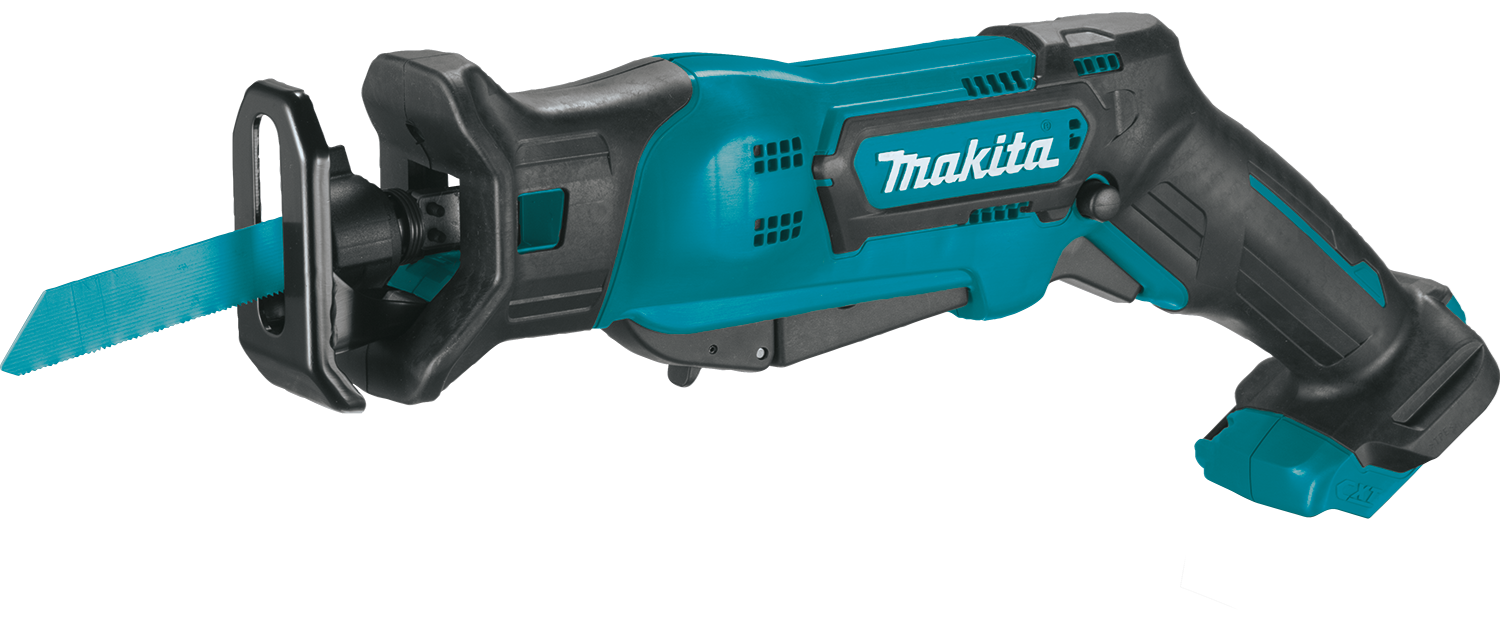
The exact U.S. RJ03Z page marks that SKU discontinued and describes it as the 12V max CXT saw, tool only. The separate RJ03R1 kit page names one RJ03Z saw body plus two 2.0Ah batteries, charger, case and blade packages. Do not transfer the kit's contents to a resale RJ03Z box or assume the kit is a replacement or currently available.
Explore this need in the finder →Does the RJ03Z match a Makita 18V LXT platform requirement?
No. RJ03Z is a 12V max CXT configuration, not 18V LXT. The maker's exact model page links the RJ03 family manual, and that manual lists the CXT battery cartridges. The 18V LXT finder choice is intentionally not a match; check the battery and charger model numbers printed on the offer and tool before buying.
Explore this need in the finder →Does the RJ03Z satisfy a 4 lb bare-tool weight ceiling?
The RJ03 manual lists 2.9 lb with BL1016/BL1021B or 3.3 lb with BL1041B and explicitly says the weight includes the battery cartridge. That cannot prove the bare saw weighs 4 lb or less, so the strict bare-tool filter leaves it out until an exact tool-only weight is established.
Explore this need in the finder →Read the suffix as a package boundary
Makita's exact U.S. RJ03Z page labels this model “12V max CXT Recipro Saw, Tool Only” and marks it discontinued. That is the identity of this configuration, not a promise about today's stock or the contents of any used listing. The separate RJ03R1 product page names one RJ03Z saw body as part of its kit, but that kit's batteries, charger, case and blade packages cannot be transferred to a standalone RJ03Z offer. The RJ03Z page does not give a complete included-accessory list, so its pictured blade is not enough to claim that a blade—or any other accessory—is in the box.
For a specific offer, ask for a clear model-plate photo and a written inventory. “Tool only” distinguishes it from a battery-and-charger kit, but does not tell us what every reseller has bundled or whether the used battery ecosystem is healthy. The current manufacturer's page is an identification and manual bridge. It is not a dealer listing, a present-availability report or evidence of the condition of a particular unit.
What the shared RJ03 manual establishes
The model-linked RJ03 instruction manual provides the saw-body specifications used here: a 1/2-inch stroke, 0–3,300 strokes per minute and listed maximum capacities of 2 inches for pipe and 2 inches for wood. It describes the battery system as DC 10.8V to 12V max CXT. The same page-linked family manual is also linked from the RJ03R1 page, which specifies that kit's saw as RJ03Z; this is why the shared body features can be bridged while the package remains distinct.
Makita's page and manual describe a compact saw, and the manual diagrams both a rear trigger and a forward switch lever/guide area. The reviewed manufacturer material does not label RJ03Z one-handed. I therefore classify it as compact-bodied and two-handed, rather than assume that “compact” means a one-hand tool. That is a conservative editorial classification from the primary material, not a handling test. Its short 14-3/4-inch length applies with BL1016 or BL1021B batteries; the RJ03 manual lists 15-1/4 inches with BL1041B. Battery choice changes the configuration, so an older offer should be checked against its exact power source.
The exact RJ03R1 kit page documents the shared saw's tool-less clamp, work light and lack of orbital settings; the page's specification section names no orbital setting, and the manual covers the RJ03 body operation. The manual describes a dual-position switch and variable speed by trigger pressure. It also permits the shoe to slide after loosening a hex bolt, to use a fresher portion of the blade edge. This is not enough to establish a pivoting adjustable shoe, so the finder leaves that essential capability unknown rather than treating a slide adjustment as a pivot.
Do not turn battery-on weight into bare-tool weight
The RJ03 manual gives 2.9 lb with BL1016 or BL1021B and 3.3 lb with BL1041B. Its footnote says that the quoted weight includes the battery cartridge. Makita does not publish a bare-tool mass for RJ03Z in the reviewed sources. A buyer applying a strict maximum bare-tool weight should therefore not count this saw as passing merely because one battery-installed value is below that limit. A tool-only package can still be heavier in use once a compatible battery is attached.
The page and manual point to Makita's 12V max CXT slide-style system; this is not the 18V LXT platform, and Makita warns against mixing CXT with pod-style 12V components. Verify the battery and charger model numbers in the instructions for the exact tool. The finder consequently does not return RJ03Z for an 18V LXT requirement. A platform adapter or an unverified seller claim is not a substitute for manufacturer compatibility documentation.
Blade, shoe contact and work support
Makita documents tool-less blade removal and installation, but the manual still calls for the battery to be removed before assembly work, for debris to be cleared from the clamp, and for the blade to be inserted deeply and checked against pulling free. It warns that a jigsaw blade cannot be used with RJ03. Those instructions are more consequential than the convenience label: a clamp that takes no wrench still needs a correctly seated compatible reciprocal blade.
The manual instructs the user to press the shoe firmly against the workpiece, secure and support the material, check what lies behind the cut and avoid letting the tool bounce. It describes light blade contact and beginning with slower trigger pressure before increasing speed. Metal cutting calls for suitable coolant and protection from hot chips. These are maker directions for setup, not a claim that a particular blade will cut a material at a given rate.
When the earlier tool-only record is useful
The RJ03Z assessment is useful when identifying a discontinued CXT tool-only suffix, comparing the compact RJ03 body with larger cordless saw formats, or checking a specific used or remaining-stock offer. It is not a current recommendation for someone who needs a documented ready-to-run package, a known bare-tool mass, a confirmed pivot shoe or a selectable orbital mode. The RJ03R1 kit is the separately documented 2.0Ah package; its exact contents do not redefine this Z configuration.
This review relies on Makita's exact U.S. RJ03Z page, the separately identified RJ03R1 kit page, Makita's RJ03 family manual and its RJ03R1 flyer. No hands-on use, ownership, cutting test, runtime estimate, condition inspection or market-price claim is made. Confirm the exact suffix, any separately supplied battery, charger and blades, seller condition, and return terms before deciding; the manufacturer's discontinued label does not tell you whether a particular offer exists or is suitable.
Key specifications
Key details at a glance
| Saw format | Compact-bodied, two-handed saw |
|---|---|
| Power source | Cordless battery |
| Battery platform | Makita 12V max CXT |
| Stroke length | 0.5 in |
| No-load stroke rate | 3300 SPM |
| Tool-free blade change | Yes |
| Selectable orbital action | No |
| Work light | Yes |
| Weight with battery | 2.9 lb |
| Overall length | 14.75 in |
| Battery in this package | No |
| Charger in this package | No |
Use the exact model’s instructions for operating limits, supplied equipment and version differences.
Sources for this review
Sources for this assessment
Match the saw to your actual work.
Use the finder to compare verified requirements, then read each exact model assessment before deciding.