
Your needs, this model
Does it fit your priorities?
Is the SPT44A-00 cordless or battery-ready?
No. This exact configuration is a corded mains saw. SKIL lists an 8 ft power cord and 13A input, so the job needs an appropriate mains outlet and a safe cord path. The -00 package list says 13 Amp Reciprocating Saw only; it does not list a battery, charger or blade. Do not confuse it with cordless SKIL models that share the reciprocating-saw category.
Explore this need in the finder →Can the SPT44A-00 take a blade without a tool, and what does its footplate adjust?
The exact product page calls the clamp tool-less, and the SPT44A manual shows a spring-loaded collar that opens for blade insertion and removal. Its diagram calls the support a pivoting footplate, so it can angle to meet the work. The manual does not document the separate sliding projection positions found on SPT44-10; unplug the cord before changing a blade or adjusting the saw, and check that the blade seats and projects beyond the footplate.
Explore this need in the finder →Is the 13A SPT44A-00 the same operating profile as SKIL's 15A SPT44-10?
No. The 13A SPT44A-00 page lists a 1 in stroke, a 0–2,800 no-load rating, variable trigger, and a 9 lb tool weight; it does not document a selectable orbital mode or a six-position speed dial. The SPT44-10 page/manual describe a 15A saw with a 1-1/4 in stroke, orbital selector, speed dial and a 11.3 lb tool weight. These published differences do not establish a measured cutting-speed ranking.
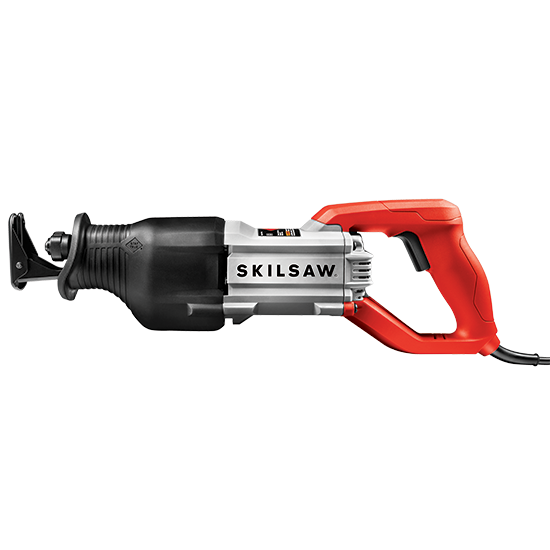
Explore this need in the finder →The SPT44A-00 is SKIL’s 13A corded reciprocating saw, a full-size two-hand design with an eight-foot power cord. This is a source-based assessment of the exact -00 product-page configuration and the manual linked from it; it is not a hands-on review. Its choice is less about a battery platform and more about whether a mains outlet, cord routing and the saw’s heavier body fit the job.
What separates this 13A model
SKIL lists a 13A input, one-inch stroke, 0–2,800 no-load speed, 9 lb tool weight, and a body measuring 19.7 inches long by 3.6 inches wide and 8 inches high. The manufacturer’s specification table labels the speed unit “r.p.m.”; the linked manual talks about adjusting the blade’s stroke rate but does not supply a corresponding SPM value. This review retains the page’s wording rather than silently relabelling its figure as strokes per minute. Neither figure is a field cutting-rate result.
The selected product page documents a variable-speed trigger and tool-less blade clamp. In the linked SPT44A manual, the blade is secured by twisting a spring-loaded collar, inserting the blade to the shoulder and checking that it is held. That is a genuine tool-free change mechanism, but it is not permission to change a hot blade or leave the saw connected: the manual says to unplug before changing a blade or making adjustments. It also emphasizes that the blade must extend beyond the footplate throughout the stroke.
Footplate support without overclaiming adjustment
The manual’s tool diagram identifies a pivoting footplate, so the support can angle against the work surface. That is not the same feature as the sliding, multi-position shoe on SPT44-10 or the shoe that slides along an effective stroke adjustment track on some cordless models. I did not find documentation for an SPT44A extension-position count or a selectable orbital control in its exact product page or linked manual. A buyer for whom either function is essential should treat it as unconfirmed here, rather than infer it from a photo or another saw’s manual.
The exact package list names a 13 Amp Reciprocating Saw and does not list a battery, charger or blade. The saw is therefore not a kit that can be deployed without a suitable mains source, and its eight-foot cord is a planning constraint. A job may require a correctly rated extension cord, but its selection depends on length and conditions; follow the saw’s manual and the electrical source requirements rather than improvising. The page’s product image shows the corded saw body, not extra equipment.
How to think about the 13A/15A comparison
The same SKIL family includes the SPT44-10, a separate 15A configuration with a longer stroke, higher listed no-load number, orbital selector and speed dial. Those are real published differences, but they are not a tested ranking. SPT44A-00 is shorter and lighter on the manufacturer’s listed dimensions and weight: 19.7 inches and 9 lb versus 27.7 inches and 11.3 lb for SPT44-10. That size contrast is relevant if storage, reach or prolonged handling are part of the decision. Neither figure alone predicts control in a particular cut.
SKIL markets its BUZZKILL feature as suppressing vibration, including a stated comparison with competitors. No controlled comparison was performed for this assessment, so the claim should not be read as measured proof of reduced operator exposure or greater comfort in a specific material. The useful documented controls here are the trigger and pivoting footplate. The page does not document a separate speed dial or orbital selector on this -00 model; those functions should not be imported from its 15A sibling.
When the SPT44A-00 fits
It is a candidate for a buyer who wants corded mains operation, a conventional two-hand grip, a tool-free blade collar and no need for a battery-and-charger kit. The page-listed 13A input and one-inch stroke describe the model, not its productivity in every material. A working setup should include a blade matched to the material, a supported workpiece, an accessible disconnect and a cord path outside the cut and trip areas. The manual explains cutting pressure and warns against using the saw without keeping the blade correctly supported through the footplate.
What this evidence does not answer
The reviewed sources do not establish its current retail availability, a blade included in the -00 box, adjustable shoe projection positions, a specific SPM rating, selectable orbital action, a lock-on switch or measured vibration, runtime, cut speed or service life. The manual cover identifies SPT44A and the manufacturer product page identifies SPT44A-00; verify the suffix on any listing. Before deciding, check the work area’s supply and cord needs, blade requirements, body length and carry weight, and use the page-linked manual for mounting, cutting and maintenance. No product was owned, measured or tested for this review.
Key specifications
Key details at a glance
| Saw format | Full-size, two-handed saw |
|---|---|
| Power source | Corded mains power |
| Motor current | 13 A |
| Stroke length | 1 in |
| Tool-free blade change | Yes |
| Bare-tool weight | 9 lb |
| Overall length | 19.7 in |
| Battery in this package | No |
| Charger in this package | No |
Use the exact model’s instructions for operating limits, supplied equipment and version differences.
Sources for this review
Sources for this assessment

Match the saw to your actual work.
Use the finder to compare verified requirements, then read each exact model assessment before deciding.