
Your needs, this model
Does it fit your priorities?
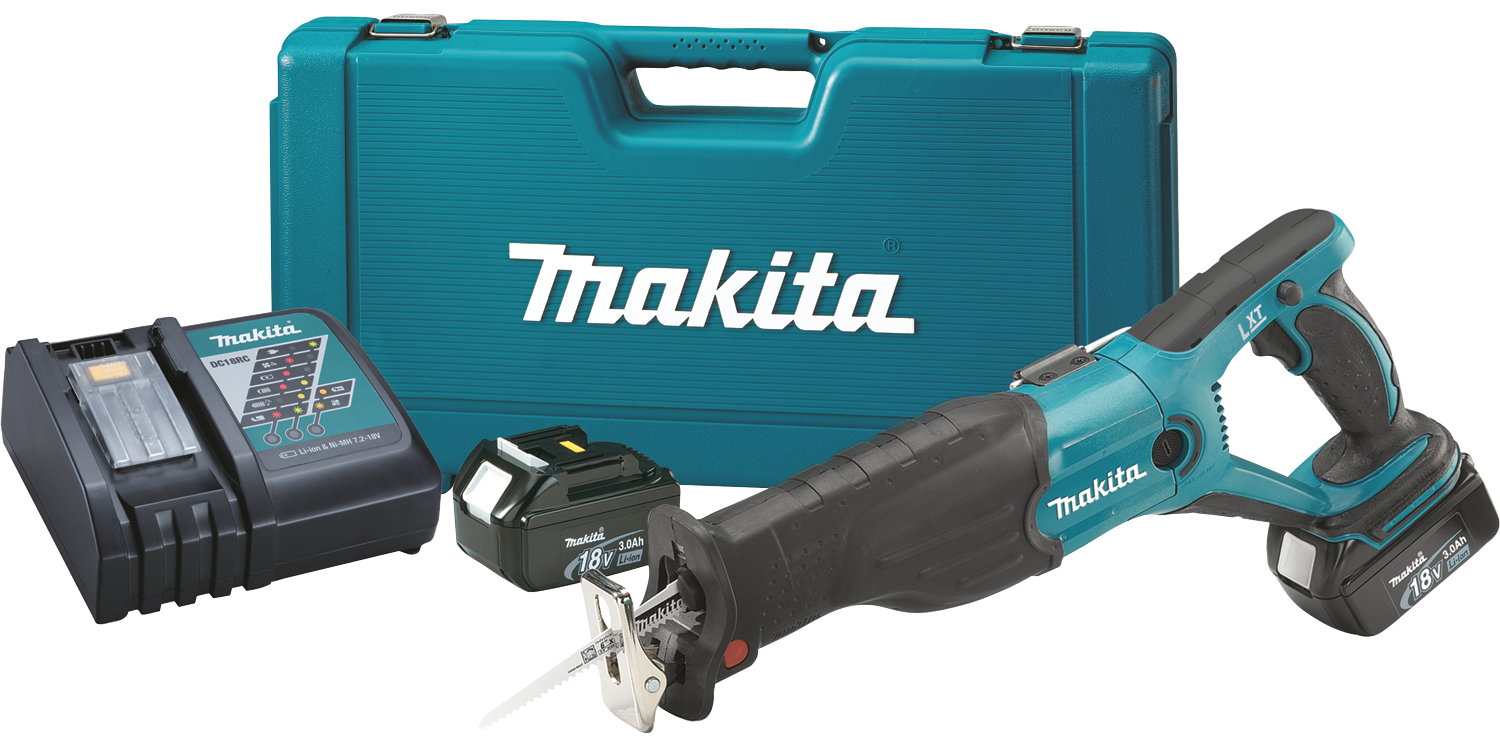
What was included in the XRJ02 3.0Ah kit?
Makita's exact U.S. page identifies a discontinued XRJ02 kit, and its U.S. general catalog lists two BL1830 3.0Ah batteries, a DC18RC rapid charger, one 6-inch 6-TPI saw blade and a tool case. That is the historical package specification, not evidence of what a present resale listing contains; check the exact box and battery condition.
Explore this need in the finder →Does XRJ02 have a tool-free clamp and adjustable shoe?
The linked XRJ02/XRJ03 manual shows a blade-clamp lever and five shoe positions. It also cautions that the shoe should stay firmly against the work and that the battery must be removed before service. This supports the specific clamp and shoe choices; it does not establish orbital action.
Explore this need in the finder →Can XRJ02 meet a strict bare-tool weight limit?
No documented bare-tool number was found. The manual gives 7.7 lb with a BL1815N pack and 8.2 lb with BL1830/BL1840 packs. Those battery-installed values cannot prove that a saw meets a bare-tool cap, so the numeric finder correctly leaves this exact limit unmatched.
Explore this need in the finder →Makita · 18V LXT cordless reciprocating saw · earlier 3.0Ah kit · XRJ02
The XRJ02 is a full-size, two-handed 18V LXT reciprocating saw sold in a kit configuration, not a current bare-tool listing. Makita's U.S. product page now marks the exact XRJ02 model discontinued. Its 2016 U.S. catalog identifies the package as two 3.0Ah BL1830 batteries, a DC18RC charger, one 6-inch 6-TPI blade and a tool case. That is useful historical package evidence, not proof that any seller today has the same box, healthy batteries or a supported warranty. This is a source-based assessment; the saw was not owned, tested or independently measured.
A conventional two-hand saw with a practical shoe adjustment
The XRJ02 has a rear pistol grip and long front barrel, which put it in the full-size format rather than the one-hand class. Its common XRJ02/XRJ03 manual lists a 1-1/8-inch stroke, a variable 0–2,900 strokes-per-minute range, and maximum capacities of 5-1/8 inches in pipe and 10 inches in wood. The catalog ties the wood figure to a 12-inch blade. Treat those as maker-published boundaries under stated conditions, not as comparative cut-speed results or a promise for every material, blade or access angle.
The shoe can be repositioned through five settings. The manual presents this as a way to expose a fresher portion of a blade as one section wears; it is not a substitute for selecting the correct blade length, securing the workpiece or checking the path beyond the cut. Keep the foot planted as the manual requires. A shoe that loses contact can increase vibration and twisting, so the adjustment should not be read as permission to lever the saw against unstable stock.
Kit contents are a real distinction from XRJ02Z
The model suffix matters here. XRJ02 is the documented kit with two BL1830 3.0Ah packs and a DC18RC charger. The separate XRJ02Z review covers the tool-only page; the exact U.S. catalog says that Z configuration excludes battery and charger and does not clearly itemize its accessory list. Do not transfer the XRJ02 kit contents to the Z model just because the saw bodies look alike. The included 3.0Ah capacity is a historical package detail, not a runtime estimate: workpiece, blade, pack age, temperature and load all affect time between charges.
Makita's page also says XRJ04T is the XRJ02 replacement. That gives a buyer a current-family reference, not evidence that XRJ04T is the same tool or that it has the same package. Compare the separate XRJ04T kit assessment if staying on the LXT platform. It uses a later saw family and its own two 5.0Ah pack listing. The newer family is a different configuration; the model names do not make its parts, controls, battery contents or performance interchangeable with XRJ02.
Blade changes and the weight question
The manual's blade-change diagrams show a clamp lever rather than a wrench-operated holder, and Makita's catalog describes tool-less blade changes. That is a useful feature when work calls for different teeth or blade lengths, but still requires power isolation. The manual says to remove the battery before service, insert the blade fully and verify that it is retained. It also documents a front work light and a retractable hook on XRJ02; those model-specific controls are not automatically present on the shorter XRJ03Z.
Weight is easy to misread. The manual gives 7.7 pounds with a BL1815N cartridge and 8.2 pounds with BL1830 or BL1840 cartridges. These are battery-installed saw weights, not bare-tool mass or the carry weight of two batteries, a charger, blade and case. Makita does not establish a bare-tool figure in the reviewed sources, so this model cannot be matched to a strict bare-tool ceiling. The exact manual and maker page also do not establish a selectable orbital mode; unknown controls should remain unknown rather than be inferred from the saw's age or silhouette.
Who should still consider the XRJ02?
It is a reasonable research candidate for someone specifically seeking an earlier LXT two-handed saw with a known historical kit list and a five-position shoe. It is a poor choice for a buyer who needs ordinary current availability, wants a verified light bare tool, or cannot evaluate an older battery set. Ask for the exact model label, the parts actually offered, charger markings and battery condition; check return rights and any applicable recall notice before treating a used or leftover kit as ready to work. Do not assume a marketplace package matches the old catalog entry.
For removal work, the operating plan still matters more than a maximum SPM number. Pick a blade matched to the material and reach, support the offcut, secure the work, confirm the shoe can sit flat and keep the other hand away from the blade path. Follow the specific manual and use suitable eye protection and other required protective equipment. The XRJ02's documented kit contents and controls can answer a narrow buying question, but they do not establish hands-on cut quality, runtime, durability or current dealer stock.
Key specifications
Key details at a glance
| Saw format | Full-size, two-handed saw |
|---|---|
| Power source | Cordless battery |
| Battery platform | Makita 18V LXT |
| Stroke length | 1.12 in |
| No-load stroke rate | 2900 SPM |
| Pivot shoe positions | 5 |
| Tool-free blade change | Yes |
| Work light | Yes |
| Hang hook | Yes |
| Weight with battery | 8.2 lb |
| Overall length | 19.62 in |
| Battery in this package | Yes |
| Charger in this package | Yes |
Use the exact model’s instructions for operating limits, supplied equipment and version differences.
Sources for this review
Sources for this assessment
Match the saw to your actual work.
Use the finder to compare verified requirements, then read each exact model assessment before deciding.