
Your needs, this model
Does it fit your priorities?
Is the DCS367B a one-handed saw?
No. The product is compact, but the linked DCS367 manual instructs a firm two-handed grip while cutting. Treat the compact description as a body-size/access feature, not a one-handed classification.
Explore this need in the finder →Can DCS367B meet a five-pound bare-tool ceiling?
The exact product page states “Only 5 lbs. In weight (TOOL ONLY),” which supports a 5 lb bare-tool entry. Its separate structured 5.4 lb assembled-product field is not the same basis. At a 5 lb maximum, it meets this documented numeric condition.
Explore this need in the finder →Does the DCS367B package include a battery or charger?
No. Its exact B page lists the saw as tool-only and states that battery and charger are sold separately. Compare exact kit SKUs if the package must contain the power equipment.
Explore this need in the finder →Compact-bodied, but not a one-handed saw
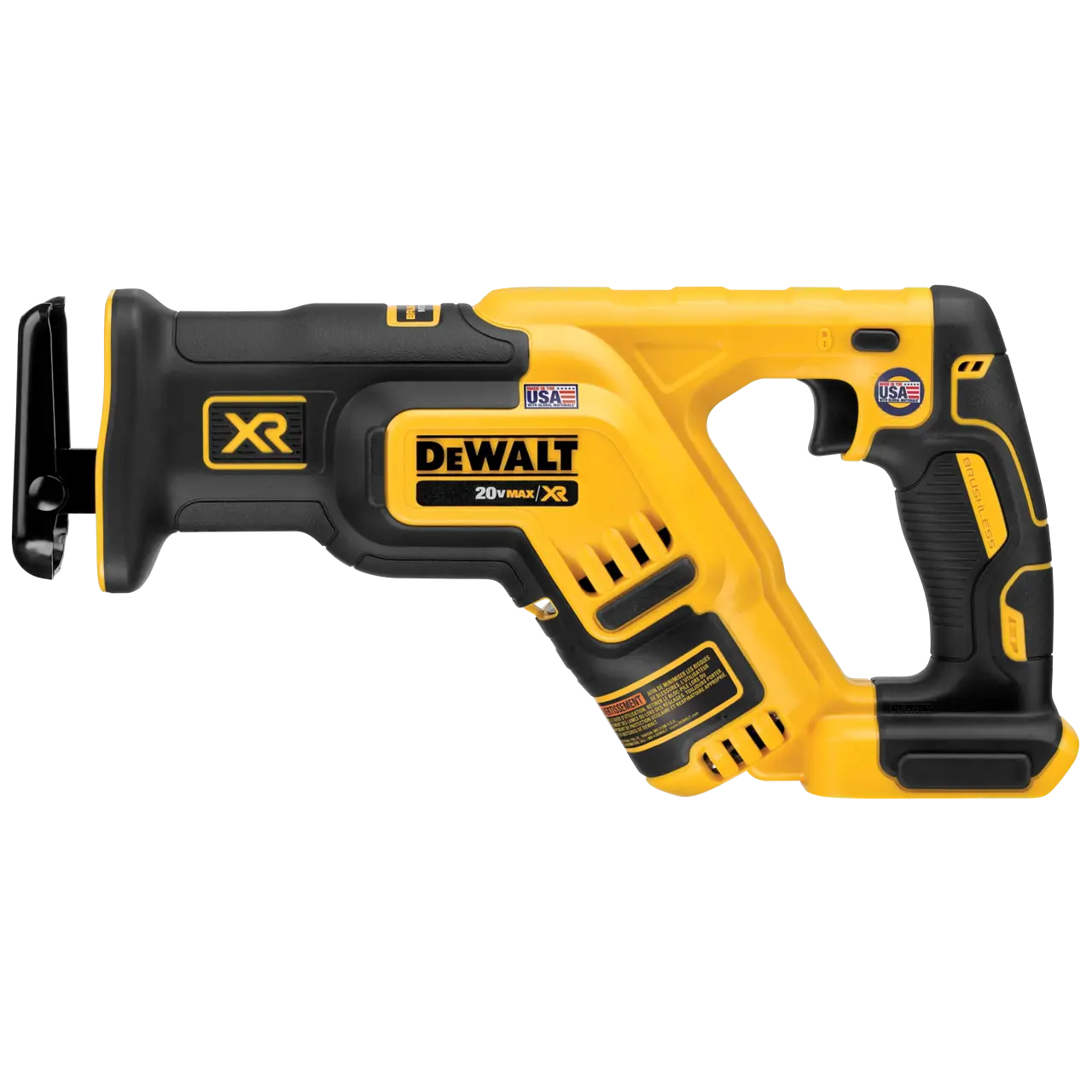
The DCS367B is a tool-only 20V MAX XR brushless compact reciprocating saw. DEWALT describes its 14.5-inch length as helpful between studs and in other tight locations, and the official feature list states a five-pound tool-only weight. It also lists a 1-1/8-inch stroke, a variable trigger up to 2,900 SPM, an LED and a four-position keyless blade clamp. These are specific documented reasons to consider this saw where a conventional full-length housing is awkward, but they do not make the machine a one-handed pruning saw. The linked manual says to hold it firmly with both hands for cutting operations, so its appropriate finder category is compact-bodied, two-handed reciprocating saw.
The bare-tool package includes the DCS367 saw only; battery and charger are sold separately. The official page says the saw works with DEWALT 20V MAX batteries and chargers, but a buyer should confirm exact compatibility in the manual rather than assuming every similarly named pack works. The product page's separate structured data gives an assembled-product weight of 5.4 pounds, while the feature list specifically labels five pounds as tool-only. Those are not equivalent values; the explicit bare-tool statement is the basis for the five-pound matching field. Neither number describes a battery-on kit of the buyer's chosen configuration.
Blade-position flexibility without overclaiming shoe adjustment
The keyless four-position blade clamp is an actionable feature for access: the blade can be installed in multiple orientations, which can help when working close to a floor, wall or other obstruction. The exact page does not document a pivoting or adjustable shoe, selectable orbital action, or a named cut-capacity range for this particular B SKU. The manual's safety instructions about holding a shoe against stock do not prove that the shoe has a particular adjustment mechanism. That distinction matters if those features are hard requirements; the matcher does not award a positive tag from a generic drawing or from another saw in the same line.
For a blade change, remove the battery, open the clamp release, insert the shank fully, let the release return and check that the blade is retained before reconnecting power. Use a blade appropriate to the material and long enough to remain beyond the shoe and workpiece through the full cut. Clamp or otherwise secure the stock to a stable platform and keep the non-trigger hand away from the blade path. Compact form helps with access but does not reduce the need to control vibration, avoid binding, inspect for concealed wires or pipes, and support the workpiece safely.
Where it sits beside other compact 20V choices
The brushless DCS367B differs from the brushed DCS387D1 compact two-handed kit, which supplies a 2.0Ah battery, charger and bag but does not have an explicit tool-only weight in the source record. It also differs from the full-size brushless DCS382H1, whose POWERSTACK battery and charger are in the box but whose exact page does not give a bare-tool weight or a no-load speed. The standard DCS380P1 is a brushed full-size kit with a documented adjustable pivot shoe and a 5.0Ah pack. These are not interchangeable claims: format, motor, package contents, weight basis and shoe evidence each come from the exact SKU rather than from the shared 20V MAX label.
The maker's description of up to 2.5 times longer runtime is a manufacturer comparison, not an independent runtime result; actual work per charge depends on battery, blade, material and technique. Likewise, 2,900 SPM is a no-load ceiling, not a measured loaded performance rating. No test results, cut counts or durability findings are asserted here. The compact body's documented dimensions are more useful as a starting point for clearance planning than a promise that the saw will fit every stud bay or confined cut.
Who should shortlist it
The DCS367B makes sense for a buyer already using DEWALT 20V MAX equipment who values a compact two-handed brushless tool and has separate compatible battery and charging equipment. It is unusually straightforward on bare-tool mass because the exact page labels the five-pound figure as tool only. It is not the choice for someone who needs battery and charger in the same package, an expressly documented adjustable shoe, a selectable orbital mode, or one-handed operation. Check the exact B suffix, the manual's battery guidance, the blade shank and length, and the space needed for both tool body and blade. This is an evidence-led reading of manufacturer materials, not a hands-on review or claim of personal use.
Key specifications
Key details at a glance
| Saw format | Compact-bodied, two-handed saw |
|---|---|
| Power source | Cordless battery |
| Battery platform | DEWALT 20V MAX |
| Motor type | Brushless |
| Stroke length | 1.12 in |
| No-load stroke rate | 2900 SPM |
| Tool-free blade change | Yes |
| Work light | Yes |
| Bare-tool weight | 5 lb |
| Overall length | 14.5 in |
| Battery in this package | No |
| Charger in this package | No |
Use the exact model’s instructions for operating limits, supplied equipment and version differences.
Sources for this review
Sources for this assessment
Match the saw to your actual work.
Use the finder to compare verified requirements, then read each exact model assessment before deciding.