
Your needs, this model
Does it fit your priorities?
Is DCS387D1 a one-handed saw for pruning?
No. DEWALT calls this model compact, but the linked DCS387 manual instructs a firm two-handed grip for cutting. Its smaller body is a clearance feature, not a one-handed product classification; secure the workpiece rather than holding it in the free hand.
Explore this need in the finder →Does the DCS387D1 box provide a battery and charger?
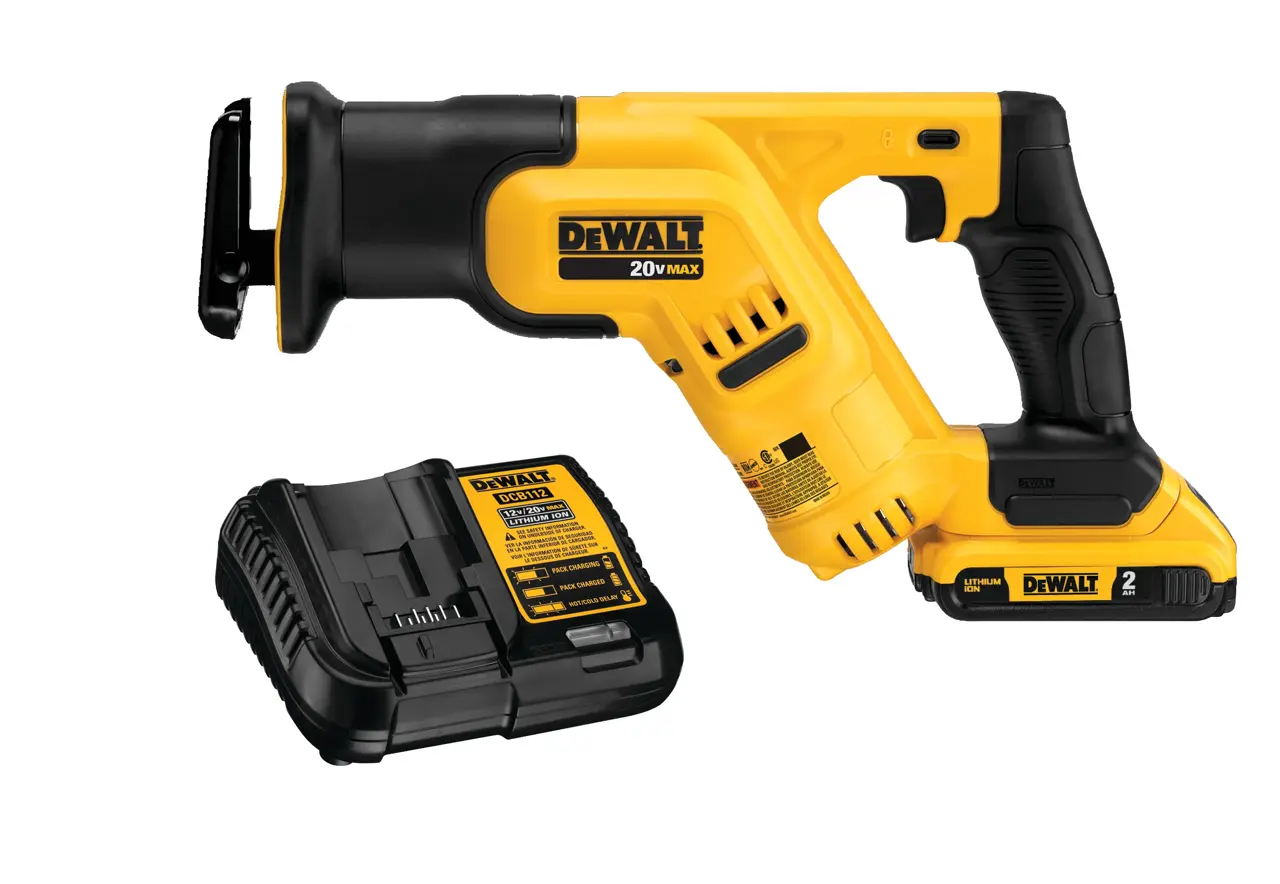
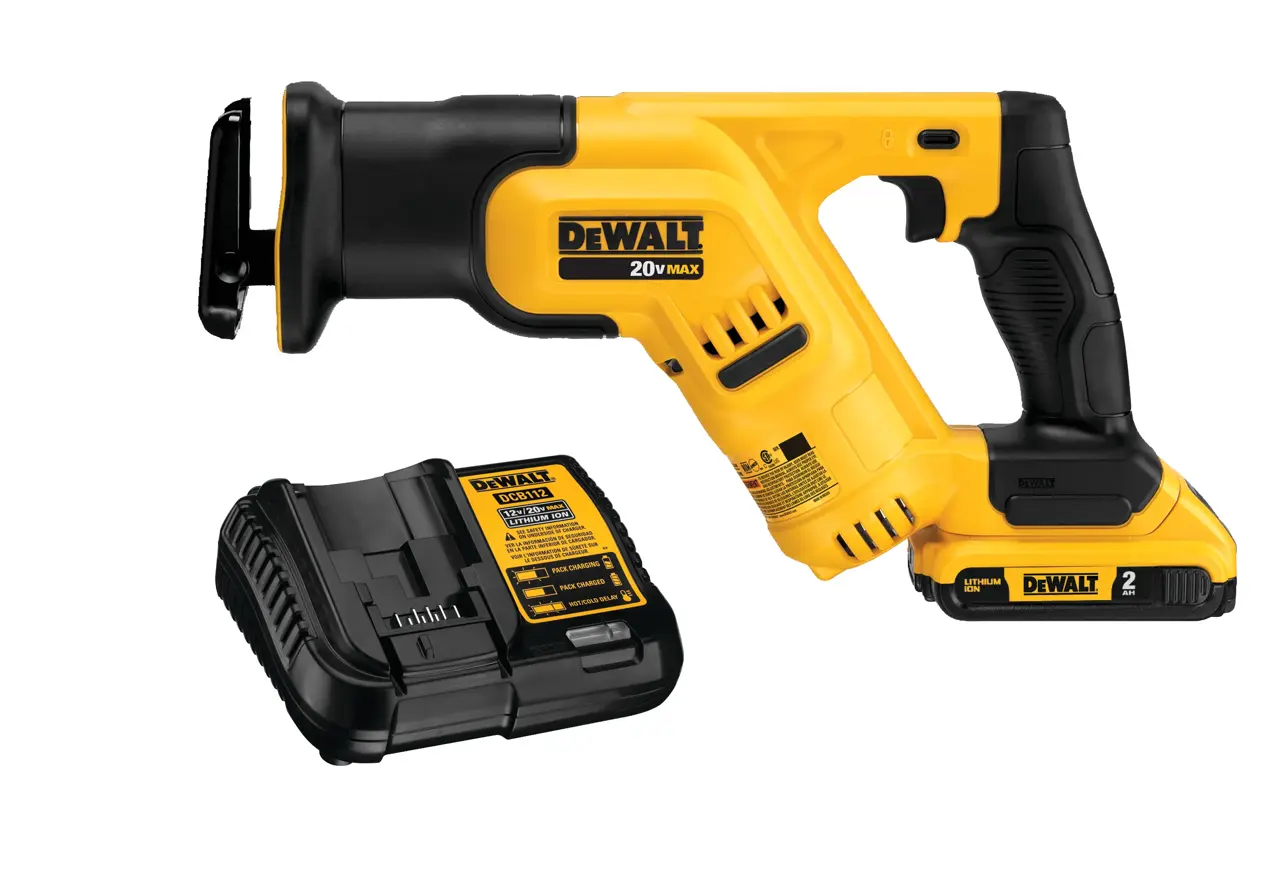
The exact D1 page lists one 2.0Ah DCB203 battery, one DCB112 charger, a kit bag and the DCS387 saw. Confirm the suffix and contents on the offer; the DCS387 tool-only and other kit configurations are separate SKUs.
Explore this need in the finder →Can I use a numeric weight filter for this kit?
The page gives an assembled-product weight of 8.4 lb while the exact tool’s bare-tool weight is not stated. Do not substitute the battery-on kit figure for a strict tool-only ceiling; a numeric match requires a documented bare-tool value.
Explore this need in the finder →A compact, two-handed 20V kit with a small battery
The DCS387D1 is a DEWALT 20V MAX compact reciprocating-saw kit, not one of the maker's one-handed saws. Its model page describes a 14.5-inch compact body for tight work and a variable-speed trigger, while the manual instructs the operator to hold the saw firmly with both hands for cutting. The package list is unusually useful for a buyer comparing exact suffixes: one 2.0Ah DCB203 battery, one DCB112 charger, a kit bag and the DCS387 saw are listed. That is a ready-to-power configuration for someone who wants the DCS387 platform rather than a bare tool, but the modest capacity pack is not evidence of runtime on any particular job.
The manufacturer lists a 1-1/8-inch stroke, a 0–2,900 SPM trigger range, an LED and a keyless four-position clamp that allows tool-free blade changes. The product page also describes a pivoting shoe. Those details distinguish the tool from a simple fixed-position clamp, but they do not establish selectable orbital action, a cut-capacity figure, a vibration measurement or a tested cutting rate. The SPM maximum is a published no-load speed ceiling, not a promise that the blade will sustain that rate through a loaded cut.
Four blade orientations matter more than a speed headline
A four-position blade clamp can let an operator orient a compatible reciprocating-saw blade for different access and flush-cut situations. It does not make this a detail-cutting jigsaw, and a different blade position does not substitute for a blade selected for the material. Before use, confirm the blade's shank and tooth pattern, check that its length remains beyond the shoe and the full workpiece through the intended stroke, and remove the battery before changing or adjusting accessories. Secure the stock to a stable support and keep the blade path clear of the hand doing the clamping. The manual emphasizes a two-handed grip and warns about binding, kickback and flying debris; a compact housing is not a reason to hold loose material in the free hand.
The pivoting shoe gives the front of the saw a point of contact that can follow the cut setup. It is useful to know that movement is documented for this model, but the page does not give a number of positions or describe a depth-stop scale. I would not buy it on the assumption that the shoe can be extended to a specific indexed depth or that the tool has an orbital mode: neither detail is established in the exact DCS387D1 source reviewed here.
Kit weight and clearance are separate questions
DEWALT's feature list gives the saw's total body length as 14.5 inches, while the same page's structured product data labels an assembled-product length of 16.75 inches and an assembled-product weight of 8.4 pounds. Those are not a single clearly defined bare-tool measurement. Because the kit includes a battery and charger, the package weight is particularly easy to mistake for the saw's weight. This assessment keeps the strict bare-tool weight field unknown; a visitor setting a maximum-weight requirement should not see this kit qualify just because the body is called lightweight. If the work area has a hard clearance limit, check the actual tool dimensions and intended blade projection rather than relying on the compact label alone.
The DCS387D1 is a brushed-motor configuration. It is a different fit from the compact brushless DCS367B, which is sold without battery or charger and has a documented five-pound tool-only figure. It is also unlike the brushless, full-size DCS382H1 kit: both use DEWALT's 20V MAX system and both have pivoting shoes, but they are distinct saws with different motor and package evidence. The comparable saw body in the DCS387 family appears with other exact package suffixes in DEWALT's catalogue; do not assume a different kit has this D1 battery, charger or bag.
Who should consider the DCS387D1
This package deserves a look when the job calls for a cordless, compact-bodied saw that is still operated with both hands, and the DCB203 2.0Ah battery and DCB112 charger in the box suit the buyer's existing system or intended setup. It has a useful blade-change arrangement, work light and a documented pivoting shoe. It is a poor match for someone specifically seeking a one-handed pruning-format tool, selectable orbital action, a verified bare-tool weight below a strict threshold, or a listed high-capacity battery package. Before checkout, verify the exact DCS387D1 suffix, the written contents, the 20V MAX pack/charger compatibility and the blade needed for the material. This is a source-based configuration assessment; no hands-on test, runtime trial, measurement or ownership is claimed.
Key specifications
Key details at a glance
| Saw format | Compact-bodied, two-handed saw |
|---|---|
| Power source | Cordless battery |
| Battery platform | DEWALT 20V MAX |
| Motor type | Brushed |
| Stroke length | 1.12 in |
| No-load stroke rate | 2900 SPM |
| Tool-free blade change | Yes |
| Work light | Yes |
| Overall length | 14.5 in |
| Battery in this package | Yes |
| Charger in this package | Yes |
Use the exact model’s instructions for operating limits, supplied equipment and version differences.
Sources for this review
Sources for this assessment
Match the saw to your actual work.
Use the finder to compare verified requirements, then read each exact model assessment before deciding.