
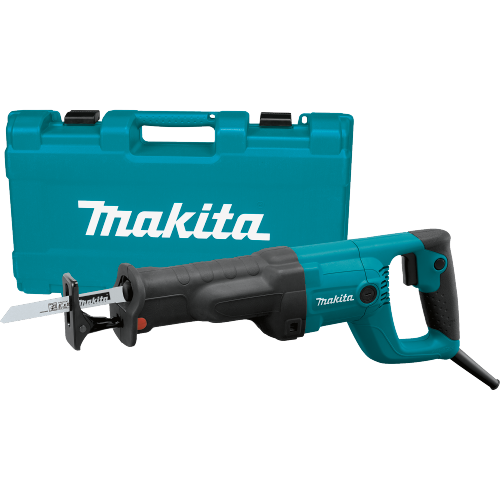
Your needs, this model
Does it fit your priorities?
Is the JR3050T the same trigger version as the JR3050TZ?
No. The JR3050T manual and shared manufacturer flyer identify a lock button that can hold the trigger in the on position; the exact JR3050TZ page lists no lock-on switch. Their 11 A, 1-1/8 in, 0-2,800 SPM base specifications are close, but the suffix changes a real control feature. Makita marks JR3050T discontinued and lists JR3051T as its replacement.
Explore this need in the finder →Can I use the JR3050T's lock button as a convenience?
The JR3050T manual describes locking the tool on by pulling the variable-speed trigger and then pressing the lock button; it also warns to maintain a firm grasp. It is not a substitute for a safe cut setup. Disconnect mains power before blade changes or adjustment, and use the exact manual to understand how to stop a locked trigger.
Explore this need in the finder →Is the JR3050T documented below a 7.5 lb bare-tool limit?
Makita's JR3050T manual and flyer state a 7.3 lb net tool weight, so the bare saw fits a 7.5 lb maximum. That does not describe the combined weight of its case and blade, and the model's discontinued status means any offer needs careful model-number and condition checks.
Explore this need in the finder →Makita · earlier 11 A corded reciprocating saw · exact model JR3050T
The JR3050T deserves a separate assessment because its suffix marks a real product configuration, not an alternate spelling of the JR3050TZ. Makita's US page now labels JR3050T discontinued and names JR3051T as its replacement. The older saw is still relevant to someone researching an exact offer, but that status is not a promise of current supply, parts, warranty coverage or safe condition for a used tool. The matcher therefore keeps it out unless a visitor explicitly includes earlier models.
What the records establish
Makita's JR3050T manual and manufacturer flyer document an 11-amp corded saw with a 1-1/8-inch stroke, variable speed up to 2,800 SPM and a 7.3-pound net tool weight. The flyer lists a blade and tool case. The tool needs a suitable 120-volt source, cord reach and a route that does not place the lead across the cut, pinch point or walking path. No battery or charger is part of the operating plan.
These figures are useful for identifying this model and checking whether the format fits a known work area. They do not establish a measured cut rate, vibration level, durability history or performance through any particular material. Makita's manual warns against forcing the tool, requires a supported workpiece, and directs the user to keep the shoe against the stock while cutting. A maximum no-load stroke-rate figure should not be read as an output guarantee under load.
The important difference from JR3050TZ
The JR3050T has a lock button associated with its trigger. Makita's manual explains how pulling the trigger and pressing that button holds the switch on for continuous operation, and cautions the operator to maintain a firm grasp. The exact JR3050TZ page, by contrast, lists no lock-on switch. Both are described with 11 amps, a 1-1/8-inch stroke and a 0-2,800 SPM range, but the control is a functional difference that changes the starting and stopping routine. Do not assume that an image of a similar teal tool or a seller's shorthand proves which suffix is in the box.
The shoe is adjustable through five positions and the blade change is tool-less according to the manual/flyer. Before changing a blade or moving the shoe, unplug the saw. Confirm the blade is seated and locked before use, and select a length that remains engaged through the full stroke without contacting the support beneath the work. The manufacturer describes the package as including a blade, but a used or incomplete offer may not retain that accessory; confirm its contents directly.
Earlier status changes the buying decision
For a visitor who specifically needs a current catalog model, the JR3050T is the wrong starting point. Makita's product page points to the JR3051T replacement, which has different current specifications, including a 12-amp motor and a 1-3/16-inch stroke. That replacement is not treated as interchangeable, and its independent assessment is still open in the catalogue ledger. This review does not imply that the newer model is better for every job; it gives the reader a clear model boundary.
Someone evaluating an earlier tool should inspect the exact nameplate, plug, cord, blade clamp, shoe and switch behavior, and should not buy a model whose safety controls or condition cannot be confirmed. The manufacturer's listed 7.3-pound net figure refers to the saw, not the case and blade together. It does not describe a complete carry package. A discontinued page is primary evidence for model status, not evidence of seller inventory or a seller's claims.
Who might still shortlist the JR3050T?
It belongs on a comparison list only when the exact JR3050T lock-on configuration is intentional and the user has a suitable corded setup. It is not the right answer to a cordless-platform requirement, and the older status needs to be considered before price or convenience. Makita's manual remains the reference for safe blade changes, shoe adjustment and workpiece support. This source-based review cannot verify an individual used unit, unseen accessories or prior maintenance.
Makita JR3050T discontinued-model record · JR3050T instruction manual · Compare the JR3050TZ version without a lock-on switch
Key specifications
Key details at a glance
| Saw format | Full-size, two-handed saw |
|---|---|
| Power source | Corded mains power |
| Motor current | 11 A |
| Stroke length | 1.12 in |
| No-load stroke rate | 2800 SPM |
| Pivot shoe positions | 5 |
| Tool-free blade change | Yes |
| Bare-tool weight | 7.3 lb |
| Overall length | 17.75 in |
| Trigger lock-on switch | Yes |
| Battery in this package | No |
| Charger in this package | No |
Use the exact model’s instructions for operating limits, supplied equipment and version differences.
Sources for this review
Sources for this assessment
Match the saw to your actual work.
Use the finder to compare verified requirements, then read each exact model assessment before deciding.