
Your needs, this model
Does it fit your priorities?
What comes with the JR3050TZ, and does it need a battery?
Makita's US JR3050TZ page describes a corded 11 A saw and lists wood- and metal-cutting blades plus a tool case. It is not a battery platform tool: plan for a compatible 120 V outlet, cord reach and a safe routing path. Verify the exact model suffix on the offer because the discontinued JR3050T is a separate trigger configuration.
Explore this need in the finder →Can the JR3050TZ shoe be repositioned?
Yes. The JR3050TZ page describes tool-less shoe adjustment, and its type-specific manual shows a five-way shoe position change. Unplug the saw before adjustment or blade work, secure the workpiece, and keep the shoe firmly against the material during cutting; a repositionable shoe is not a substitute for support or clearance checks.
Explore this need in the finder →Does the JR3050TZ satisfy a 7.5 lb bare-tool ceiling?
Makita lists 7.3 lb as net tool weight on the JR3050TZ US page and its manual gives the same net figure. That supports the 7.5 lb upper limit for the tool itself, not a promise that the case, blades, extension cord or any other carried items weigh 7.3 lb together.
Explore this need in the finder →Makita · 11 A corded reciprocating saw · exact model JR3050TZ
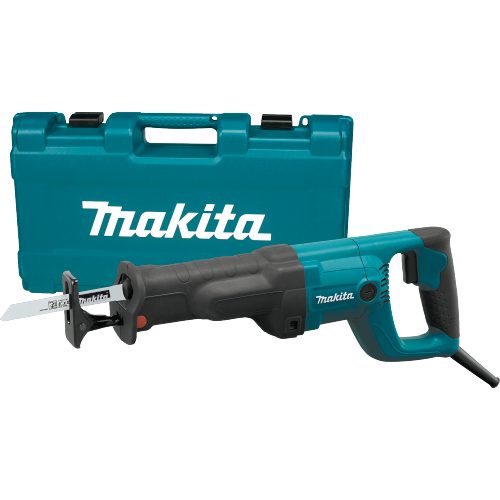
The JR3050TZ is the straightforward member of Makita's older 11-amp reciprocating-saw line: a mains-powered, two-hand saw with a variable trigger, a 1-1/8-inch stroke and a five-position shoe. Makita's current US page identifies this exact suffix and lists two cutting blades and a case. This is a source-based assessment, not a hands-on test; the published stroke and no-load rate describe specifications, not how quickly a particular pipe, stud or nail-embedded board will be cut.
What the 11-amp corded setup means
Power comes from a corded 120-volt supply, not a battery. That is useful when the work stays near an appropriate outlet and the cord can be kept outside the cut path, away from sharp stock and clear of the operator's footing. It is a poor match for a roof edge, a remote demolition area or a crowded spot where the cord cannot be routed safely. An extension cord is not a substitute for checking the manual's gauge and length guidance or the supply voltage on the tool plate.
The manufacturer's 1-1/8-inch stroke and variable 0-2,800 SPM range give a practical description of the tool's reciprocating motion. The upper figure is a no-load specification, not an independent cutting result. Makita also lists no orbital setting for this model. Buyers who specifically need a documented selectable orbital mode should compare the separately reviewed Milwaukee 2722 series instead; this JR3050TZ does not provide that documented choice.
Shoe and blade setup
The JR3050TZ's shoe is not just a fixed nose: the type-specific Makita manual explains a five-way adjustment, and the product page describes tool-less shoe adjustment. The manual's practical purpose is to reposition the contact point when one portion of a blade has dulled, so another section can be used. That does not make the saw suitable for a cut without stable support. Makita cautions users to keep the shoe against the work, secure the workpiece, and choose a blade that reaches through the material for the full stroke without striking a bench or floor.
Makita also describes tool-less blade changes. Treat that as a convenience, not as permission to touch the clamp while the saw is powered. Unplug before adjusting the shoe or changing a blade, remove debris around the clamp, insert the blade fully and check that it is retained before approaching the work. Hidden wires and pipes remain a separate hazard; a shoe position cannot make an unknown wall safe to cut.
Package and the T/Z distinction
The exact JR3050TZ page lists the saw, a wood-cutting blade, a metal-cutting blade and a tool case. The package is corded, so it has no battery or charger to match to a cordless platform. The page reports a 7.3-pound net weight for the tool. That is useful for a bare-saw comparison, but it is not the weight of the case, blades, extension cord or a complete jobsite carry load.
Check the suffix carefully. The discontinued JR3050T is a different model record, not a box variation: its manual and flyer describe a trigger lock button for continuous-on use, while the JR3050TZ page says there is no lock-on switch. They share core published dimensions and rates, but controls matter when choosing a tool. Makita identifies the JR3051T as the replacement for the discontinued T model; it has its own 12-amp and longer-stroke specifications and is assessed separately.
Who should shortlist it?
Consider the JR3050TZ when a corded format, conventional two-hand grip, adjustable shoe, included blades and case, and a documented 7.3-pound tool weight line up with the work. It is less compelling when cordless mobility, an included battery system, orbital selection, or an unusually narrow access profile is essential. Before buying, verify the complete JR3050TZ suffix, the condition and contents of the exact offer, an appropriate mains connection, blade suitability for the material, and the manual's support and safety instructions. The 11-amp rating and high no-load number do not substitute for those checks.
Makita JR3050TZ product details · JR3050TZ instruction manual · Compare the discontinued JR3050T
Key specifications
Key details at a glance
| Saw format | Full-size, two-handed saw |
|---|---|
| Power source | Corded mains power |
| Motor current | 11 A |
| Stroke length | 1.12 in |
| No-load stroke rate | 2800 SPM |
| Pivot shoe positions | 5 |
| Tool-free blade change | Yes |
| Selectable orbital action | No |
| Bare-tool weight | 7.3 lb |
| Overall length | 17.75 in |
| Trigger lock-on switch | No |
| Battery in this package | No |
| Charger in this package | No |
Use the exact model’s instructions for operating limits, supplied equipment and version differences.
Sources for this review
Sources for this assessment
Match the saw to your actual work.
Use the finder to compare verified requirements, then read each exact model assessment before deciding.