
Your needs, this model
Does it fit your priorities?
What is actually in the PS60N box?
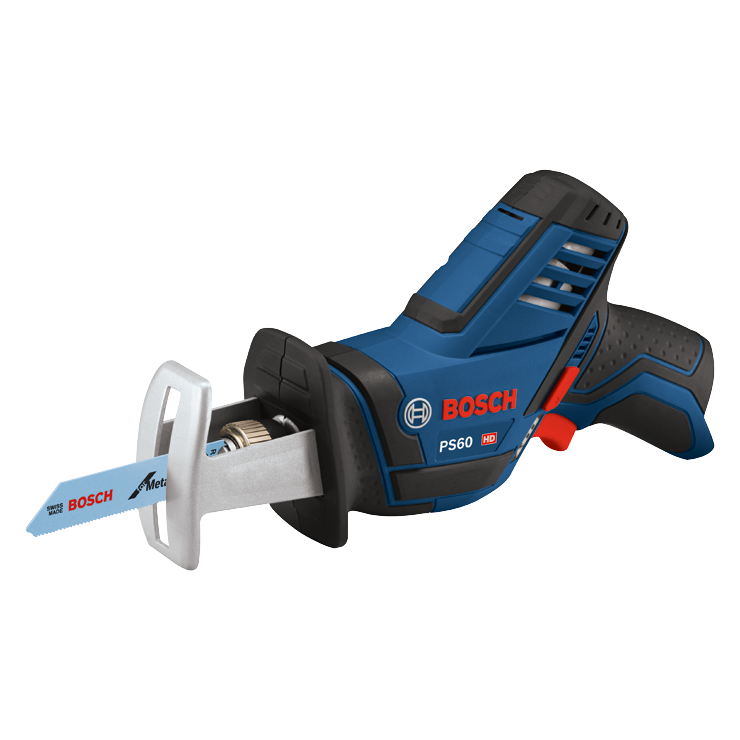
Bosch labels PS60N a bare tool, marks no case included and lists one PS60 saw plus a metal and a wood blade. The exact page does not list a battery or charger; do not treat an attached battery in an image or a retailer’s bundle as the manufacturer’s standard bare-tool contents.
Explore this need in the finder →Can I require a known light tool-only weight for PS60N?
Yes. Bosch explicitly describes its 2.2 lb figure as tool-only weight, not including the battery. The weight is useful for a bare-tool ceiling but does not describe the complete carried setup or how the saw feels in a particular cut.
Explore this need in the finder →Is PS60N a one-hand saw for narrow work?
It has a short pocket-saw body, but Bosch’s PS60 manual instructs a two-handed grip: one hand on the handle and the other on the insulated front boot. It is therefore not recommended as a one-hand model by this assessment; clamp the work and keep the footplate in contact as directed.
Explore this need in the finder →PS60N is the bare-tool version of Bosch’s small 12V Max pocket saw
The exact U.S. Bosch listing calls the PS60N a 12V Max Pocket Reciprocating Saw (Bare Tool). Its included-items list names the PS60 saw and two blades, one for metal and one for wood; Bosch says no case is included. Because the product is labelled bare tool, do not assume a battery or charger comes in the box. The related PS60-102 is the kit route: Bosch lists one 2.0Ah battery, a 12V charger and a carrying bag there. The two SKUs should remain separate even though they use the same PS60 saw body.
Compact dimensions and a real two-hand operating instruction
Bosch lists the PS60N at 11 inches long, 2.3 inches wide and 2.2 pounds, specifically identifying the weight as tool-only and excluding the battery. The shared part number printed on Bosch’s PS60N and PS60-102 pages is 3601F4L910, which supports a common saw body; the package suffix changes the included equipment, not the documented stroke mechanism. A 0.57-inch stroke and up-to-3,000 no-load SPM are listed in the PS60 manual. They describe the tool, not a tested cutting speed through any particular material.
“Pocket” is a helpful size description, but it should not be mistaken for permission to use the saw with one hand. The PS60 manual directs the operator to grasp the rear handle with one hand and place the other on the insulated front boot. It also says to clamp the work, keep the footplate pressed against it to reduce jumping and vibration, and allow the saw to reach speed before starting the cut. This assessment treats the PS60N as compact-bodied but two-handed in use. That is the safer fit distinction for a buyer whose hands must remain on the tool.
Blade changes and small-job setup
The PS60N page lists a tool-free blade change, and the manual describes the actual twist-collar operation. Remove the battery before changing or adjusting anything. Twist the collar, seat the blade fully, let the spring-loaded clamp return, then tug the blade to confirm that the retaining pin has engaged. The manual says the blade may be installed teeth-up or teeth-down, but must extend beyond the footplate and work through the full stroke. It warns that an overly short or badly angled blade can jam and snap.
A variable-speed trigger offers a way to start more deliberately, while the lock-off switch blocks an accidental trigger pull when engaged. Bosch also lists a work light, battery fuel gauge and electronic brake. Those are useful documented controls on a compact tool, not evidence that the cut will be clean or that a particular battery will last through a job. Match the blade to the material and support the work securely. Bosch cautions against forcing the saw and gives material-specific notes for cutting metal; use those instructions rather than treating the two included blades as universal choices.
What the tool-only package means for total cost
The PS60N can make sense when a buyer already owns compatible Bosch 12V Max battery and charging equipment and wants the lighter, simpler tool-only box. A buyer starting without those parts should price the full working setup as a battery and charger purchase too, or compare the PS60-102 kit without assuming it is automatically the better value. The bare-tool list includes two blades but no case; confirm the seller’s exact model and box contents, especially if a photo shows a battery attached or a retailer bundles accessories.
The Bosch 12V Max ecosystem itself is a compatibility check: the site’s current battery-platform question does not offer Bosch 12V Max as a selectable brand choice, so a general cordless match is not proof that an existing Bosch pack fits. Verify the exact battery and charger models against Bosch’s compatibility documentation. The sources reviewed also do not establish selectable orbital action, an adjustable shoe or a tool-only hook. Unknown features should not be treated as present just because another Bosch saw has them.
Assessment boundary
The PS60N’s strongest paper case is its compact reach, low listed bare-tool weight, variable-speed control and tool-free collar for light repair work where a full-size saw is cumbersome. Its short stroke and small 12V platform are reasons to compare a larger saw for heavier, longer or repetitive cutting, not proof that it cannot handle a particular material. The manufacturer’s named material examples do not replace choosing a suitable blade, setting up safe support or understanding what lies behind a blind cut.
This review is based on Bosch’s exact U.S. model page and the linked PS60 operator manual. It is not a personal-use or lab-test report: the author has not used, owned, tested or independently measured this model. No price, seller stock, condition, customer experience or runtime is established here. For the exact package, manual and safety details, consult the linked Bosch records before purchase and operation.
Bosch PS60N exact product record · Compare the PS60-102 kit · Bosch PS60 operating manual
Key specifications
Key details at a glance
| Saw format | Compact-bodied, two-handed saw |
|---|---|
| Power source | Cordless battery |
| Battery platform | Bosch 12v max |
| Stroke length | 0.57 in |
| No-load stroke rate | 3000 SPM |
| Tool-free blade change | Yes |
| Work light | Yes |
| Bare-tool weight | 2.2 lb |
| Overall length | 11 in |
| Trigger lock-on switch | No |
| Battery in this package | No |
| Charger in this package | No |
Use the exact model’s instructions for operating limits, supplied equipment and version differences.
Sources for this review
Sources for this assessment
Match the saw to your actual work.
Use the finder to compare verified requirements, then read each exact model assessment before deciding.