
Your needs, this model
Does it fit your priorities?
What does the discontinued RJ01W kit include?
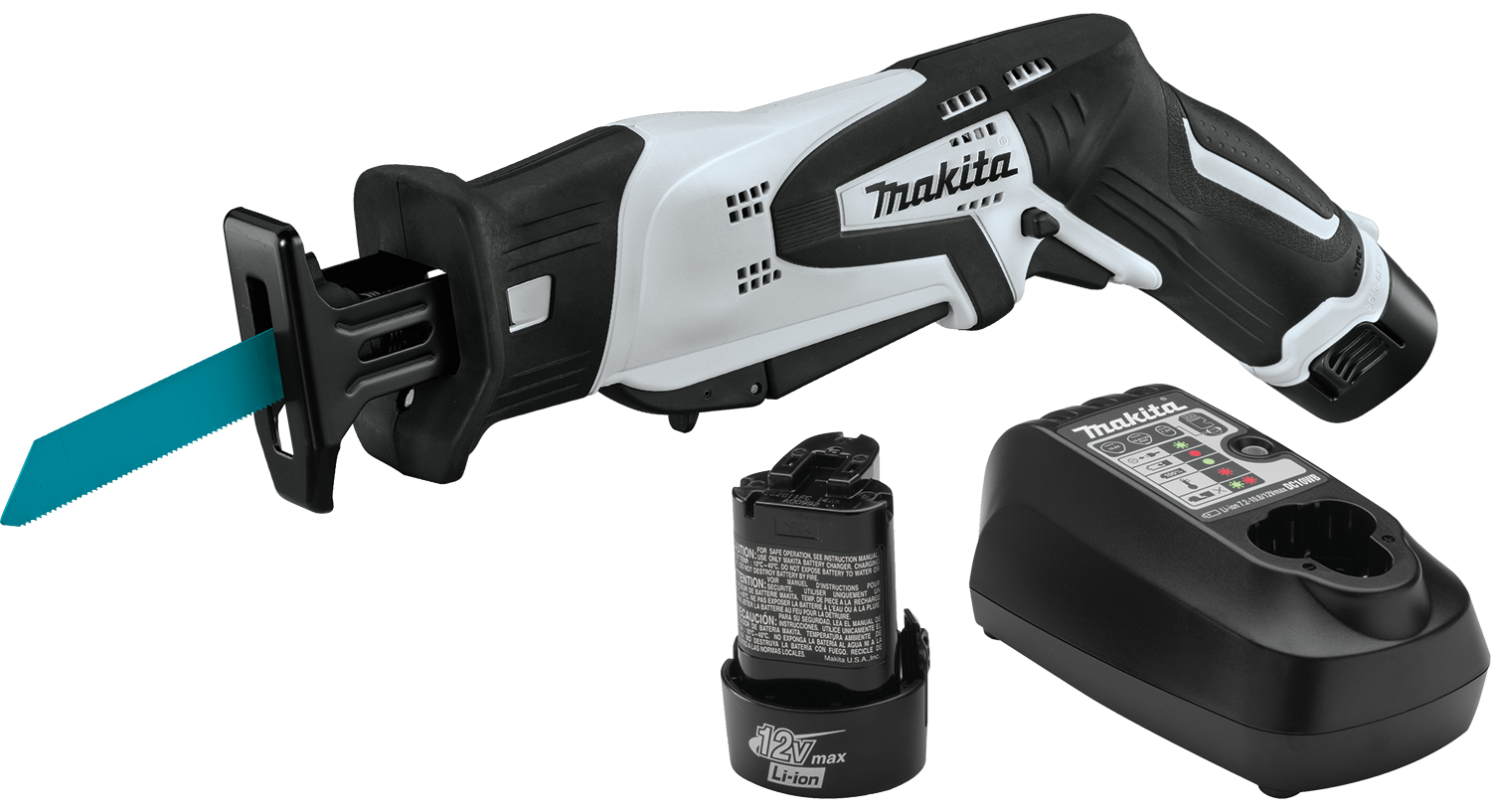
Makita's RJ01W flyer lists two BL1014 12V max Lithium-Ion batteries, a DC10WB charger and two reciprocating-saw blades. It does not name the included blade models or lengths; the separately listed optional blades should not be assumed to be the kit blades. Verify the exact RJ01W label and box contents on any used or remaining-stock offer.
Explore this need in the finder →Is the RJ01W an 18V LXT or 12V max CXT saw?
Neither label should be substituted for its documented older system: the RJ01W page calls it 12V max Lithium-Ion, and its manual lists BL1014 as the standard cartridge. Makita's later RJ03R1 is a separate CXT kit with different batteries. The RJ01 manual says to use designated packs; do not assume an LXT or CXT battery fits or is supported. The public platform filters therefore do not count RJ01W as Makita 18V LXT.
Explore this need in the finder →Does Makita's 2.6 lb RJ01W figure satisfy a strict bare-tool weight limit?
No conclusion about bare-tool weight follows from that number: both the RJ01 manual and RJ01W flyer label 2.6 lb as a with-battery figure, and the manual's 14-inch overall length is also with battery. Makita does not state a bare-tool mass in these sources, so a strict 3 lb tool-only filter leaves RJ01W unmatched rather than treating the battery-installed value as the saw's weight.
Explore this need in the finder →Makita's discontinued RJ01W is an earlier compact reciprocating-saw kit built around the company's 12V max Lithium-Ion battery line. The exact U.S. page marks the model discontinued and identifies the newer RJ03R1 as a replacement model. That is useful family history, not proof that a secondhand RJ01W is interchangeable with the later 12V max CXT platform or that every seller's box contains the original kit parts.
Keep the RJ01W kit separate from the later CXT model
The model-specific RJ01W flyer lists two BL1014 batteries, a DC10WB charger and two reciprocating-saw blades. It does not identify the two blades by part number or length. The product-page image shows the saw, a battery and a charger, but the photograph is not a reliable way to count everything in the box. The named package contents come from the written flyer; if an offer is used or open-box, verify the model plate and each component rather than treating that historical list as a seller guarantee.
Makita's page links to the RJ01 instruction manual and an RJ01W parts breakdown. The manual names BL1014 as the standard battery cartridge and gives a 10.8V DC / 12V max rating. This is not the later CXT family: the RJ03R1 assessment covers a separate saw kit with CXT battery models. Nor does a common manufacturer make the RJ01W compatible with Makita's 18V LXT line. Check the battery and charger model numbers in the exact manual and on the parts before purchase; do not infer fit from a voltage label or brand.
Small form, meaningful limits
The RJ01W's manual and flyer list a 1/2-inch stroke, up to 3,300 strokes per minute, and maximum cutting capacities of 2 inches in pipe and 2 inches in wood. Those are manufacturer specifications, not a measured cut rate or a promise about a particular blade, material condition or work angle. A higher no-load stroke count also does not erase the shorter stroke or establish that this older saw will cut faster than a larger model. The flyer presents the body as a compact one-handed tool; that is why it belongs with the compact format in this guide, but it is not a hands-on assessment of control, fatigue or suitability for every one-handed cut.
A one-handed format may be relevant where clearance and access matter, but it does not make an unsupported workpiece safe or remove the need to control the moving blade. The RJ01 manual directs the operator to press the shoe firmly against the workpiece and warns that lifting it away can lead to vibration, twisting and blade breakage. Secure the material, inspect it for nails, consider concealed wiring and check clearance beyond the cut so the blade will not strike a floor or workbench. Do not let a compact body substitute for a safe support plan.
Two switch positions and a manual clamp
The model flyer describes two ways to start the motor: a paddle-style switch lever or a trigger. The manual shows that both controls use lock-off protection and that speed rises with switch pressure. This is a choice of control position, not an orbital selector or a lock-on function. Makita also documents a front work light. These are useful distinctions when comparing the saw's control layout on paper, but they do not establish a runtime, a brighter work area or a performance advantage in actual use.
The flyer calls the blade change tool-less, and the manual describes rotating the clamp sleeve to release and retain a blade. The instructions still require removing the battery before servicing, cleaning chips from the blade and clamp, inserting the blade fully, and checking that it is retained before operation. For metal, the manual calls for suitable cutting oil and protection from hot chips. The parts breakdown identifies a shoe, but the reviewed sources do not describe a pivot or adjustment procedure, and they do not establish selectable orbital action. Both fields remain unknown rather than being borrowed from another Makita reciprocating saw.
Weight and length are not bare-tool measurements
The published 2.6-pound figure is explicitly with the BL1014 battery; the manual likewise says its weight includes the battery cartridge. The stated 14-inch overall length is also the with-battery dimension. Makita does not publish a bare-tool weight in these RJ01W materials, so the 2.6-pound number cannot prove that the saw itself meets a strict tool-only weight ceiling. The flyer separately gives a six-pound shipping weight for the kit, which is a different quantity again. Do not confuse the battery-installed saw, the boxed package and a bare tool when comparing lifting or transport needs.
These distinctions matter even for an older light-duty package. A present-day battery may be degraded, the original kit's listed parts may be missing, and the seller may describe a related model without showing the suffix. A product page marked discontinued is not a current inventory, warranty or condition statement. Ask for clear photographs of the label and box, confirm that the battery is the listed BL1014 type and the charger is DC10WB, and check the seller's return and battery-condition terms.
Who should still compare it
RJ01W is worth identifying when a buyer deliberately wants an earlier, compact one-handed Makita reciprocal saw and is prepared to verify the age and condition of its battery system. It is a poor match for someone requiring a documented bare-tool weight, current CXT or 18V LXT compatibility, an adjustable shoe or selectable orbital action. The exact manual, flyer, discontinued product page and model parts list support this assessment; they do not establish modern availability or the condition of any specific listing. No cutting, runtime, ergonomics or durability test was performed, and no ownership or personal use is claimed.
For a later 12V comparison, read the separate Makita RJ03R1 CXT kit assessment. It documents a different saw-body/package identity and different battery models; the replacement link does not make its kit contents transferable to RJ01W. Match the exact suffix, battery and charger labels, listed accessories and workpiece setup before choosing a seller.
Key specifications
Key details at a glance
| Saw format | Compact, one-handed saw |
|---|---|
| Power source | Cordless battery |
| Battery platform | Makita 12v lithium ion legacy |
| Stroke length | 0.5 in |
| No-load stroke rate | 3300 SPM |
| Tool-free blade change | Yes |
| Work light | Yes |
| Weight with battery | 2.6 lb |
| Overall length | 14 in |
| Battery in this package | Yes |
| Charger in this package | Yes |
Use the exact model’s instructions for operating limits, supplied equipment and version differences.
Sources for this review
Sources for this assessment
Match the saw to your actual work.
Use the finder to compare verified requirements, then read each exact model assessment before deciding.