
Your needs, this model
Does it fit your priorities?
What is the 6520-21 stroke and maximum no-load rate?
Milwaukee's model-matched operator manual lists the 6520-21 at 1-1/8 in stroke and 0-2,800 strokes per minute, with a 13 A 120 V AC supply. Those are no-load specifications; they do not state how quickly this saw will cut a particular material. Compare the exact blade, work support and operating approach rather than treating the number as a timed result.
Explore this need in the finder →Can the 6520-21 switch between orbital and straight cutting?
Yes. The exact product page identifies the model as orbital, and its matching operator manual lists an orbit-control switch for the 6520-21. The manual describes straight motion for smoother cuts and orbital motion for more aggressive cutting. It also documents an adjustable six-position pivot shoe and a Quik-Lok blade clamp; those features do not remove the need to support material and select an appropriate blade.
Explore this need in the finder →Does its carrying case mean the 6520-21 is a cordless kit?
No. The exact box list names a 13 Amp Orbital Sawzall and a carrying case. The manual identifies the saw as 120 V AC mains-powered, so it is a corded tool, not a battery-platform tool; no battery or charger is listed. Check the cord path and outlet before treating it as a fit for the work area.
Explore this need in the finder →A distinct 13-amp Sawzall with a shorter stroke
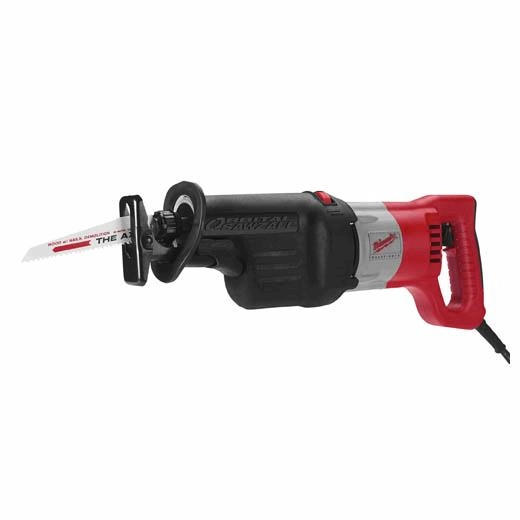
Milwaukee's exact U.S. page identifies the 6520-21 as a 13 Amp Orbital Sawzall Recip Saw. The in-box list names one saw and one carrying case. This is a mains-powered corded model, not a cordless tool or battery kit: its model-matched manual lists 120 V AC and 13 A. The manufacturer page's data dates the product to 2010. This review therefore treats it as an earlier-generation reference without claiming that the exact page establishes seller stock, a working used condition or current parts supply.
The 6520-21 needs its own specifications even though Milwaukee's operator manual also covers 6523-21, 6536-21 and 6538-21. In its own row, the 6520-21 has a 1-1/8-inch stroke and a 0-2,800 strokes-per-minute no-load range. Those figures differ from the 1-1/4-inch, 0-3,000-SMP rows for 6523-21 and 6536-21. The 6538-21 has a 1-1/4-inch stroke but a 15 A motor and 0-2,800 SPM.
Interpreting the 1-1/8-inch, 2,800-SPM figures
The 6520-21 is not fairly summarized by saying it is slow or weak just because another model has a larger stroke. No-load SPM and stroke length are specifications, not a timed cut. Material, blade, cutting angle, support, operator control and line supply all affect the result. A shorter reciprocation may be relevant to the work you intend, but the sources do not quantify the benefit or dictate which blade to use for every job. This review does not claim measured speed, cut quality or productivity.
The product page mentions a gear-protecting clutch and orbital action. Its linked manual confirms an orbit-control switch, describing straight action for smoother cuts and orbital motion for more aggressive cutting. That choice is useful to assess before purchase, but it is not a guarantee of finish. The exact 6520-21 page does not make the counterbalance or constant-power claims found on some sibling pages; those fields remain unknown here.
Front-end setup: clamp, shoe and blade length
The manual identifies a Quik-Lok blade clamp and an adjustable pivot shoe shared across the four catalog numbers it names. Milwaukee says the shoe has six positions and slides forward or back, including when lower blade clearance is needed. It must stay on the saw; the manual warns against operating without it. A blade must project beyond the shoe and work throughout its stroke, and the manufacturer advises against blades shorter than 3-1/2 inches. Check the thickness of the work and the blade's travel before making a cut.
The clamp is twist-operated rather than a fastener requiring a separate wrench, but blade changes still require isolation from power. Unplug the saw, clear chips or sawdust that may prevent the clamp from gripping, seat a compatible blade and tug-test it. Milwaukee calls for Sawzall blades but its reviewed manual does not state a shank dimension, so check the actual blade and tool documentation rather than assume a specification. Keep the shoe pressed against a supported workpiece as the cut proceeds; neither orbital action nor an adjustable shoe prevents binding by itself.
Power and package tradeoffs
A carrying case is convenient for storage and transport, but it does not make this saw cordless. The case accompanies a corded 120 V tool; the package list does not include a battery or charger. A cord avoids matching a platform and managing charging, but it demands a suitable outlet and attention to where the lead lies. That tradeoff can suit a fixed workshop more readily than a ladder, a vehicle interior or a job with many moving stations.
The operator manual explains extension-cord gauge by length/current and warns that an undersized cord can cause voltage drop and possible tool damage. Follow the manual and nameplate, use a safe outlet, inspect the lead, and route it away from the blade and work path. No review can make an unknown household outlet or extension cord suitable by assumption.
Against the closely related 6536-21, the most concrete differences are the 6520-21's 1-1/8-inch stroke and 2,800-SPM top no-load figure versus the 6536-21's 1-1/4-inch and 3,000-SPM figures; 6536-21's product page also specifies a counterbalance. The 6523-21 shares a 13 A supply but adds a rotating handle and has the longer-stroke figures. For more current cordless formats, a buyer can compare the full-size M18 2821-20, but battery compatibility and packages are entirely different.
Unknowns and assessment boundary
The exact page and manual do not give a bare-tool weight, overall length, work light, hang hook or lock-on specification. Unknown is not an automatic failure of the physical tool; it means this assessment cannot verify a hard requirement. Do not use the carrying-case weight or a seller's unspecified number as a bare-tool value. The official notice page checked for this review did not contain a 6520-21 entry, but that limited search is not an exhaustive serial-number or repair-history check.
This is an evidence-based assessment rather than a hands-on review. The saw was not owned, used, measured or tested. For someone comparing earlier corded reciprocating saws, the 6520-21's identity is clear: it is a 13 A orbital model, with its own shorter stroke/speed specification, a case, an adjustable shoe and a Quik-Lok clamp. Whether those attributes suit the cut depends on access, blade, support, supply and the exact work, none of which can be guaranteed from product-page copy alone.
Key specifications
Key details at a glance
| Saw format | Full-size, two-handed saw |
|---|---|
| Power source | Corded mains power |
| Motor current | 13 A |
| Stroke length | 1.12 in |
| No-load stroke rate | 2800 SPM |
| Pivot shoe positions | 6 |
| Tool-free blade change | Yes |
| Selectable orbital action | Yes |
| Battery in this package | No |
| Charger in this package | No |
Use the exact model’s instructions for operating limits, supplied equipment and version differences.
Sources for this review
Sources for this assessment
Match the saw to your actual work.
Use the finder to compare verified requirements, then read each exact model assessment before deciding.