
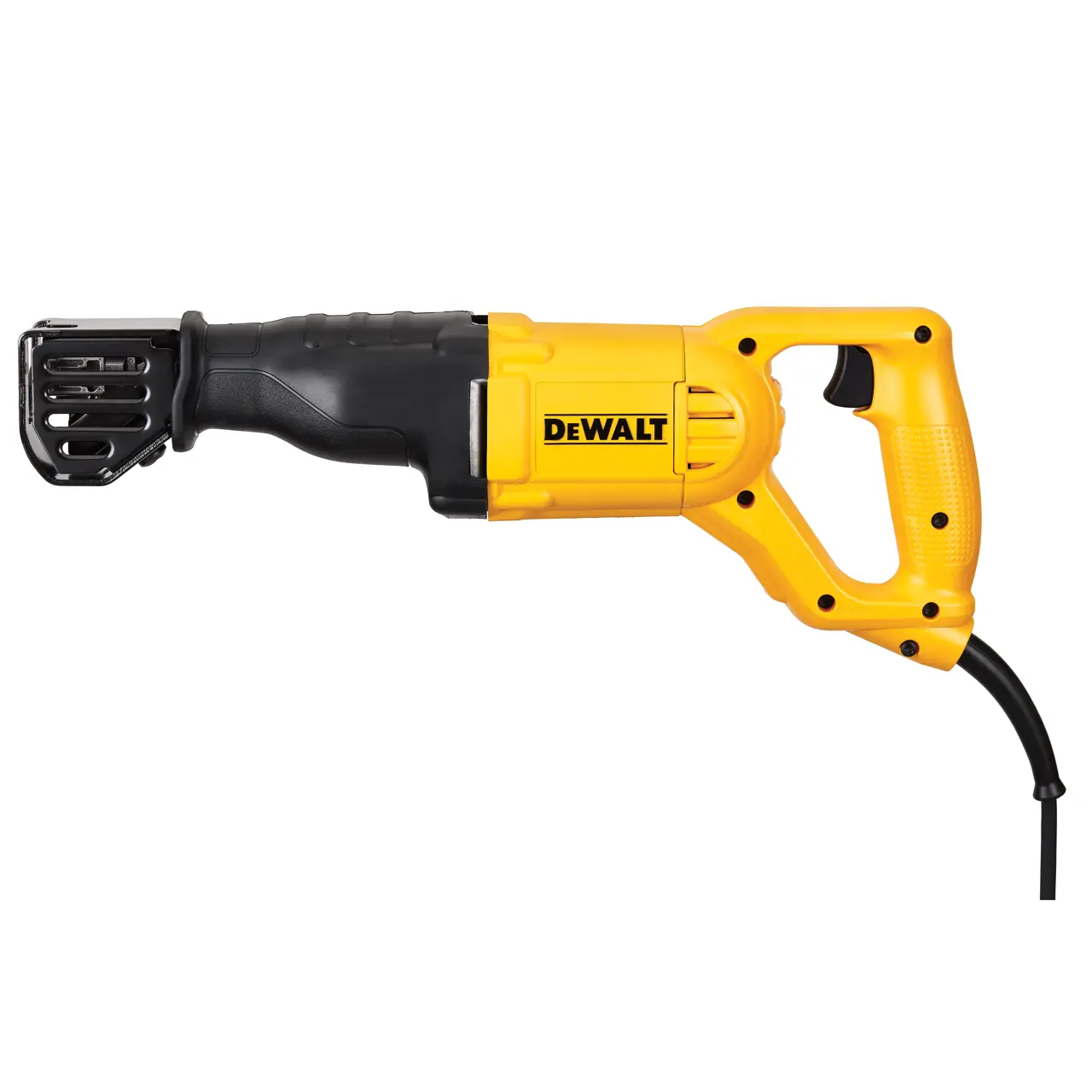
Your needs, this model
Does it fit your priorities?
Does the DWE304 package supply a battery and charger?
No battery system is listed for this corded model. The exact DEWALT in-box list names one 10-amp corded DWE304 saw; the mains cord, outlet, and any permitted extension arrangement are part of the operating setup. Do not select this model for a battery-included requirement.
Explore this need in the finder →What do the four DWE304 blade-clamp positions change?
DEWALT describes a keyless, lever-action four-position clamp that can orient the blade for different approaches, including flush cutting. The number refers to blade orientation, not a documented adjustable pivot shoe. Isolate the saw from power before a blade change, use a compatible blade, and confirm the clamp is locked.
Explore this need in the finder →Is the DWE304's 7.83 lb page figure a confirmed bare-tool weight?
The DEWALT page labels 7.83 lb as assembled-product weight, not bare-tool weight, and also has a generic Tool Only field that does not align neatly with its one-saw in-box list. This assessment keeps the strict bare-tool weight unknown. A hard lifting ceiling needs a clearly defined model-specific weight rather than a relabeled package value.
Explore this need in the finder →A straightforward 10-amp corded setup
The DWE304 is DEWALT's 10-amp corded reciprocating saw, with a stated 1-1/8-inch stroke and up to 2,800 strokes per minute. The important practical distinction is the supply: this saw needs a suitable mains outlet and a cord route that will not cross the blade path, pinch point, or a trip hazard. There is no battery arrangement to charge or carry, but there is also no cordless fallback when the work is outside a usable outlet's reach. That makes it a sensible candidate for a fixed shop, renovation room, or other controlled work area where the cord can be managed; it is a poor match for work that routinely moves away from power.
The no-load stroke-rate figure describes the maker's unloaded specification, not a cut-rate comparison. Blade type, material, support, cut direction, and operator control all affect the work. I would not treat the DWE304's 2,800-SPM line as proof that it cuts faster or slower than another model. DEWALT lists a variable-speed trigger, so the operator can meter the start of a cut rather than relying on a separate speed dial.
Four clamp positions are not four shoe settings
DEWALT describes a keyless, lever-action clamp with four blade positions. Those are blade orientations, which can help place the blade for a flush approach or to suit a restricted angle. The manual shows a release lever for blade installation and removal; that supports the tool-free-clamp tag, but the saw must be disconnected from its power source before a blade change, and the blade still needs to be fully secured before use. The four positions belong to the clamp, not a documented adjustable pivot-shoe system. The DWE304 sources reviewed here do not establish an adjustable shoe, an orbital selector, a built-in light, or a hang hook. Leave those needs unassumed and use the exact review and manual rather than filling in a nearby model's feature list.
The manual describes a two-hand operating position and emphasizes securing the material on a stable support. This is not the one-handed compact format just because reciprocating saws are often called demolition tools. Keep the shoe in contact with the work when practical, choose a blade appropriate to the material, and give the blade enough clearance to travel without hitting framing, hidden services, or the user's free hand.
Power, extension cords, and workpiece control
For corded work, the setup is part of the choice. The manual says to match the tool's nameplate to the supply and provides extension-cord wire-gauge guidance by current and length; it warns that an undersized cord can cause voltage drop, power loss, and overheating. Follow the exact manual and local electrical requirements instead of guessing that any long household lead will do. Do not expose the tool to wet conditions, and inspect a cut path for hidden wiring, plumbing, or gas lines before a blind cut. Clamp or otherwise support the material instead of holding it against the body. These precautions matter more to a real job than a headline SPM figure.
A cord also changes where the saw can be staged. Make sure the lead can follow the tool without wrapping around the work or snagging as the blade advances. An outlet's presence does not by itself prove that the circuit and extension arrangement are suitable; read the nameplate, manual, and site requirements.
How it compares with the other corded DWE saws
The DWE304 and the 12-amp DWE305 share the documented 1-1/8-inch stroke, a keyless four-position lever clamp, and a variable-speed trigger. Their published motor ratings and maximum no-load rates differ: 10 amps and 2,800 SPM for the DWE304, compared with 12 amps and 2,900 SPM for the DWE305. Those are model specifications, not a measured cut test or a guaranteed difference in results. The choice is between exact rated tools and their power setups, not a claim that an amp or an extra 100 no-load strokes settles every cutting task.
The DWE357 is the compact-bodied corded alternative in this small assessed group. Its shorter-body positioning may prompt a tighter-space comparison, but confirm the actual clearance on the exact product record before planning around a nominal dimension. The three remain distinct model identities; shared corded power or a shared brand does not make their weight, shoe, or included items interchangeable.
Package and measurement limits
The DWE304 page's in-box list names one 10-amp corded saw. No battery or charger is part of its operating plan, so a battery-included filter should not be used as a substitute for the mains arrangement. DEWALT's product data gives an assembled-product weight of 7.83 pounds and an assembled length of 19.2 inches, but it does not label that weight as a bare-tool figure; the same page also has a generic "Tool Only" field that does not align neatly with the single-saw in-box list. For that reason, this assessment preserves the reported number as assembled-product data but does not treat it as the bare-tool weight required by the strict weight filter. A buyer with a hard lifting ceiling should seek a clear model-specific weight basis rather than assuming a package label answers it.
Overall, the DWE304 is the simpler fit when corded mains use, two-handed control, and the listed lever clamp match the job. It is not an answer to a cordless-platform need, a documented adjustable-shoe requirement, or a verified bare-tool-weight ceiling. Confirm the precise DWE304 identity, the included saw, and the mains and extension-cord setup before committing to it.
Key specifications
Key details at a glance
| Saw format | Full-size, two-handed saw |
|---|---|
| Power source | Corded mains power |
| Motor type | Brushed |
| Motor current | 10 A |
| Stroke length | 1.12 in |
| No-load stroke rate | 2800 SPM |
| Tool-free blade change | Yes |
| Overall length | 19.2 in |
| Battery in this package | No |
| Charger in this package | No |
Use the exact model’s instructions for operating limits, supplied equipment and version differences.
Sources for this review
Sources for this assessment
Match the saw to your actual work.
Use the finder to compare verified requirements, then read each exact model assessment before deciding.