
Your needs, this model
Does it fit your priorities?
How is the DWE305 different from the 10-amp DWE304?
The DWE305 product page specifies 12 amps and a 0-2,900 no-load stroke rate; the separate DWE304 page specifies 10 amps and 0-2,800 SPM. Both list a 1-1/8-inch stroke, variable trigger, and four-position lever clamp. Those are published specifications, not comparative cut tests. Check the exact DWE305 nameplate and mains/extension setup for the job.
Explore this need in the finder →Does the DWE305's four-position clamp prove its shoe is adjustable?
No. The manufacturer describes four blade-clamp orientations; it does not document an adjustable pivot shoe in the sources used here. The manual calls for keeping the shoe supported against the work where practical, but that is different from repositioning it. Keep the adjustable-shoe need strict unless an exact current manual or model page establishes the capability.
Explore this need in the finder →Does the 8.0 lb DWE305 figure satisfy a bare-tool weight limit?
The official product data calls 8.0 lb an assembled-product weight and does not give its basis as bare-tool weight. The DWE305 fact therefore leaves the bare-tool field unknown; the strict weight matcher will not treat a package measurement as proof that the tool meets your ceiling.
Explore this need in the finder →A 12-amp corded saw with a variable-speed trigger
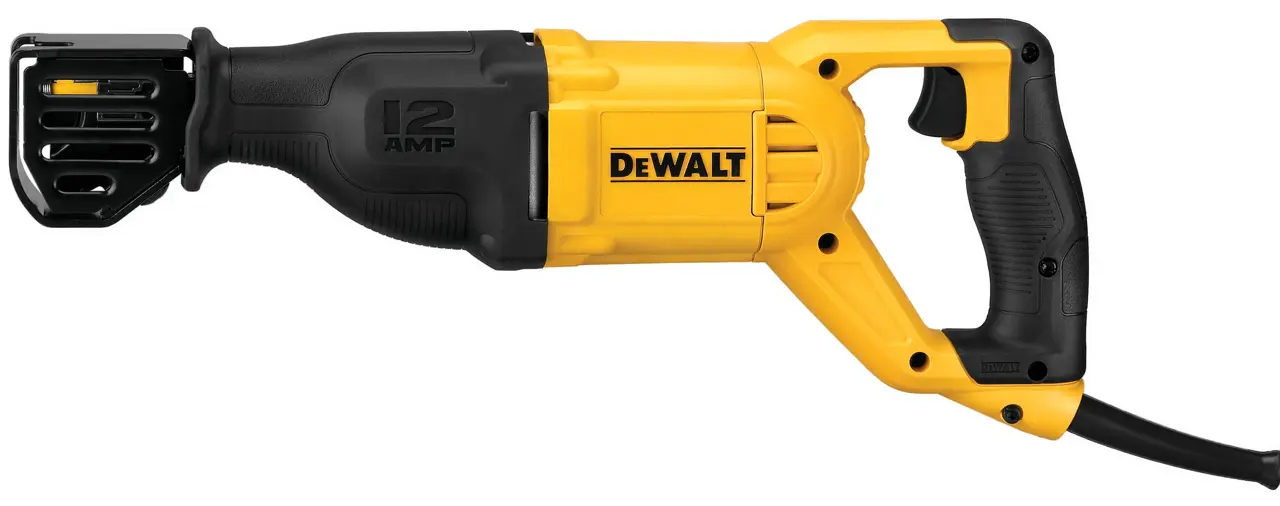
The DWE305 is DEWALT's 12-amp reciprocating saw. Its current US product page specifies 120 volts, corded mains power, a 1-1/8-inch stroke, and a maximum no-load rate of 2,900 strokes per minute. The trigger is variable speed; there is no separate dial documented in the sources reviewed. That combination describes a conventional two-handed corded saw, not a cordless tool or a compact one-handed design. A fixed worksite outlet and a managed lead are therefore part of the purchase decision, not accessories to think about after the saw arrives.
The 2,900-SPM figure is a no-load rating. It cannot tell us how quickly this saw will pass through a particular pipe, nail-embedded lumber, or sheet material. Blade geometry and material, a firm support point, access, and how steadily the tool is controlled matter. I treat the published rate as a specification, not as a test result or proof that this model will outperform the DWE304.
Blade clamp and flush-cut positioning
DEWALT lists a four-position, keyless lever-action blade clamp and the product page connects those positions with flush-cut versatility. The four positions let the operator orient the blade differently; they are not evidence of an adjustable pivot shoe. The shared DWE304/DWE305 manual illustrates opening the release lever, inserting the blade shank from the front, and lowering the lever to secure it. Disconnect the cord before changing the blade, keep fingers away from the clamp and reciprocating path, and confirm the blade has locked before work begins. The blade itself is not named in the DWE305 in-box list, so choose a blade for the material and verify the shank and length against the manual.
The same manual describes proper hand placement using the main handle and forward grip. It advises securing the workpiece on a stable platform. These are useful clues about the DWE305's actual handling category: despite the flexible blade orientation, it remains a two-handed tool. Keep the saw shoe supported against the work where possible and do not use the saw as a substitute for a clamp or a stable support.
What the extra amp rating does—and does not—say
Against the DWE304, the DWE305 has the higher published current rating (12 amps rather than 10) and the slightly higher maximum no-load stroke rate (2,900 rather than 2,800 SPM). Both pages specify a 1-1/8-inch stroke, a lever-operated four-position clamp, and variable trigger control. Those distinctions help identify which exact model is under consideration; they do not supply comparative cut testing, and no such testing was done for this assessment. If the task is confined to a tight workspace, also compare the product-page dimensions and plan a realistic cord path, rather than assuming a higher current rating makes the saw easier to control.
The DWE357 shifts to a more compact body and a higher no-load rate, while the maker's page and Type 3 manual introduce a separate shoe-description issue. That is a different form-factor decision, not simply a higher-rate replacement for the DWE305. Read each model's specific assessment instead of carrying the DWE357's compact-body wording, fixed-shoe instruction, or dimensions across to the DWE305.
Plan for a corded site
The DWE305's manual tells the reader to make sure the supply agrees with the nameplate and gives extension-cord gauge guidance based on the tool's amperage and cord length. A long or undersized lead can cause voltage drop, loss of power, and overheating. Follow the manual and local electrical requirements for the actual outlet and extension arrangement; do not treat a plug that fits as proof of a suitable circuit. Route the cord clear of the blade, moving work, pinch points, standing water, and foot traffic. If that path cannot be kept clear, a corded model is a poor match even if mains power is available somewhere nearby.
For cutting, the manual calls for stable work support, a deliberate start with the blade lightly in contact, and an appropriate blade for the material. Before a blind or plunge cut, identify concealed wiring, gas, and water services. Stop if the material shifts or the cut line cannot be controlled. These setup questions are especially important for a reciprocating saw because the tool does not have a base that guides a fine, finished contour.
In-box contents and uncertain weight basis
The exact DWE305 page lists one DWE305 saw and zero included batteries; it does not list a charger. That is consistent with the corded operating plan. The product data reports an assembled-product weight of 8.0 pounds and an assembled length of 19.38 inches, but it does not identify the weight as a bare-tool weight. This review therefore leaves the questionnaire's bare-tool weight field unknown rather than converting an assembled-product label into a stricter measurement. If lifting weight or overhead time is a hard limit, ask for a clearly defined tool-only number and verify the exact version.
The DWE305 is worth considering when a 12-amp, 120-volt corded reciprocating saw, two-hand grip, and four-position lever clamp line up with the jobsite. Its role is less compelling where cord routing is difficult, a known low bare-tool weight is essential, or an adjustable shoe or orbital selector is a must; those features are not established here. Check the DWE305 model code, package list, supply, blade choice, and manual before purchase.
Key specifications
Key details at a glance
| Saw format | Full-size, two-handed saw |
|---|---|
| Power source | Corded mains power |
| Motor current | 12 A |
| Stroke length | 1.12 in |
| No-load stroke rate | 2900 SPM |
| Tool-free blade change | Yes |
| Overall length | 19.38 in |
| Battery in this package | No |
| Charger in this package | No |
Use the exact model’s instructions for operating limits, supplied equipment and version differences.
Sources for this review
Sources for this assessment
Match the saw to your actual work.
Use the finder to compare verified requirements, then read each exact model assessment before deciding.