
Your needs, this model
Does it fit your priorities?
What arrives with the Milwaukee 6538-21?
The exact U.S. 6538-21 page's box list names one 15.0 Amp Super Sawzall reciprocating saw and one carrying case. It is a corded 120 V model, not a battery kit; the listed contents do not include a battery or charger. Confirm that the exact listing is catalog no. 6538-21 and budget for any blades or other accessories not itemized on the page.
Explore this need in the finder →Does the 6538-21 have adjustable orbital action?
Yes. Its model-matched operator manual names 6538-21 and describes an orbit-control switch between straight and orbital action. The manual recommends straight action when a smoother cut is needed and describes orbital action for more aggressive cutting; it does not promise a particular result in a given material. The same manual documents a six-position adjustable shoe and Quik-Lok clamp.
Explore this need in the finder →Can its listed 15 A and constant-power feature establish a cut-rate advantage?
No. Milwaukee's page identifies a 15 A motor and describes Constant Power Technology as maintaining speed and power under load. Those are manufacturer specifications and design claims, not a measured cut-rate comparison. The manual lists 1-1/4 in stroke and up to 2,800 no-load strokes per minute; blade choice, material, support, supply and technique still matter.
Explore this need in the finder →The 6538-21 is a specific 15-amp corded package
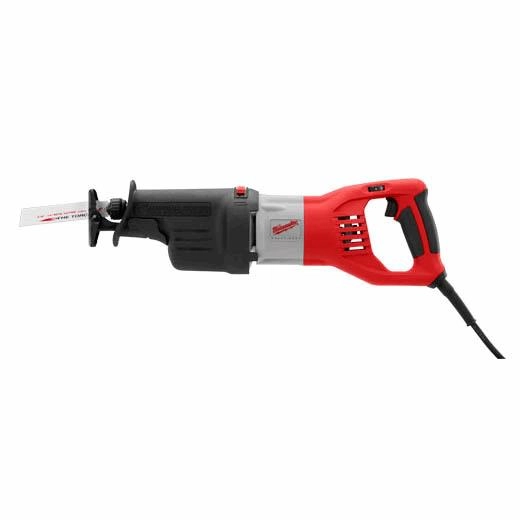
Milwaukee's U.S. product page identifies the 6538-21 as a 15.0 Amp Super SAWZALL Recip Saw. Its box list is unusually helpful: one saw and one carrying case. There is no battery system to match and no charger listed; this is a 120 V AC mains tool with a power cord. The case is part of this exact package, but the image on the page shows the tool rather than the case contents. Verify the full catalog number on an offer and confirm what is physically included instead of using a visually similar Sawzall listing.
The manufacturer product data dates the model's public announcement to 2012 and its launch to 2013. This assessment treats it as an earlier-generation reference, not as an assertion that a particular retailer has stock, that a used example is sound, or that replacement parts are available. The page remains useful evidence for the model's identity and maker-stated features.
15 amps and a 1-1/4-inch stroke describe the tool, not a test result
The model-specific row in Milwaukee's operator manual lists 120 V AC, 15 A, a 1-1/4-inch stroke and a top no-load rate of 2,800 strokes per minute. Those values help distinguish the 6538-21 from the 13 A orbital models, but the maximum stroke rate is not a cut-time prediction. Blade geometry, tooth selection, the material, how it is supported, supply voltage and how the saw is controlled all affect the work. A thicker or longer stroke number by itself does not promise a cleaner or faster result.
Milwaukee describes Constant Power Technology as maintaining speed and power under load, and names a counterbalance and gear-protecting clutch. Those are design claims from the manufacturer; this review contains no load test, vibration reading, durability comparison or proof that the clutch prevents damage. They are relevant things to compare against another model's documentation, not independent results.
Orbital control, shoe adjustment and the blade clamp
The official manual cover specifically lists the 6538-21. Its functional drawing and operating instructions identify an orbital-control switch, an adjustable pivot shoe and a Quik-Lok blade clamp. Milwaukee describes the orbital range as adjustable between straight and orbital action: straight motion is the manual's choice when a smoother cut is needed, while orbital action is presented for more aggressive cutting. The exact material and cut still determine the appropriate setting; a mode selector is not a substitute for blade selection and support.
The shoe slides through six positions. The manual says its forward/back movement can use a less-worn part of a blade or help when blade clearance is low. It also warns not to run the saw without the shoe and requires the blade to project past both shoe and work throughout its travel. Use a blade at least 3-1/2 inches long, which the manual says is needed to maintain that projection. The manual names Milwaukee Sawzall blades and a Quik-Lok clamp but does not state a shank dimension, so check the particular blade's fit rather than relying on an invented measurement.
Blade changes are not a powered operation: disconnect the plug first, make sure debris has not prevented the clamp from gripping, confirm the collar has returned, and tug on the installed blade as the manual directs. The shoe must stay fitted. For any plunge or blind cut, inspect for hidden wiring, pipe and other obstructions; the manual's permitted blade motions do not identify what lies behind a surface.
Where the corded format helps—and where it does not
A corded 15 A saw avoids battery-platform and charging questions, which can suit a stationary bench, renovation room or service area with appropriate mains power and a planned cord route. It is less convenient where the cut requires climbing, working around a vehicle, moving among rooms, or keeping the lead clear of the blade and debris. The manual includes extension-cord sizing guidance and warns that undersized or damaged cords can cause voltage drop, loss of power or damage. Follow the saw's manual and nameplate, use a suitable grounded outlet or approved configuration, and keep the cord away from the cut. A household extension cord is not automatically adequate because it fits the plug.
For comparison, the separately listed 6536-21 is a 13 A model with the same 1-1/4-inch stroke but a 3,000 SPM no-load ceiling and a page-stated counterbalance. The 6520-21 is also 13 A but has a shorter 1-1/8-inch stroke and 2,800 SPM. These specs do not rank their cutting performance. The odd one in this group is the 6523-21, whose turning handle changes the grip angle, not its power source or reach.
What the source record does not settle
Neither the reviewed manufacturer page nor its model-matched manual provides a bare-tool weight or overall length. A strict lifting limit or a tight clearance plan therefore cannot treat an unlabelled seller figure as a verified measurement. The sources also do not establish a work light, hang hook or trigger lock-on for this exact SKU. The assessment does not claim a better cut, a quieter feel, more durability, or a particular service life. No hands-on testing or use took place.
In short, the documented case, 15 A corded supply, 1-1/4-inch stroke, selectable orbital action, six-position shoe and tool-free clamp make the 6538-21 identifiable as a capable-featured earlier full-size configuration. Its limits are equally practical: cord management, old-generation status, unknown bare-tool weight and no independent performance evidence. Check the exact model, manual, included case, cord condition and safe supply before deciding whether those tradeoffs suit the job.
Key specifications
Key details at a glance
| Saw format | Full-size, two-handed saw |
|---|---|
| Power source | Corded mains power |
| Motor current | 15 A |
| Stroke length | 1.25 in |
| No-load stroke rate | 2800 SPM |
| Pivot shoe positions | 6 |
| Tool-free blade change | Yes |
| Selectable orbital action | Yes |
| Battery in this package | No |
| Charger in this package | No |
Use the exact model’s instructions for operating limits, supplied equipment and version differences.
Sources for this review
Sources for this assessment
Match the saw to your actual work.
Use the finder to compare verified requirements, then read each exact model assessment before deciding.